Commentary - (2025) Volume 9, Issue 5
Received: 01-Oct-2025, Manuscript No. cmcr-25-178079;
Editor assigned: 03-Oct-2025, Pre QC No. P-178079;
Reviewed: 17-Oct-2025, QC No. Q-178079;
Revised: 22-Oct-2025, Manuscript No. R-178079;
Published:
29-Oct-2025
, DOI: 10.37421/2684-4915.2025.9.395
Citation: Noor, Zainab. ”Effective Complication Management Across Diverse Fields.” Clin Med Case Rep 09 (2025):395.
Copyright: © 2025 Noor Z. This is an open-access article distributed under the terms of the Creative Commons Attribution License, which permits unrestricted use, distribution and reproduction in any medium, provided the original author and source are credited.
The comprehensive management of medical complications is a cornerstone of effective patient care across numerous clinical domains. Understanding and implementing strategies to prevent, identify, and treat adverse events are critical for improving patient safety, optimizing outcomes, and enhancing overall quality of life. Optimizing patient recovery and effectively handling potential problems after surgery are crucial aspects of modern medicine. Enhanced Recovery After Surgery (ERAS) pathways exemplify this approach, outlining strategies that significantly improve patient outcomes and ensure robust complication management [1].
In oncology, managing common adverse reactions and complications during chemotherapy and targeted cancer therapies is a paramount concern. Practical approaches for healthcare professionals are essential to mitigate side effects, enhancing patient comfort and safety throughout the treatment process [2].
For effective diabetes complication management, understanding the core mechanisms and treatment strategies for acute conditions like diabetic ketoacidosis and hyperosmolar hyperglycemic state is vital. This includes detailing their pathophysiology and outlining the best management practices to prevent severe outcomes [3].
Anesthesia complication management places a high priority on preventing and managing perioperative hypothermia. Systematic reviews and meta-analyses provide comprehensive overviews of effective, evidence-based interventions crucial for ensuring patient safety and improving overall surgical outcomes [4].
Acute myocardial infarction often leads to serious complications, necessitating immediate and precise management strategies. Crucial insights involve prompt recognition and intervention to address mechanical, electrical, and ischemic complications, which collectively improve patient prognosis [5].
The global health crisis highlighted the critical need for managing the wide array of complications associated with COVID-19 in adult patients. This involves exploring diverse clinical manifestations and establishing current best practices for mitigating adverse outcomes, which is fundamental for effective infectious disease management [6].
Patients undergoing hemodialysis face unique and complex challenges in complication management. Addressing issues such as cardiovascular, infectious, and access-related problems is essential for improving their quality of life and ultimately enhancing survival rates [7].
Solid organ transplantation, while life-saving, can lead to serious neurological complications. Effective strategies for their diagnosis and management are vital to preserve neurological function and optimize patient outcomes post-transplant [8].
Critically ill patients frequently develop gastrointestinal complications that significantly impact their prognosis. Identifying and managing these issues, alongside preventative measures and therapeutic interventions, is essential for improving patient recovery in intensive care settings [9].
Finally, managing obstetric complications effectively is fundamental to ensuring both maternal and fetal health. Key strategies focus on preventing and responding to emergencies during pregnancy, labor, and postpartum, emphasizing integrated care pathways and timely interventions to minimize adverse outcomes [10].
Effective complication management is paramount in surgical and perioperative settings. For instance, implementing Enhanced Recovery After Surgery (ERAS) pathways significantly improves patient recovery by strategically addressing potential post-surgery issues, leading to better outcomes and streamlined complication handling [1]. In a related vein, preventing and managing perioperative hypothermia is a crucial aspect of anesthesia complication management. Evidence-based interventions, often highlighted in systematic reviews and meta-analyses, are key to ensuring patient safety and improving overall outcomes during surgical procedures [4]. These proactive measures underscore the importance of comprehensive planning in clinical practice.
Managing complications arising from chronic conditions and in critically ill patients demands specialized attention. For individuals with diabetes, grasping the pathophysiology and optimal treatment strategies for acute crises like diabetic ketoacidosis and hyperosmolar hyperglycemic state is indispensable for effective diabetes complication management [3]. Similarly, critically ill patients often develop gastrointestinal complications that profoundly impact their prognosis. Focusing on identifying, preventing, and treating these issues is vital for improving recovery in intensive care environments [9]. These areas highlight the continuous need for vigilance and tailored interventions in complex patient populations.
Patients undergoing specific systemic therapies or those with particular organ system vulnerabilities require targeted strategies for complication management. For cancer patients, addressing common adverse reactions and complications during chemotherapy and targeted therapies is essential. Healthcare professionals deploy practical approaches to mitigate side effects, thereby enhancing patient comfort and safety throughout their arduous treatment journey [2]. Furthermore, managing complications arising from acute myocardial infarction requires prompt recognition and intervention to effectively address mechanical, electrical, and ischemic issues, ultimately improving patient prognosis and survival [5]. Those on hemodialysis also face unique challenges, encompassing cardiovascular, infectious, and access-related problems, where essential guidance aims to improve their quality of life and survival rates [7].
Dealing with complications in immunocompromised patients and those facing widespread infectious diseases presents another critical area of focus. Patients who have undergone solid organ transplantation, for example, are susceptible to a diverse range of neurological complications. Establishing effective strategies for their diagnosis and management is crucial to preserving neurological function and optimizing patient outcomes post-transplant [8]. On a broader scale, managing the multifaceted complications associated with COVID-19 in adult patients became a global health priority. Narrative reviews in this field explore diverse clinical manifestations and outline best practices for mitigating adverse outcomes, emphasizing the vital role of effective infectious disease management [6]. These demonstrate the evolving landscape of medical challenges.
Beyond individual patient care, public health aspects like maternal and fetal health also rely heavily on robust complication management. Effectively managing obstetric complications is fundamental, encompassing key strategies for preventing and responding to emergencies throughout pregnancy, labor, and the postpartum period. This often involves emphasizing integrated care pathways and timely interventions to minimize adverse outcomes for both mother and child [10]. This holistic perspective underscores the broad reach and critical importance of effective complication management across all stages of life and health.
Effective complication management is a critical pillar across diverse medical fields, ensuring improved patient outcomes and safety. This compilation highlights strategies for enhancing recovery post-surgery through ERAS pathways and managing perioperative risks like hypothermia [1, 4]. It also addresses acute complications in chronic diseases, such as diabetic ketoacidosis and hyperosmolar hyperglycemic state, alongside gastrointestinal issues in critically ill patients [3, 9]. Specialized care extends to oncology, where mitigating adverse reactions during chemotherapy and targeted therapies is crucial for patient comfort [2]. Furthermore, the focus includes managing severe cardiovascular events like acute myocardial infarction complications and the multifaceted sequelae of infectious diseases such as COVID-19 in adult patients [5, 6]. Patients undergoing hemodialysis require specific interventions for cardiovascular, infectious, and access-related problems to enhance their quality of life [7]. Post-transplantation, managing neurological complications is vital for preserving function and optimizing patient prognosis [8]. Finally, robust strategies for obstetric complication management are fundamental to safeguarding maternal and fetal health throughout pregnancy, labor, and postpartum emergencies [10]. Collectively, these insights underscore the continuous need for prompt recognition, evidence-based interventions, and integrated care pathways to navigate complex medical challenges.
None
None
Indexed at, Google Scholar, Crossref
Indexed at, Google Scholar, Crossref
Indexed at, Google Scholar, Crossref
Indexed at, Google Scholar, Crossref
Indexed at, Google Scholar, Crossref
Indexed at, Google Scholar, Crossref
Indexed at, Google Scholar, Crossref
Indexed at, Google Scholar, Crossref
Indexed at, Google Scholar, Crossref
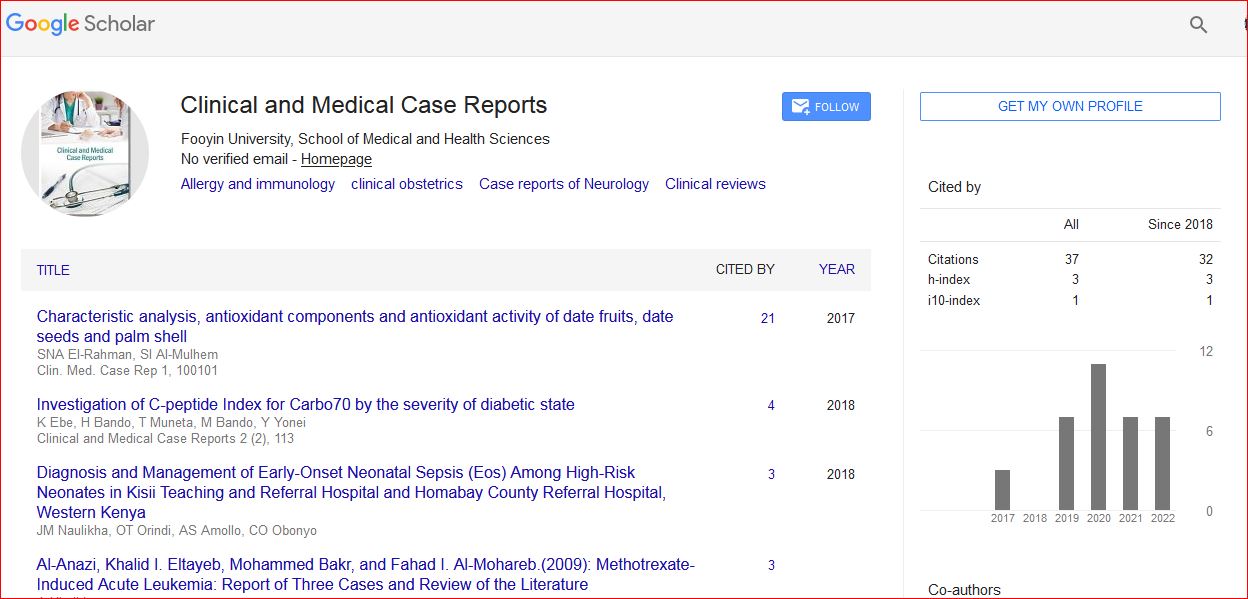
Clinical and Medical Case Reports received 53 citations as per Google Scholar report