Opinion - (2025) Volume 13, Issue 3
Received: 02-Jun-2025, Manuscript No. jcdd-25-176794;
Editor assigned: 04-Jun-2025, Pre QC No. P-176794;
Reviewed: 18-Jun-2025, QC No. Q-176794;
Revised: 23-Jun-2025, Manuscript No. R-176794;
Published:
30-Jun-2025
, DOI: 10.37421/2329-9517.2025.13.675
Citation: Ahmed Khan. ED Chest Pain: Comprehensive Risk
Stratification & Management. J Cardiovasc Dis Diagn 13 (2025):675.
Copyright: © 2025 K. Ahmed This is an open-access article distributed under the terms of the Creative Commons Attribution License, which permits unrestricted use,
distribution and reproduction in any medium, provided the original author and source are credited.
Understanding how emergency departments effectively evaluate low-risk patients presenting with chest pain is fundamental to modern healthcare. This involves the crucial implementation of systematic reviews and meta-analyses to identify best practices. Key findings highlight the significant effectiveness of standardized protocols and established risk stratification tools, such as the HEART score. These measures are instrumental in enabling the safe discharge of patients who are not at high risk, thereby considerably improving the overall efficiency of Emergency Departments (EDs) and successfully reducing the number of unnecessary hospital admissions. Importantly, these advancements are achieved without any compromise to patient safety [1].
Moreover, a comprehensive guideline provides thoroughly updated recommendations for both the diagnosis and subsequent management of aortic diseases. This is particularly vital given that aortic conditions represent a critical and often life-threatening cause of acute chest pain. The guideline strongly emphasizes the necessity of early recognition for serious conditions, specifically highlighting aortic dissection. It meticulously outlines structured diagnostic algorithms and specific treatment strategies, all designed to significantly improve patient outcomes and to minimize long-term morbidity associated with these complex conditions [2].
Beyond cardiac concerns, another important area of focus is noncardiac chest pain. This article provides current insights into its complex pathophysiology, discusses the inherent diagnostic challenges encountered by clinicians, and explores the diverse management strategies available. A central theme is the absolute necessity of thoroughly excluding any cardiac causes before clinicians consider other potential factors such as gastrointestinal, musculoskeletal, or psychological issues. This structured approach helps ensure appropriate and effective patient care [3].
Furthermore, a systematic review and meta-analysis specifically investigates the impact of sex differences on the presentation and overall management of acute coronary syndromes. This research confirms a critical disparity: women frequently exhibit atypical symptoms compared to men. This often leads to significant diagnostic delays and, consequently, a less aggressive approach to treatment. These factors collectively contribute to demonstrably worse outcomes for women when compared to their male counterparts experiencing similar conditions [4].
Expanding on the topic of non-cardiac chest pain, a narrative review delves into its diagnosis and management specifically within primary care settings. This review advocates for a highly methodical approach, beginning with the critical step of excluding urgent cardiac conditions. Following this, it recommends systematically evaluating potential gastrointestinal, musculoskeletal, and psychological etiologies. Effective management often involves integrating a combination of lifestyle modifications and targeted pharmacological interventions to address the underlying issues [5].
An update on contemporary strategies for risk stratifying patients experiencing chest pain in the emergency department underscores crucial advancements in this field. The article highlights the paramount importance of incorporating highly sensitive troponin assays alongside validated clinical decision tools. This combined approach allows for the accurate identification of low-risk patients suitable for safe discharge, while simultaneously ensuring that high-risk individuals receive prompt and aggressive management necessary for their condition. These strategies represent a significant step forward in patient care [6].
The significant role of psychological factors in the manifestation and persistence of noncardiac chest pain has been thoroughly investigated through a systematic review and meta-analysis. This body of research reveals a strong and consistent association between various mental health conditions, such as anxiety, depression, and somatization, and the experience of chest pain. These findings compellingly suggest that integrating mental health interventions is not merely beneficial but absolutely vital for achieving effective patient management in these complex cases [7].
In the context of acute coronary syndrome (ACS), a practical approach to diagnosis emphasizes a structured and methodical integration of several key elements. This includes a comprehensive patient history, detailed electrocardiogram (ECG) findings, and precise measurements of cardiac biomarker levels. This comprehensive strategy is designed to ensure prompt and highly accurate identification of ACS, thereby facilitating timely intervention and ultimately leading to improved patient outcomes through decisive action [8].
Addressing a distinct population, a narrative review specifically focuses on the emergency department evaluation of chest pain in children. While the review reassures clinicians that the majority of pediatric chest pain cases are benign, it concurrently stresses the critical need for vigilance regarding rare but potentially serious underlying conditions. It provides clear guidance on conducting thorough history taking, performing detailed physical examinations, and judiciously utilizing diagnostic tests to arrive at an accurate diagnosis [9].
Finally, from an economic and practical standpoint, a study meticulously evaluates the cost-effectiveness of various rapid rule-out strategies designed for acute myocardial infarction in patients who present with chest pain. The compelling conclusion of this research is that accelerated diagnostic protocols, especially those that incorporate high-sensitivity troponin measurements, represent a highly cost-effective approach. These strategies ultimately lead to significantly reduced healthcare expenditures and contribute to improved patient outcomes by enabling quicker and more accurate diagnoses [10].
Managing chest pain in the Emergency Department (ED) requires a systematic and evidence-based approach to ensure patient safety and optimize resource utilization. Systematic reviews highlight the effectiveness of standardized protocols and risk stratification tools, such as the HEART score, in safely identifying and discharging low-risk patients. This not only enhances ED efficiency but also significantly reduces unnecessary hospital admissions [1]. To further refine this process, contemporary strategies for risk stratifying chest pain patients involve incorporating high-sensitivity troponin assays and validated clinical decision tools. These advancements are crucial for accurately distinguishing between low-risk individuals, who can be safely discharged, and high-risk patients who require immediate, aggressive management [6]. This integrated approach ensures that patient care is both effective and appropriate, tailoring interventions to individual risk profiles.
Acute Coronary Syndrome (ACS) stands as a common and critical etiology of chest pain, demanding prompt and accurate diagnosis. A practical approach integrates patient history, Electrocardiogram (ECG) findings, and cardiac biomarker levels to facilitate timely intervention and improve outcomes [8]. However, here's the thing: understanding sex differences in ACS presentation is vital. Research indicates that women often exhibit atypical symptoms, leading to diagnostic delays and less aggressive treatment compared to men, which ultimately contributes to worse outcomes [4]. Beyond ACS, aortic diseases, such as aortic dissection, are another critical cause of acute chest pain that necessitate early recognition. Comprehensive guidelines offer updated recommendations for their diagnosis and management, outlining structured diagnostic algorithms and treatment strategies designed to improve patient outcomes and minimize morbidity [2]. Timely and precise identification of these serious conditions is paramount.
When cardiac causes are ruled out, attention shifts to noncardiac chest pain, a condition with complex pathophysiology. Current insights emphasize the necessity of thoroughly excluding cardiac etiologies before exploring gastrointestinal, musculoskeletal, and psychological factors [3]. In primary care settings, a methodical approach is advocated, beginning with ruling out urgent cardiac conditions, then systematically evaluating these other etiologies. This often integrates lifestyle modifications and pharmacological interventions for effective management [5]. Psychological factors play a significant role in the manifestation and persistence of noncardiac chest pain. Research shows a strong association between conditions like anxiety, depression, and somatization with chest pain, underscoring that mental health interventions are integral for effective patient management in these cases [7]. This means a holistic view of the patient is essential for proper diagnosis and treatment.
Evaluating chest pain in specific populations, such as children, presents unique challenges. For children, most chest pain is benign, yet clinicians must remain vigilant for rare but serious underlying conditions. Guidance on thorough history taking, physical examination, and judicious use of diagnostic tests is crucial for appropriate evaluation in the Emergency Department [9].
From a broader healthcare system perspective, the cost-effectiveness of rapid rule-out strategies for acute myocardial infarction has been evaluated. Studies conclude that accelerated diagnostic protocols, especially those incorporating high-sensitivity troponin, represent a cost-effective approach. These strategies lead to reduced healthcare expenditures and improve patient outcomes through quicker and more accurate diagnoses, demonstrating clear benefits for both patients and the healthcare system [10].
Evaluation and management of chest pain in emergency departments is a complex process that demands careful risk stratification and diagnostic accuracy. Standardized protocols and tools, like the HEART score, are crucial for safely discharging low-risk patients, thereby boosting ED efficiency and reducing unnecessary hospital admissions. At the same time, contemporary strategies emphasize high-sensitivity troponin assays and validated clinical decision tools for precise identification of both low-risk and high-risk individuals. Acute Coronary Syndrome (ACS) remains a significant cause of chest pain, requiring methodical integration of patient history, Electrocardiogram (ECG) findings, and cardiac biomarkers for prompt diagnosis and intervention. It is also recognized that sex differences impact ACS presentation and management, with women often experiencing atypical symptoms leading to diagnostic delays and less aggressive treatment. Beyond cardiac causes, noncardiac chest pain is prevalent, necessitating a structured approach that thoroughly excludes cardiac etiologies before considering gastrointestinal, musculoskeletal, and psychological factors. Psychological factors, including anxiety, depression, and somatization, play a significant role in noncardiac chest pain, highlighting the importance of mental health interventions. Specific guidelines exist for critical conditions like aortic diseases, emphasizing early recognition and structured treatment. Even in pediatric cases, while most chest pain is benign, vigilance for serious underlying conditions is paramount, guided by thorough history and examination. Ultimately, rapid rule-out strategies, especially with high-sensitivity troponin, are proven to be cost-effective, improving patient outcomes and reducing healthcare costs.
Indexed at, Google Scholar, Crossref
Indexed at, Google Scholar, Crossref
Indexed at, Google Scholar, Crossref
Indexed at, Google Scholar, Crossref
Indexed at, Google Scholar, Crossref
Indexed at, Google Scholar, Crossref
Indexed at, Google Scholar, Crossref
Indexed at, Google Scholar, Crossref
Indexed at, Google Scholar, Crossref
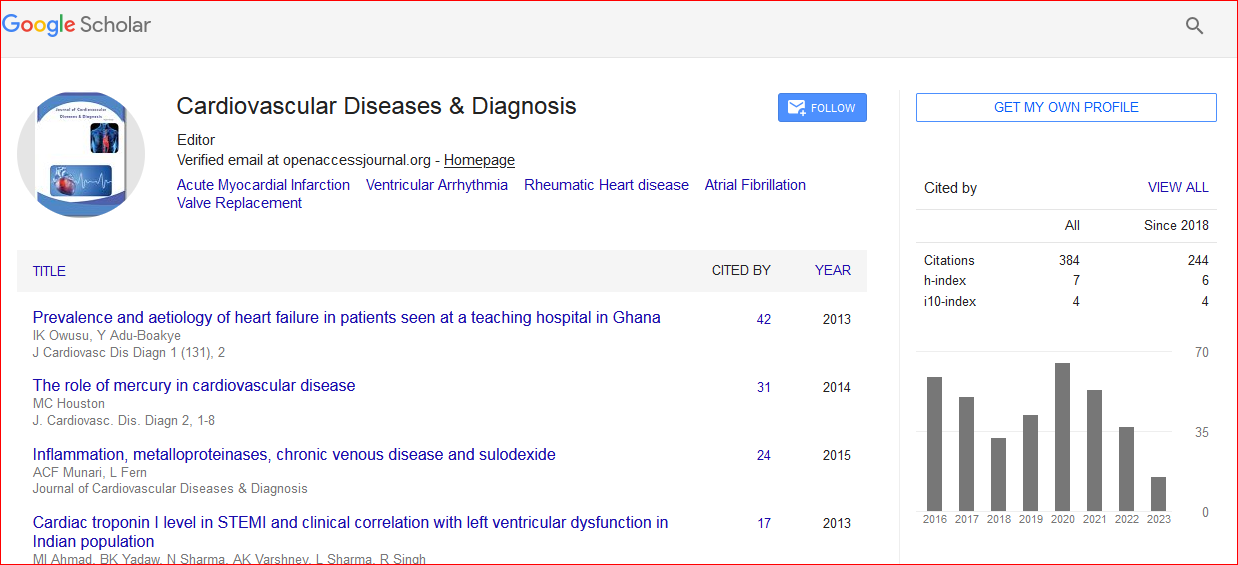
Cardiovascular Diseases & Diagnosis received 427 citations as per Google Scholar report