Brief Report - (2025) Volume 13, Issue 3
Received: 02-Jun-2025, Manuscript No. jcdd-25-176782;
Editor assigned: 04-Jun-2025, Pre QC No. P-176782;
Reviewed: 18-Jun-2025, QC No. Q-176782;
Revised: 23-Jun-2025, Manuscript No. R-176782;
Published:
30-Jun-2025
, DOI: 10.37421/2329-9517.2025.13.668
Citation: Leila Haddad. ”ECG: AI, Wearables, Evolving Cardiac
Care.” J Cardiovasc Dis Diagn 13 (2025):668.
Copyright: © 2025 H. Leila This is an open-access article distributed under the terms of the Creative Commons Attribution License, which permits unrestricted use, distribution
and reproduction in any medium, provided the original author and source are credited.
This research highlights how artificial intelligence can interpret an electrocardiogram to screen for cardiac amyloidosis, a challenging condition to diagnose. The AI-enabled ECG demonstrated impressive accuracy, suggesting it could be a valuable tool for early detection in a clinical setting. It's a prime example of leveraging technology to improve diagnostic pathways for specific cardiac conditions, moving beyond traditional ECG interpretation.[1] The 2023 ESC Guidelines provide a comprehensive framework for managing ventricular arrhythmias and preventing sudden cardiac death. They cover the role of ECG in risk stratification, diagnosis of specific arrhythmogenic syndromes, and guiding therapeutic decisions. It's essential guidance for cardiologists, emphasizing updated evidence-based approaches to these life-threatening conditions.[2] These 2023 ESC Guidelines offer the latest recommendations for managing acute coronary syndromes (ACS), including STEMI and NSTEMI. The ECG remains a cornerstone in the initial diagnosis and risk stratification of ACS, guiding immediate therapeutic interventions like reperfusion. The guidelines update evidence on how ECG findings should influence patient management, from pre-hospital care to in-hospital treatment strategies.[3]
\n\nThis review delves into the rapidly evolving landscape of wearable technologies for ECG monitoring. It discusses various devices, from smartwatches to patches, their technical capabilities, and their clinical applications in detecting arrhythmias and monitoring cardiac health. The insights here are crucial for understanding the potential and limitations of remote ECG monitoring in daily life and specialized healthcare settings.[4] This meta-analysis explores the utility of ECG for risk stratification in patients with heart failure with preserved ejection fraction (HFpEF). It synthesizes data on how various ECG parameters can predict adverse outcomes in this complex patient group. What this really means is that even in HFpEF, where the heart's pumping function appears normal, ECG still offers critical prognostic information, aiding in more personalized patient management.[5] This article offers a global perspective on the current state of ECG acquisition and interpretation. It touches on variations in practice, challenges in training, and the ongoing need for standardization to ensure accurate diagnoses worldwide. Understanding these global differences is important for improving the quality and consistency of cardiovascular care across diverse healthcare settings.[6] Here's the thing: this publication from the American College of Cardiology and American Heart Association provides key data elements and definitions for athlete screening, which often includes ECG. It emphasizes standardized approaches for identifying at-risk athletes, aiming to prevent sudden cardiac events. The focus is on consistency in preparticipation evaluation, which is vital for athlete safety and effective risk management.[7]
This article discusses the ongoing challenges in using ECG to identify and manage drug-induced QT prolongation, a potentially dangerous side effect of many medications. It covers current understanding and future directions in assessing this risk, emphasizing the need for careful ECG monitoring and improved predictive tools. The insights here are crucial for clinicians prescribing medications with QT-prolonging potential.[8] This review delves into how ECG is used in diagnosing and managing congenital heart disease (CHD) in children. It covers the specific ECG patterns associated with various structural heart defects and how these findings guide further diagnostic steps and treatment plans. This piece is key for anyone needing to understand the unique nuances of pediatric ECG interpretation in complex cardiac conditions.[9]This paper examines the current state and future prospects of noninvasive electrocardiographic mapping for ventricular tachycardia. It discusses how advanced ECG techniques can localize the origin of arrhythmias without invasive procedures, aiding in diagnosis and treatment planning. The insights here are critical for advancing arrhythmia management by reducing the need for invasive mapping while improving therapeutic precision.[10]
Recent innovations are reshaping how Electrocardiogram (ECG) data is analyzed. Artificial Intelligence (AI), for instance, now effectively interprets ECGs to screen for challenging conditions like cardiac amyloidosis. This AI-enabled approach shows impressive accuracy, promising earlier detection in clinical settings and marking a significant leap beyond traditional ECG methods [1].The utility of ECG extends across critical clinical guidelines. The 2023 ESC Guidelines provide comprehensive frameworks for managing ventricular arrhythmias and preventing sudden cardiac death, emphasizing ECG's pivotal role in risk stratification and guiding therapeutic decisions [2]. Similarly, these guidelines also offer updated recommendations for managing acute coronary syndromes (ACS), including STEMI and NSTEMI. Here's the thing: ECG remains a cornerstone for initial diagnosis, risk stratification, and guiding immediate interventions like reperfusion. What this really means is that ECG findings continue to heavily influence patient management from pre-hospital care to in-hospital treatment strategies [3].
The landscape of ECG monitoring is rapidly evolving with wearable technologies, encompassing devices from smartwatches to advanced patches. These innovations offer new capabilities for remote ECG monitoring, detecting arrhythmias, and continuously tracking cardiac health, becoming crucial for understanding both their potential and limitations in daily life and specialized healthcare [4]. Beyond diagnostic utility, ECG also offers critical prognostic information. For example, a meta-analysis on heart failure with preserved ejection fraction (HFpEF) shows that various ECG parameters can predict adverse outcomes, even when the heart's pumping function appears normal. This aids in more personalized patient management [5].Standardization of ECG acquisition and interpretation is a global imperative, addressing variations in practice and training to ensure consistent, high-quality cardiovascular care worldwide [6]. Specific guidelines are also critical for unique populations, such as athletes, where American College of Cardiology/American Heart Association publications outline key data elements for screening, including ECG, to identify at-risk individuals and prevent sudden cardiac events. The focus here is on consistency in preparticipation evaluation for athlete safety and effective risk management [7].
Despite its long history, ECG continues to present challenges and opportunities in specialized areas. Clinicians face ongoing difficulties in using ECG to identify and manage drug-induced QT prolongation, a potentially dangerous side effect of many medications. This emphasizes the need for careful monitoring and improved predictive tools for medications with QT-prolonging potential [8]. In pediatric cardiology, ECG is indispensable for diagnosing and managing congenital heart disease (CHD) in children, with specific patterns guiding diagnostic steps and treatment plans, highlighting the unique nuances of pediatric ECG interpretation in complex cardiac conditions [9]. Looking ahead, noninvasive electrocardiographic mapping for ventricular tachycardia is advancing, offering techniques to localize arrhythmia origins without invasive procedures, which is critical for improving therapeutic precision and reducing the need for invasive mapping [10].
Recent advancements showcase the evolving utility of Electrocardiogram (ECG) in diverse cardiac diagnostics and management. Artificial Intelligence (AI) is now interpreting ECGs to screen for conditions like cardiac amyloidosis, demonstrating impressive accuracy for early detection. Guidelines from the European Society of Cardiology (ESC) in 2023 provide comprehensive frameworks for managing ventricular arrhythmias and acute coronary syndromes, reinforcing ECGâ??s cornerstone role in risk stratification and guiding therapeutic decisions. Wearable technologies are rapidly expanding ECG monitoring capabilities, offering new avenues for detecting arrhythmias and tracking cardiac health remotely. Even in complex cases like heart failure with preserved ejection fraction (HFpEF), ECG-based risk stratification provides critical prognostic information, leading to more personalized patient care. There's an ongoing global effort to standardize ECG acquisition and interpretation, addressing variations in practice and training to ensure consistent, high-quality cardiovascular care. Key data elements and definitions for athlete screening emphasize standardized ECG approaches to identify at-risk individuals and prevent sudden cardiac events. Challenges persist in using ECG to monitor and manage drug-induced QT prolongation, highlighting the need for careful observation and improved predictive tools. In pediatrics, ECG is crucial for diagnosing and managing congenital heart disease, revealing specific patterns that guide treatment plans. Noninvasive electrocardiographic mapping represents a future direction for ventricular tachycardia management, aiming to localize arrhythmias with greater precision and reduce the need for invasive procedures.
Indexed at, Google Scholar, Crossref
Indexed at, Google Scholar, Crossref
Indexed at, Google Scholar, Crossref
Indexed at, Google Scholar, Crossref
Indexed at, Google Scholar, Crossref
Indexed at, Google Scholar, Crossref
Indexed at, Google Scholar, Crossref
Indexed at, Google Scholar, Crossref
Indexed at, Google Scholar, Crossref
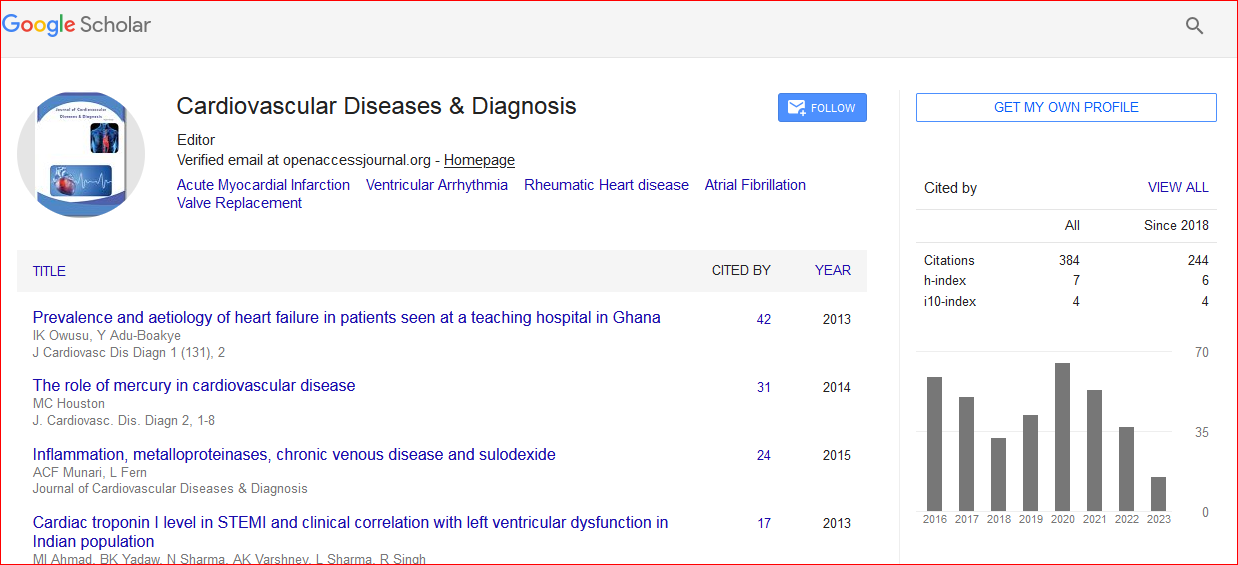
Cardiovascular Diseases & Diagnosis received 427 citations as per Google Scholar report