Short Communication - (2025) Volume 9, Issue 2
Received: 01-Apr-2025, Manuscript No. cmcr-25-177684;
Editor assigned: 03-Apr-2025, Pre QC No. P-177684;
Reviewed: 17-Apr-2025, QC No. Q-177684;
Revised: 22-Apr-2025, Manuscript No. R-177684;
Published:
29-Apr-2025
, DOI: 10.37421/2684-4915.2025.9.369
Citation: Benali, Layla. ”EBP: Implementation, Barriers, Facilitators, Education.” Clin Med Case Rep 09 (2025):369.
Copyright: © 2025 Benali L. This is an open-access article distributed under the terms of the Creative Commons Attribution License, which permits unrestricted use, distribution and reproduction in any medium, provided the original author and source are credited.
This review identifies common challenges in integrating evidence-based practices (EBPs) into mental health settings, such as organizational resistance, lack of resources, and provider skepticism. It also highlights facilitators like strong leadership, collaborative teamwork, and ongoing training, suggesting a multi-faceted approach is crucial for successful EBP adoption[1].
This systematic review explores effective strategies for incorporating evidence-based practice (EBP) into undergraduate nursing curricula. Key findings emphasize the importance of dedicated EBP courses, faculty role modeling, practical assignments, and clinical experiences that allow students to apply EBP principles in real-world settings to develop critical appraisal skills[2].
This study investigates nurses' understanding, perspectives, and application of evidence-based practice (EBP) in their daily clinical decision-making. It reveals areas where knowledge and practice could be strengthened, suggesting targeted educational interventions and supportive organizational cultures are vital to bridge the gap between knowing about EBP and actively using it[3].
This systematic review and meta-synthesis provides a comprehensive overview of factors affecting the uptake of evidence-based practice (EBP) in various healthcare environments. It categorizes barriers (e.g., lack of time, training, access to resources) and facilitators (e.g., EBP mentors, organizational support, positive attitudes), offering insights for developing effective implementation strategies[4].
This systematic review investigates the effectiveness of interprofessional education (IPE) in enhancing evidence-based practice (EBP) competencies among future healthcare professionals. It suggests that collaborative learning experiences, where students from different disciplines work together, can significantly improve their skills in finding, appraising, and applying evidence, fostering a more unified approach to patient care[5].
This scoping review explores various strategies and frameworks for enhancing the capacity of public health professionals to engage in evidence-based practice. It identifies key components like access to research, training in critical appraisal, and supportive organizational structures as crucial for promoting the systematic use of evidence in public health decision-making and program implementation[6].
This qualitative study explores the perspectives of medical doctors and nurses on the integration of shared decision-making (SDM) with evidence-based practice (EBP). It highlights both the perceived benefits, such as improved patient satisfaction and adherence, and the challenges, including time constraints and perceived conflicts between patient preferences and best evidence. The findings suggest a need for better training and support to effectively combine EBP and SDM in clinical encounters[7].
This scoping review examines the methodological advancements in evidence-based practice (EBP) within occupational therapy. It reveals evolving approaches to synthesizing evidence, developing guidelines, and measuring EBP implementation, emphasizing the need for robust research designs and standardized reporting to strengthen the evidence base and improve clinical effectiveness[8].
This scoping review identifies unique challenges faced by developing countries in adopting evidence-based practice (EBP), such as limited infrastructure, lack of access to research, and insufficient training. It also highlights opportunities, including the growing digital accessibility of information and the potential for context-specific adaptations, underscoring the need for tailored strategies to foster EBP in these settings[9].
This systematic review and meta-analysis evaluates the impact of various educational strategies on healthcare professionals' knowledge, attitudes, and skills regarding evidence-based practice (EBP). It concludes that multifaceted educational interventions, particularly those involving hands-on training and mentorship, are most effective in improving EBP competencies across different professional groups, emphasizing continuous professional development[10].
Challenges in integrating Evidence-Based Practices (EBPs) into mental health settings involve organizational resistance, lack of resources, and provider skepticism. Strong leadership, collaborative teamwork, and ongoing training act as facilitators, emphasizing a multi-faceted approach for successful adoption [1]. A broader systematic review and meta-synthesis corroborates these findings, identifying barriers such as lack of time, insufficient training, and limited access to resources. Conversely, EBP mentors, organizational support, and positive attitudes serve as crucial facilitators across various healthcare environments, guiding the development of effective implementation strategies [4]. Notably, developing countries face distinct challenges like limited infrastructure, poor research access, and inadequate training. Despite these, opportunities arise from increasing digital information access and potential for context-specific adaptations, indicating a need for tailored strategies to foster EBP in these settings [9].
Regarding educational approaches, a systematic review highlights effective strategies for integrating EBP into undergraduate nursing curricula. Key elements include dedicated EBP courses, faculty role modeling, practical assignments, and clinical experiences, which help students apply EBP principles and develop critical appraisal skills [2]. Furthermore, interprofessional education (IPE) proves effective in enhancing EBP competencies among future healthcare professionals. Collaborative learning experiences across different disciplines significantly improve skills in finding, appraising, and applying evidence, promoting a unified approach to patient care [5]. Evaluating the broader impact of educational strategies, a systematic review and meta-analysis found that multifaceted educational interventions, especially those with hands-on training and mentorship, are most effective in boosting EBP knowledge, attitudes, and skills among diverse healthcare professional groups. This underscores the value of continuous professional development in improving EBP competencies [10].
Understanding the current state of EBP among practitioners, a study investigated nurses' knowledge, perspectives, and application of EBP in clinical decision-making. This research exposed gaps in knowledge and practice, pointing to a need for targeted educational interventions and supportive organizational cultures to bridge the gap between theoretical understanding and active utilization of EBP [3]. In a related vein, a qualitative study explored how medical doctors and nurses perceive the integration of shared decision-making (SDM) with EBP. It identified benefits like improved patient satisfaction and adherence, but also challenges such as time constraints and perceived conflicts between patient preferences and evidence. The findings suggest that better training and support are essential for effectively combining EBP and SDM in clinical practice [7].
Efforts to advance EBP methodology and build capacity are also evident. A scoping review explored strategies for enhancing public health professionals' ability to engage in EBP. It identified critical components such as access to research, training in critical appraisal, and supportive organizational structures as fundamental for promoting the systematic use of evidence in public health decision-making and program implementation [6]. Additionally, within occupational therapy, a scoping review examined methodological advancements in EBP. It highlighted evolving approaches for evidence synthesis, guideline development, and measuring EBP implementation, stressing the need for robust research designs and standardized reporting to strengthen the evidence base and enhance clinical effectiveness [8].
The provided research synthesizes extensive findings on Evidence-Based Practice (EBP) across various healthcare domains, revealing a complex landscape of implementation. Key challenges include organizational resistance, resource scarcity, provider skepticism, lack of time, and inadequate training. These hurdles are particularly pronounced in mental health settings and developing countries, which face unique infrastructure and access barriers. However, the literature also identifies crucial facilitators such as strong leadership, collaborative teamwork, ongoing training, EBP mentors, and supportive organizational cultures. Educational interventions emerge as a cornerstone for enhancing EBP. Dedicated courses, faculty role modeling, practical assignments, interprofessional education, hands-on training, and mentorship are consistently effective in improving EBP competencies among nursing students and a broad spectrum of healthcare professionals. There is also a recognized need to bridge the gap between theoretical knowledge and active application, especially in clinical decision-making for nurses. Furthermore, the integration of EBP with shared decision-making presents both benefits, like improved patient satisfaction, and challenges, such as time constraints. Methodological advancements in fields like occupational therapy and strategies for building capacity in public health underscore the continuous evolution and refinement required for robust EBP implementation. Overall, the literature emphasizes a multi-faceted and tailored approach to successfully embed EBP, addressing both systemic barriers and individual competency gaps.
None
None
Indexed at, Google Scholar, Crossref
Indexed at, Google Scholar, Crossref
Indexed at, Google Scholar, Crossref
Indexed at, Google Scholar, Crossref
Indexed at, Google Scholar, Crossref
Indexed at, Google Scholar, Crossref
Indexed at, Google Scholar, Crossref
Indexed at, Google Scholar, Crossref
Indexed at, Google Scholar, Crossref
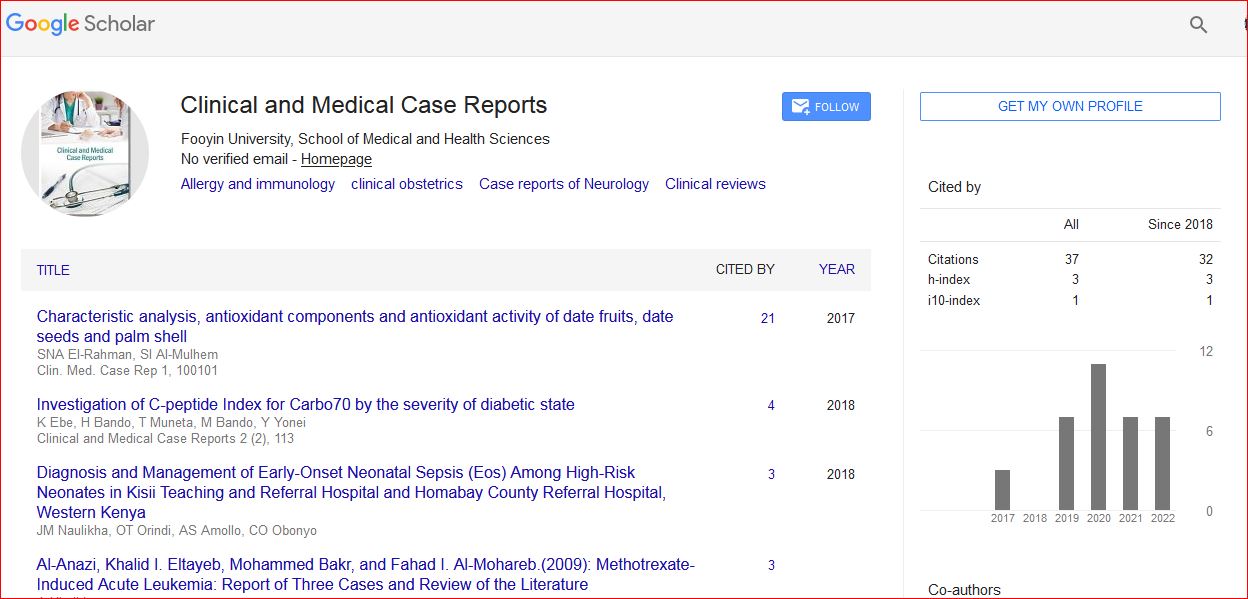
Clinical and Medical Case Reports received 53 citations as per Google Scholar report