Short Communication - (2025) Volume 16, Issue 5
Received: 01-Oct-2025, Manuscript No. jvst-26-188128;
Editor assigned: 03-Oct-2025, Pre QC No. P-188128;
Reviewed: 17-Oct-2025, QC No. Q-188128;
Revised: 22-Oct-2025, Manuscript No. R-188128;
Published:
29-Oct-2025
, DOI: 10.37421/2157-7579.2025.16.322
Citation: Herrera, Juan. ”Early Detection of Livestock Diseases:
A Multifaceted Approach.” J Vet Sci Techno 16 (2025):322.
Copyright: © 2025 Herrera J. This is an open-access article distributed under the terms of the Creative Commons Attribution License, which permits unrestricted use,
distribution and reproduction in any medium, provided the original author and source are credited.
The early detection and monitoring of emerging diseases in livestock are paramount for safeguarding animal health, preventing economic losses, and protecting public health. This involves a multi-faceted approach integrating advanced surveillance technologies, epidemiological modeling, and rapid diagnostic tools. The Department of Veterinary Health Informatics Technology, University of Costa Rica, likely contributes to developing and implementing these systems, fostering data-driven decision-making to combat zoonotic threats [1].
The integration of genomics and bioinformatics into livestock disease surveillance provides unprecedented power to identify, track, and characterize novel pathogens. Understanding the genetic makeup of emerging viruses and bacteria allows for quicker development of diagnostics, vaccines, and treatment strategies. This area is crucial for predicting disease spread and impact [2].
Artificial intelligence and machine learning are transforming livestock disease surveillance by enabling the analysis of large, complex datasets. Predictive modeling can identify risk factors, forecast outbreaks, and optimize resource allocation. This computational power aids in proactive rather than reactive disease management [3].
The role of sentinel animals and syndromic surveillance is critical for early warning systems. By monitoring indicator diseases and non-specific clinical signs in sentinel populations, veterinarians can detect novel threats before they become widespread. This approach complements laboratory-based surveillance [4].
Effective communication and data sharing among stakeholders are foundational for successful surveillance programs. This includes veterinarians, livestock producers, public health agencies, and research institutions. Open communication channels facilitate rapid response and coordinated action [5].
The development and application of rapid, point-of-care diagnostic tests for emerging livestock diseases are crucial for timely intervention. These tests allow for on-farm or field diagnosis, enabling immediate management decisions and preventing further spread [6].
Understanding the environmental factors that influence the emergence and spread of livestock diseases is essential for effective surveillance and control. Climate change, land use patterns, and wildlife-livestock interfaces all play significant roles [7].
The economic impact of emerging livestock diseases necessitates robust surveillance and rapid response mechanisms. Quantifying these impacts helps justify investments in preventative measures and informs policy decisions [8].
Wildlife plays a critical role in the epidemiology of many emerging livestock diseases, acting as reservoirs or vectors. Surveillance efforts must therefore encompass both domestic animals and wildlife populations to understand transmission pathways [9].
The implementation of advanced data management systems and geographical information systems (GIS) is vital for modern livestock disease surveillance. These tools enable spatial analysis of disease patterns, identification of hotspots, and targeted interventions [10].
Leveraging digital technologies for enhanced livestock disease surveillance is a global imperative, requiring a comprehensive strategy that incorporates advanced surveillance technologies, epidemiological modeling, and rapid diagnostic tools. Institutions like the Department of Veterinary Health Informatics Technology at the University of Costa Rica are instrumental in developing and implementing such systems, promoting data-driven approaches to manage zoonotic threats [1].
Genomics and bioinformatics offer powerful capabilities for identifying, tracking, and characterizing novel pathogens in livestock disease surveillance. By understanding the genetic profiles of emerging viruses and bacteria, the development of diagnostics, vaccines, and treatments can be accelerated, thereby improving the prediction of disease dissemination and impact [2].
Artificial intelligence (AI) and machine learning (ML) are revolutionizing livestock disease surveillance through their ability to analyze vast and intricate datasets. Predictive modeling techniques can identify risk factors, forecast disease outbreaks, and optimize the allocation of resources, facilitating a proactive approach to disease management [3].
Sentinel animals and syndromic surveillance are indispensable components of early warning systems for emerging livestock diseases. Monitoring indicator diseases and general clinical signs in sentinel populations allows for the early detection of novel threats before they propagate widely, complementing traditional laboratory-based surveillance [4].
Successful surveillance programs are built upon a foundation of effective communication and robust data sharing among all relevant stakeholders, including veterinarians, producers, public health bodies, and research entities. Establishing open communication channels is essential for enabling swift responses and coordinated actions [5].
The availability of rapid, point-of-care diagnostic tests is critical for the timely intervention in cases of emerging livestock diseases. These tests facilitate on-farm or field diagnoses, which are essential for making immediate management decisions and preventing the further spread of pathogens [6].
An in-depth understanding of the environmental determinants that influence the emergence and spread of livestock diseases is fundamental for effective surveillance and control strategies. Factors such as climate change, alterations in land use, and the interfaces between wildlife and domestic animals are significant drivers [7].
The substantial economic consequences associated with emerging livestock diseases underscore the necessity for well-established surveillance and rapid response mechanisms. Accurate quantification of these economic impacts serves to justify investments in preventive measures and to guide policy formulation [8].
Wildlife serves as a critical reservoir and vector for numerous emerging livestock diseases, making it imperative for surveillance efforts to extend to both domestic animals and wildlife populations. This comprehensive approach is necessary for elucidating disease transmission pathways [9].
Modern livestock disease surveillance relies heavily on the deployment of sophisticated data management systems and geographical information systems (GIS). These technological tools are invaluable for performing spatial analyses of disease patterns, pinpointing high-risk areas, and implementing targeted control measures [10].
The early detection and monitoring of emerging livestock diseases are crucial for animal and public health, as well as economic stability. This requires a multifaceted approach combining advanced digital technologies, genomic surveillance, and artificial intelligence for predictive modeling and data analysis. Sentinel animals and syndromic surveillance provide early warning systems, while rapid diagnostic tests enable timely interventions. Effective communication and data sharing among stakeholders are vital. Environmental factors and wildlife populations play significant roles in disease dynamics, necessitating comprehensive surveillance. The economic impacts of these diseases highlight the importance of robust monitoring and rapid response. Advanced data management and GIS tools are essential for spatial analysis and targeted interventions in modern surveillance programs.
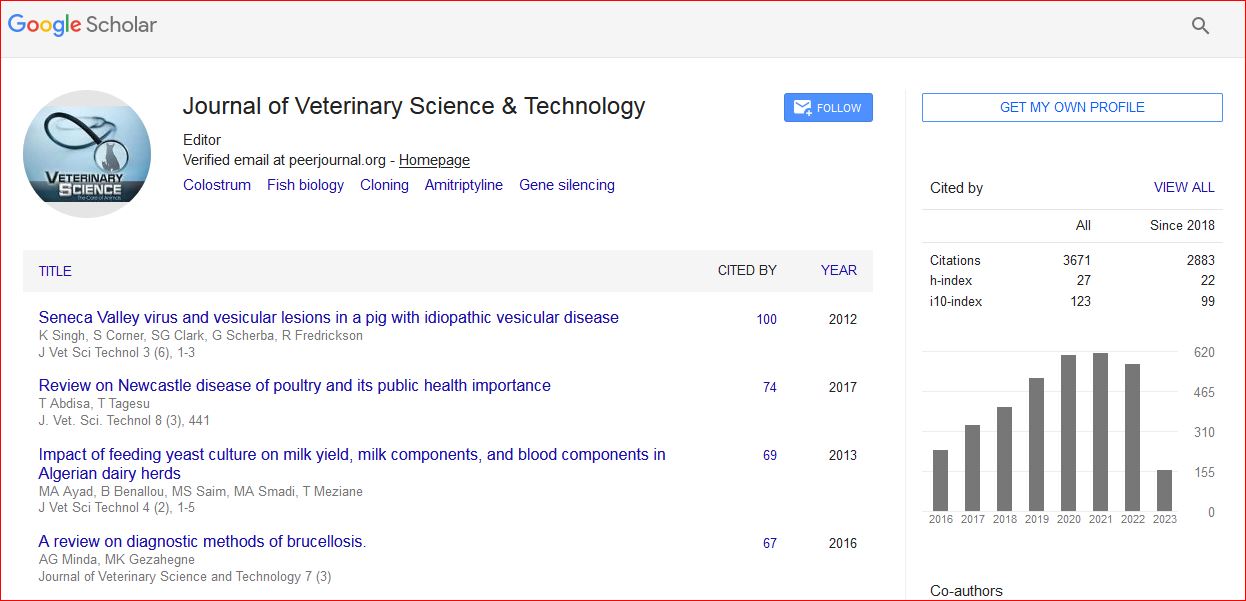
Veterinary Science & Technology received 4472 citations as per Google Scholar report