Commentary - (2025) Volume 14, Issue 4
Received: 01-Jul-2025, Manuscript No. jtsm-26-179576;
Editor assigned: 03-Jul-2025, Pre QC No. P-179576;
Reviewed: 17-Jul-2025, QC No. Q-179576;
Revised: 22-Jul-2025, Manuscript No. R-179576;
Published:
29-Jul-2025
, DOI: 10.37421/2167-0919.2025.14.511
Citation: Demir, Yusuf. ”Dynamic SLA Management: Key For Telecom Success.” J Telecommun Syst Manage 14 (2025):511.
Copyright: © 2025 Demir Y. This is an open-access article distributed under the terms of the Creative Commons Attribution License, which permits unrestricted use, distribution
and reproduction in any medium, provided the original author and source are credited.
Service-Level Agreement (SLA) management is a cornerstone of modern telecommunications operations, vital for guaranteeing service quality and reliability. These agreements define the expected performance levels between service providers and customers, forming the basis for operational oversight and customer satisfaction [1]. The evolution of telecommunications technology has introduced new complexities, necessitating dynamic and data-driven approaches to SLA management [2]. This field is crucial for fostering customer loyalty by ensuring consistent service delivery and transparent performance reporting [3]. Effective SLA management also plays a strategic role in optimizing network performance and driving innovation within the telecom sector [4]. The integration of advanced technologies like artificial intelligence and machine learning is increasingly being explored to enhance the efficiency and accuracy of SLA management processes [5]. Understanding the critical success factors for implementing and managing SLAs is paramount for telecom operators to achieve mutual benefits and operational excellence [6]. Furthermore, the shift towards cloud-based services presents unique challenges and opportunities for defining and assuring SLA performance in virtualized environments [7]. The integration of Network Function Virtualization (NFV) requires dynamic SLA frameworks that can adapt to evolving resource allocations and service demands [8]. Developing and negotiating robust SLAs is particularly important for enterprise customers, ensuring clear understanding of obligations and performance expectations [9]. Finally, the indispensable role of data analytics in transforming raw network data into actionable insights for SLA management cannot be overstated [10].
Service-Level Agreement (SLA) management in telecommunications is fundamentally about ensuring that service providers meet predefined performance standards, thereby managing customer expectations and fostering trust. This involves clearly defining metrics such as availability, response times, and throughput, which are crucial for the reliable operation of telecom networks [1].
The dynamism of the telecom sector, driven by technologies like 5G and IoT, necessitates a continuous re-evaluation and adaptation of SLA frameworks to address new service complexities and user demands [2].
A well-structured SLA directly impacts customer loyalty by setting clear service quality benchmarks and establishing transparent mechanisms for performance tracking and issue resolution [3].
Strategically, SLAs serve as a benchmark for network performance, enabling operators to identify areas for improvement and ensure alignment with customer needs, ultimately driving competitive advantage [4].
The adoption of AI and ML offers powerful capabilities for automating the monitoring of network performance, predicting potential breaches, and dynamically adjusting SLAs to maintain service quality [5].
Key to successful SLA implementation are clear communication, stakeholder alignment, robust performance measurement, and effective dispute resolution processes, all contributing to operational efficiency [6].
In the context of cloud-based services, SLAs must adapt to the fluid nature of virtualised network functions, requiring more granular definitions and automated orchestration [7].
The integration of NFV introduces further complexity, demanding dynamic SLA frameworks capable of real-time monitoring and rapid service recovery in virtualised environments [8].
For enterprise clients, the development and negotiation of SLAs are critical to establishing a clear understanding of service scope, performance metrics, and remedies for non-compliance, ensuring a mutually beneficial agreement [9].
The application of data analytics provides the necessary tools to extract meaningful insights from vast amounts of network data, enabling proactive management and robust reporting for SLA compliance [10].
This collection of research highlights the critical importance of Service-Level Agreement (SLA) management in the telecommunications industry. SLAs are fundamental for ensuring service quality, reliability, and customer satisfaction. The evolution of technology, including 5G, IoT, cloud services, and NFV, introduces complexities that necessitate dynamic, data-driven SLA approaches. Advanced technologies like AI and machine learning are being leveraged to automate monitoring, predict issues, and improve SLA fulfillment. Effective SLA management impacts customer loyalty, drives operational efficiency, and provides a strategic advantage. Key success factors include clear communication, stakeholder alignment, robust performance measurement, and transparent reporting. The research also emphasizes the importance of developing and negotiating clear SLAs, particularly for enterprise customers, and the indispensable role of data analytics in modern SLA management.
None
None
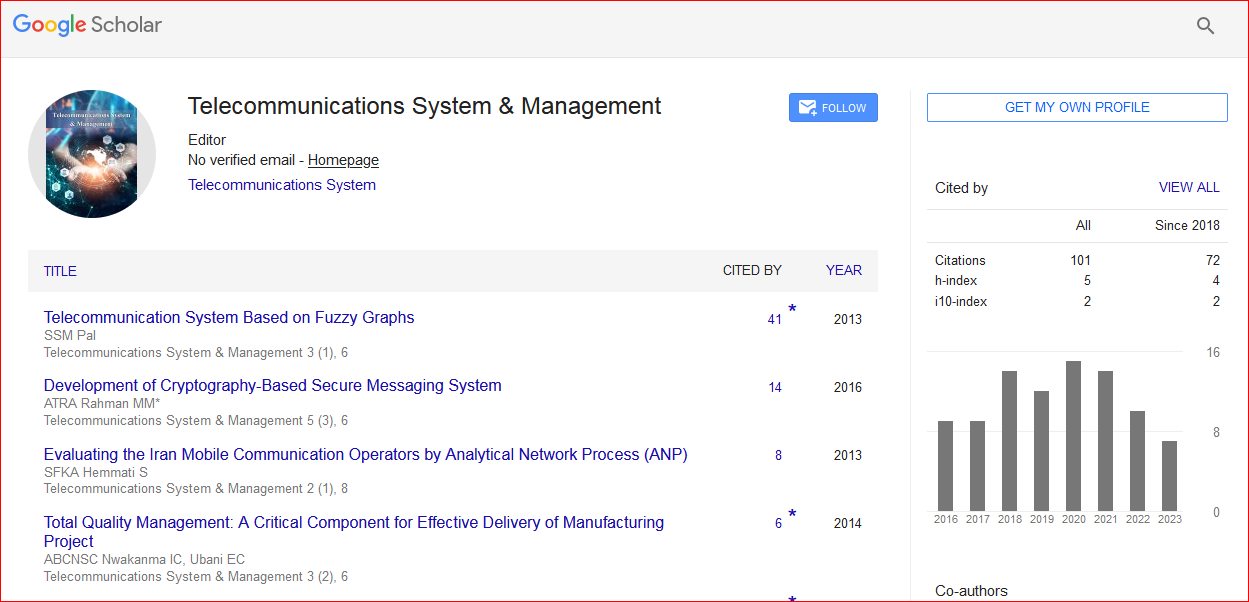
Telecommunications System & Management received 109 citations as per Google Scholar report