Perspective - (2025) Volume 9, Issue 5
Received: 01-Oct-2025, Manuscript No. cmcr-25-178082;
Editor assigned: 03-Oct-2025, Pre QC No. P-178082;
Reviewed: 17-Oct-2025, QC No. Q-178082;
Revised: 22-Oct-2025, Manuscript No. R-178082;
Published:
29-Oct-2025
, DOI: 10.37421/2684-4915.2025.9.398
Citation: El-Khoury, Ibrahim. ”Drug Repurposing: Accelerating New Therapies with AI.” Clin Med Case Rep 09 (2025):398.
Copyright: © 2025 El-Khoury I. This is an open-access article distributed under the terms of the Creative Commons Attribution License, which permits unrestricted use, distribution and reproduction in any medium, provided the original author and source are credited.
Drug repurposing stands as a compelling strategy for combating cancer, significantly cutting down on development costs and timelines. This approach leverages existing drugs with known safety profiles, accelerating their transition to new therapeutic applications. Key insights involve the integration of computational tools for identifying potential candidates, followed by rigorous experimental validation to confirm efficacy against various cancer types[1].
During the urgency of global health crises like the COVID-19 pandemic, drug repurposing offered a rapid and essential pathway for finding treatments. This involved quickly re-evaluating existing medications for their antiviral or immunomodulatory potential against the novel coronavirus. What this really means is that leveraging drugs with established safety data allowed for faster clinical trials and deployment of therapies, mitigating the immediate health impact[2].
Computational methods have revolutionized drug repurposing, moving beyond traditional wet-lab experiments. Here's the thing: advanced algorithms, machine learning, and network-based analyses sift through vast biological and chemical datasets to predict new therapeutic uses for existing drugs. This significantly improves the efficiency and reduces the cost of drug discovery by pinpointing promising candidates for further experimental validation[3].
For neurological disorders, where drug development faces unique challenges due to the complexity of the central nervous system, drug repurposing presents a crucial opportunity. What this really means is leveraging drugs already approved for other conditions can bypass lengthy initial safety testing, accelerating the search for therapies for conditions like Alzheimer's and Parkinson's disease, ultimately bringing hope to patients faster[4].
Rare diseases often suffer from a lack of dedicated drug development due to small patient populations and economic disincentives. Here's the thing: drug repurposing offers an invaluable strategy, tapping into existing pharmacopeia to provide therapeutic options where none previously existed. Success stories highlight its potential to bring treatments to patients with orphan diseases much faster and more cost-effectively than de novo drug discovery[5].
Artificial intelligence is dramatically reshaping drug repurposing by enabling the analysis of colossal datasets, including genomic, proteomic, and clinical information. Let's break it down: AI algorithms can identify subtle patterns and connections between drugs and diseases that human researchers might miss, predicting novel therapeutic indications with higher accuracy and significantly accelerating the discovery phase[6].
Cardiovascular diseases remain a leading cause of global mortality, and the development of new treatments is notoriously challenging. What this really means is that drug repurposing offers a strategic advantage by reassessing established medications for new cardiovascular indications. This approach can bypass extensive early-stage development, potentially bringing new therapies to patients faster and addressing unmet clinical needs[7].
Network biology provides a powerful lens for drug repurposing by mapping the intricate web of interactions between drugs, targets, genes, and diseases. Here's the thing: understanding these complex relationships can reveal unexpected therapeutic connections, allowing researchers to identify existing drugs that might modulate disease pathways in novel ways. This approach enhances the rational design and efficiency of repurposing efforts[8].
Integrating multi-omics data, such as genomics, proteomics, and transcriptomics, is becoming indispensable for effective drug repurposing. Let's break it down: by combining these diverse data types, scientists gain a more comprehensive understanding of disease mechanisms and drug actions. This holistic view enhances the precision of identifying suitable candidates for repurposing, leading to more targeted and successful interventions[9].
Drug repurposing, while offering significant advantages in terms of reduced cost and accelerated development, still faces its own set of challenges. This includes navigating complex regulatory pathways and addressing intellectual property issues for drugs approved for different indications. What this really means is that successful repurposing requires not just scientific ingenuity but also strategic planning around these logistical hurdles to maximize its impact[10].
Drug repurposing stands as a compelling strategy for combating cancer, significantly cutting down on development costs and timelines. This approach leverages existing drugs with known safety profiles, accelerating their transition to new therapeutic applications. Key insights involve the integration of computational tools for identifying potential candidates, followed by rigorous experimental validation to confirm efficacy against various cancer types[1].
During the urgency of global health crises like the COVID-19 pandemic, drug repurposing offered a rapid and essential pathway for finding treatments. This involved quickly re-evaluating existing medications for their antiviral or immunomodulatory potential against the novel coronavirus. What this really means is that leveraging drugs with established safety data allowed for faster clinical trials and deployment of therapies, mitigating the immediate health impact[2].
Computational methods have revolutionized drug repurposing, moving beyond traditional wet-lab experiments. Here's the thing: advanced algorithms, machine learning, and network-based analyses sift through vast biological and chemical datasets to predict new therapeutic uses for existing drugs. This significantly improves the efficiency and reduces the cost of drug discovery by pinpointing promising candidates for further experimental validation[3].
For neurological disorders, where drug development faces unique challenges due to the complexity of the central nervous system, drug repurposing presents a crucial opportunity. What this really means is leveraging drugs already approved for other conditions can bypass lengthy initial safety testing, accelerating the search for therapies for conditions like Alzheimer's and Parkinson's disease, ultimately bringing hope to patients faster[4].
Rare diseases often suffer from a lack of dedicated drug development due to small patient populations and economic disincentives. Here's the thing: drug repurposing offers an invaluable strategy, tapping into existing pharmacopeia to provide therapeutic options where none previously existed. Success stories highlight its potential to bring treatments to patients with orphan diseases much faster and more cost-effectively than de novo drug discovery[5].
Artificial intelligence is dramatically reshaping drug repurposing by enabling the analysis of colossal datasets, including genomic, proteomic, and clinical information. Let's break it down: AI algorithms can identify subtle patterns and connections between drugs and diseases that human researchers might miss, predicting novel therapeutic indications with higher accuracy and significantly accelerating the discovery phase[6].
Cardiovascular diseases remain a leading cause of global mortality, and the development of new treatments is notoriously challenging. What this really means is that drug repurposing offers a strategic advantage by reassessing established medications for new cardiovascular indications. This approach can bypass extensive early-stage development, potentially bringing new therapies to patients faster and addressing unmet clinical needs[7].
Network biology provides a powerful lens for drug repurposing by mapping the intricate web of interactions between drugs, targets, genes, and diseases. Here's the thing: understanding these complex relationships can reveal unexpected therapeutic connections, allowing researchers to identify existing drugs that might modulate disease pathways in novel ways. This approach enhances the rational design and efficiency of repurposing efforts[8].
Integrating multi-omics data, such as genomics, proteomics, and transcriptomics, is becoming indispensable for effective drug repurposing. Let's break it down: by combining these diverse data types, scientists gain a more comprehensive understanding of disease mechanisms and drug actions. This holistic view enhances the precision of identifying suitable candidates for repurposing, leading to more targeted and successful interventions[9].
Drug repurposing, while offering significant advantages in terms of reduced cost and accelerated development, still faces its own set of challenges. This includes navigating complex regulatory pathways and addressing intellectual property issues for drugs approved for different indications. What this really means is that successful repurposing requires not just scientific ingenuity but also strategic planning around these logistical hurdles to maximize its impact[10].
Drug repurposing is a powerful strategy that re-evaluates existing drugs for new therapeutic uses. This approach cuts down development costs and timelines significantly because these drugs already have known safety profiles. It's especially valuable in urgent situations, like the COVID-19 pandemic, where rapid deployment of therapies was essential. Beyond crises, drug repurposing shows immense promise for complex and underserved conditions, including cancer, neurological disorders like Alzheimer's and Parkinson's, rare diseases with small patient populations, and cardiovascular diseases. The process has been revolutionized by computational methods, advanced algorithms, and machine learning, which sift through vast datasets to predict new indications. Artificial Intelligence (AI) further enhances this by identifying subtle patterns in genomic, proteomic, and clinical data. Network biology provides a framework for understanding complex interactions between drugs and diseases, while multi-omics data integration offers a comprehensive view for precise candidate identification. Despite its many advantages, repurposing faces challenges such as navigating complex regulatory pathways and addressing intellectual property issues. Overcoming these logistical hurdles is crucial to maximize its impact, making drug repurposing a smart, efficient path to new treatments across a wide range of medical needs.
None
None
Indexed at, Google Scholar, Crossref
Indexed at, Google Scholar, Crossref
Indexed at, Google Scholar, Crossref
Indexed at, Google Scholar, Crossref
Indexed at, Google Scholar, Crossref
Indexed at, Google Scholar, Crossref
Indexed at, Google Scholar, Crossref
Indexed at, Google Scholar, Crossref
Indexed at, Google Scholar, Crossref
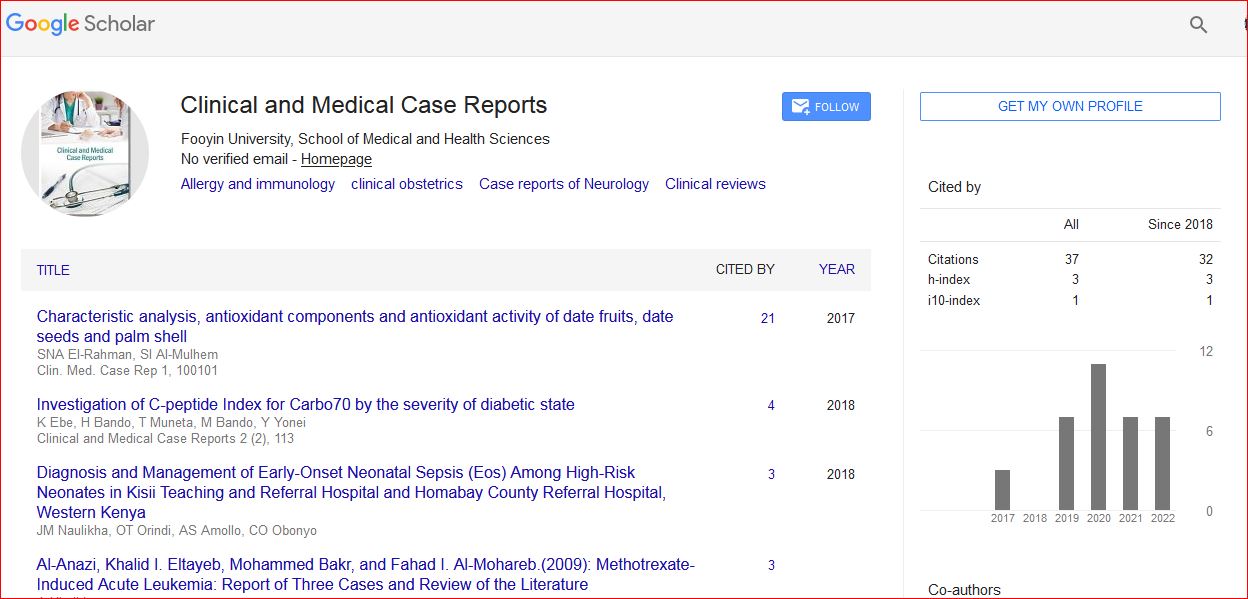
Clinical and Medical Case Reports received 53 citations as per Google Scholar report