Perspective - (2025) Volume 16, Issue 5
Received: 01-Sep-2025, Manuscript No. assj-25-174794;
Editor assigned: 03-Sep-2025, Pre QC No. P-174794;
Reviewed: 17-Sep-2025, QC No. Q-174794;
Revised: 22-Sep-2025, Manuscript No. R-174794;
Published:
29-Sep-2025
, DOI: 10.37421/2151-6200.2025.16.688
Citation: Moreau, Hugo. ”DiverseLiteraryEcologies: Confronting Global Crises.” Arts Social Sci J 16 (2025):688
Copyright: © 2025 Moreau H. This is an open-access article distributed under the terms of the Creative Commons Attribution License, which permits unrestricted use, distribution and reproduction in any medium, provided the original author and source are credited.
This article explores how literary ecologies move beyond traditional ecocriticism by emphasizing the material and socio-political dimensions of environmental issues. It argues for an approach that integrates critical environmental studies, focusing on infrastructure, pollution, and systemic inequalities, rather than solely on wilderness narratives. The discussion highlights the necessity of addressing the tangible impacts of environmental degradation as represented in literature[1].
Here's the thing, this piece investigates how literature responds to and shapes our understanding of global environmental crises. It argues that literary ecologies offer crucial perspectives for navigating complex planetary challenges, emphasizing the role of narrative in fostering ecological awareness and prompting action beyond scientific data alone[2].
This study delves into oceanic literary ecologies, analyzing how contemporary narratives portray the sea in the context of the Anthropocene. It explores themes of marine degradation, climate change impacts on coastal communities, and the interconnectedness of human and aquatic lives, highlighting literature's capacity to reframe our relationship with the ocean[3].
What this article really means is exploring how literary ecologies engage with the concept of mediated natures, especially concerning the Anthropocene and the human environmental sensorium. It discusses how literature both reflects and shapes our sensory experiences of a technologically altered world, influencing perceptions of environmental crisis and agency[4].
This article examines literary ecologies of contamination and care, rethinking how toxicity is understood and represented in the Anthropocene. It explores narratives that move beyond simple notions of purity and pollution, focusing instead on interconnectedness and the ethical implications of living in a world pervaded by environmental hazards[5].
This paper explores queer literary ecologies, focusing on the materialities, embodiments, and more-than-human relations found in LGBTQ+ literature. It argues that queer perspectives offer unique insights into environmental ethics by challenging conventional notions of nature, reproduction, and belonging, creating expansive understandings of ecological kinship[6].
This article examines urban literary ecologies, looking at how contemporary fiction depicts the 'rewilding' of cities. It analyzes narratives where nature reasserts itself in urban spaces, challenging the human-centric view of cities and exploring new forms of coexistence between urban dwellers and non-human life[7].
Let's break it down: this piece explores Indigenous literary ecologies, emphasizing how Indigenous narratives story land, language, and kinship. It highlights the deep ecological knowledge embedded in Indigenous literatures, advocating for a worldview that recognizes reciprocal relationships between humans and the more-than-human world[8].
This paper examines how literary ecologies engage with the concept of the planetary, exploring speculative futures in the face of environmental crisis. It considers how literature imagines and critiques potential ecological trajectories, offering narratives that navigate the complexities of global environmental change and inspire alternative imaginaries[9].
Here's the thing, this work explores affective literary ecologies, focusing on the role of emotions in engaging with environmental crisis through narrative. It argues that literature can cultivate specific emotional responses, like grief, hope, or anger, which are crucial for understanding and responding to ecological challenges and fostering environmental care[10].
This collection of articles on literary ecologies moves beyond traditional ecocriticism by emphasizing the material and socio-political dimensions of environmental issues[1]. Here's the thing, these pieces investigate how literature responds to and shapes our understanding of global environmental crises, underscoring narrative's role in fostering ecological awareness and prompting action beyond scientific data alone[2].
Several studies delve into specific environmental contexts. For example, some explore oceanic literary ecologies, analyzing how contemporary narratives portray the sea in the context of the Anthropocene, touching on themes like marine degradation and the interconnectedness of human and aquatic lives[3]. Other work examines urban literary ecologies, depicting the 'rewilding' of cities in contemporary fiction, challenging human-centric views of urban spaces and exploring new forms of coexistence between urban dwellers and non-human life[7].
The collection also engages with the Anthropocene's complexities. What this article really means is an exploration of how literary ecologies engage with mediated natures and the human environmental sensorium, discussing how literature reflects and shapes our sensory experiences of a technologically altered world[4]. This also includes examining literary ecologies of contamination and care, rethinking how toxicity is understood and represented, moving beyond simple notions of purity and pollution to focus on interconnectedness and ethical implications[5].
Beyond specific environments and the Anthropocene, the papers address diverse cultural and social dimensions. This paper explores queer literary ecologies, focusing on the materialities, embodiments, and more-than-human relations found in LGBTQ+ literature, offering unique insights into environmental ethics[6]. Let's break it down: another piece explores Indigenous literary ecologies, emphasizing how Indigenous narratives story land, language, and kinship, advocating for worldviews that recognize reciprocal relationships between humans and the more-than-human world[8].
Lastly, the collection considers literature's role in addressing future challenges and emotional engagement. This paper examines how literary ecologies engage with the concept of the planetary, exploring speculative futures in the face of environmental crisis and inspiring alternative imaginaries[9]. Here's the thing, other work explores affective literary ecologies, focusing on emotions like grief, hope, or anger as crucial for understanding and responding to ecological challenges and fostering environmental care through narrative engagement[10].
This collection explores diverse facets of literary ecologies, moving beyond traditional ecocriticism to engage with contemporary environmental challenges. It emphasizes the material and socio-political dimensions of environmental issues, focusing on critical environmental studies, infrastructure, pollution, and systemic inequalities, rather than solely wilderness narratives. Here's the thing, these pieces investigate how literature responds to global environmental crises, highlighting narrative's role in fostering ecological awareness and prompting action beyond scientific data. Studies delve into oceanic literary ecologies, portraying marine degradation, climate change impacts on coastal communities, and the interconnectedness of human and aquatic lives, reframing our relationship with the ocean. What this article really means is an exploration of how literary ecologies engage with mediated natures, the Anthropocene, and the human environmental sensorium, showing how literature shapes our sensory experiences of a technologically altered world. The collection also examines literary ecologies of contamination and care, rethinking toxicity, purity, and pollution in the Anthropocene by focusing on interconnectedness and ethical implications. Queer literary ecologies are explored, emphasizing materialities, embodiments, and more-than-human relations in LGBTQ+ literature, challenging conventional notions of nature and belonging. This also extends to urban literary ecologies, depicting the 'rewilding' of cities and new forms of coexistence between urban dwellers and non-human life. Let's break it down: Indigenous literary ecologies are central, highlighting how Indigenous narratives story land, language, and kinship, advocating for worldviews recognizing reciprocal relationships. The papers also examine the planetary concept, exploring speculative futures amidst environmental crises, along with affective literary ecologies that focus on emotions like grief, hope, and anger in engaging with ecological challenges through narrative.
None
None
Indexed at, Google Scholar, Crossref
Indexed at, Google Scholar, Crossref
Indexed at, Google Scholar, Crossref
Indexed at, Google Scholar, Crossref
Indexed at, Google Scholar, Crossref
Indexed at, Google Scholar, Crossref
Indexed at, Google Scholar, Crossref
Indexed at, Google Scholar, Crossref
Indexed at, Google Scholar, Crossref
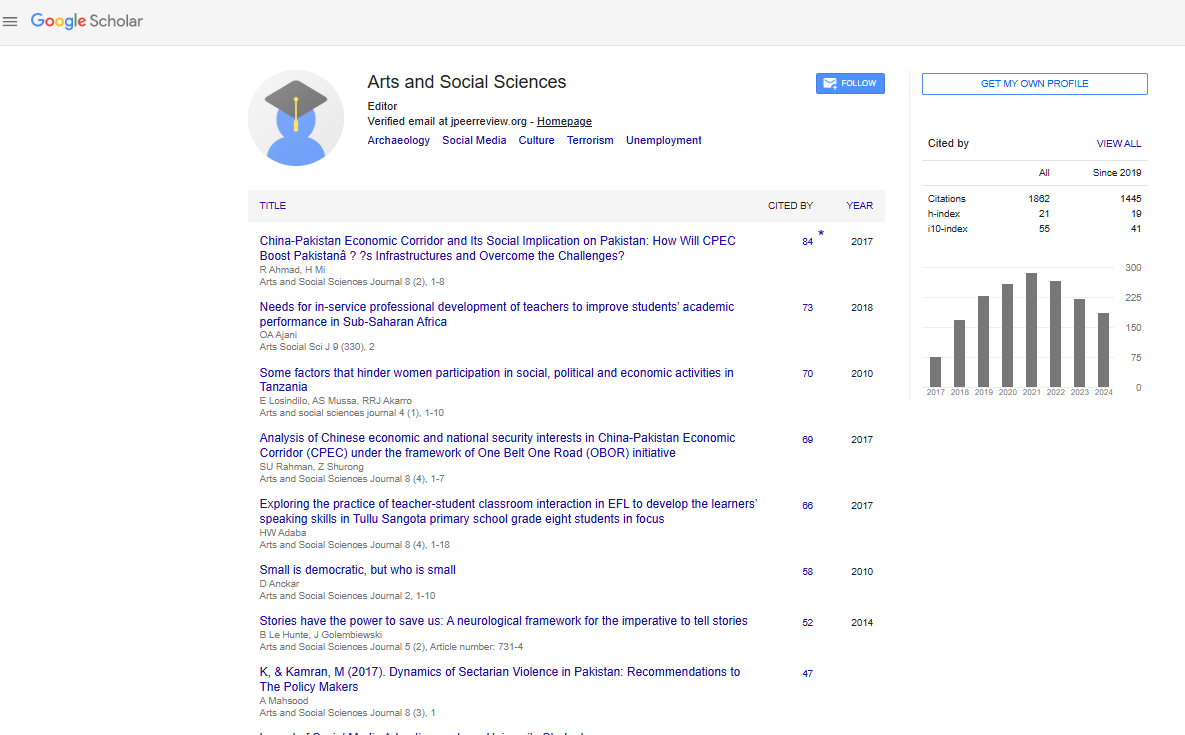
Arts and Social Sciences Journal received 1413 citations as per Google Scholar report