Opinion - (2025) Volume 16, Issue 6
Received: 01-Nov-2025, Manuscript No. jhmi-26-178895;
Editor assigned: 03-Nov-2025, Pre QC No. P-178895;
Reviewed: 17-Nov-2025, QC No. Q-178895;
Revised: 24-Nov-2025, Manuscript No. R-178895;
Published:
29-Nov-2025
, DOI: 10.37421/2157-7420.2025.16.622
Citation: Mendoza, Ricardo L.. ”Digital Twins: Revolutionizing Healthcare With AI and Ethics.” J Health Med Informat 16 (2025):622.
Copyright: © 2025 Mendoza L. Ricardo This is an open-access article distributed under the terms of the Creative Commons Attribution License, which permits unrestricted use, distribution and reproduction in any medium, provided the original author and source are credited.
Digital twin models are revolutionizing healthcare informatics by creating dynamic virtual replicas of patients, organs, or even entire healthcare systems. These models integrate real-time data from various sources, enabling personalized treatment plans, predictive diagnostics, and improved resource management. Their application spans from simulating drug interactions and surgical procedures to optimizing hospital workflows and public health interventions, ultimately aiming for enhanced patient outcomes and operational efficiency.[1] The integration of artificial intelligence and machine learning with digital twin technology is accelerating advancements in healthcare. These sophisticated models can identify complex disease patterns, predict patient responses to therapies, and guide clinical decision-making with unprecedented accuracy. The focus is on developing robust frameworks for data security and ethical implementation to ensure patient trust and regulatory compliance.[2] Patient-specific digital twins hold significant promise for simulating surgical interventions. By creating a precise virtual representation of a patient's anatomy and pathology, surgeons can practice complex procedures, anticipate potential complications, and optimize surgical approaches before entering the operating room. This leads to reduced operative time, minimized risks, and improved surgical outcomes.[3] The development of comprehensive digital twins for chronic disease management is a rapidly evolving area. These models can track disease progression, predict exacerbations, and tailor therapeutic interventions to individual patient needs. The goal is to empower patients and clinicians with actionable insights for better self-management and more effective treatment strategies.[4] Digital twins are being employed to optimize healthcare delivery systems and hospital operations. By creating virtual models of patient flow, resource allocation, and staff scheduling, institutions can identify bottlenecks, predict demand, and improve efficiency. This leads to reduced waiting times, better patient throughput, and more cost-effective healthcare.[5] The ethical implications and data privacy concerns surrounding digital twins in healthcare are critical considerations. Ensuring robust data security, anonymization, and informed consent is paramount to building trust and facilitating widespread adoption. Frameworks for responsible innovation and governance are essential.[6] Predictive modeling using digital twins for early disease detection is gaining momentum. By analyzing a patient's continuous health data, these models can identify subtle anomalies indicative of impending illness, allowing for timely intervention and potentially preventing severe health events. This shifts the paradigm from reactive to proactive healthcare.[7] The application of digital twins in drug discovery and development offers significant advantages. Virtual testing of drug efficacy and toxicity on digital models of biological systems can accelerate the identification of promising candidates and reduce the need for extensive preclinical trials, thereby lowering costs and timelines.[8] The validation and verification of digital twin models in healthcare are crucial for their reliable use in clinical decision-making. Establishing standardized methodologies and rigorous testing protocols ensures that these models accurately reflect real-world biological processes and patient states, fostering confidence among healthcare professionals.[9] The implementation of digital twins in personalized rehabilitation programs is a growing area of interest. By creating dynamic virtual models of a patient's recovery process, clinicians can continuously monitor progress, adjust therapeutic exercises, and provide tailored feedback, leading to more effective and efficient rehabilitation outcomes.[10]
Digital twin technology is fundamentally transforming healthcare informatics by constructing dynamic virtual replicas of patients, specific organs, or even entire healthcare infrastructures. These advanced models leverage the integration of real-time data streams from a multitude of sources, facilitating highly personalized treatment strategies, enabling predictive diagnostic capabilities, and significantly enhancing resource management across healthcare settings. Their broad applicability encompasses diverse areas such as simulating intricate drug interactions, practicing complex surgical procedures, optimizing the operational workflows within hospitals, and informing public health interventions, all with the overarching objectives of improving patient outcomes and boosting operational efficiencies.[1] The synergistic integration of artificial intelligence (AI) and machine learning (ML) with digital twin technology is a key driver of accelerated progress in the healthcare domain. These sophisticated computational models possess the capacity to discern intricate disease patterns, accurately predict patient responses to various therapeutic interventions, and provide guidance for clinical decision-making with a level of accuracy previously unattainable. A critical aspect of this development involves the establishment of robust frameworks to address data security and ensure ethical implementation, thereby fostering patient trust and adhering to regulatory requirements.[2] Digital twins tailored to individual patients offer immense potential for the simulation of surgical interventions. By generating a precise virtual representation that encompasses a patient's unique anatomy and pathological conditions, surgeons gain the ability to meticulously practice complex procedures, proactively anticipate potential complications, and refine surgical approaches prior to the actual operation. This meticulous preparation translates into tangible benefits such as reduced operative times, minimized patient risks, and ultimately, improved surgical results.[3] In the realm of chronic disease management, the development and application of comprehensive digital twins represent a rapidly advancing frontier. These specialized models are designed to meticulously track the progression of chronic conditions, forecast potential exacerbations, and adapt therapeutic interventions to meet the specific needs of each individual patient. The ultimate aim is to equip both patients and clinicians with actionable insights that promote enhanced self-management and facilitate the implementation of more effective treatment strategies.[4] The optimization of healthcare delivery systems and hospital operations is increasingly being addressed through the strategic deployment of digital twins. By creating virtual models that accurately depict patient flow, resource allocation patterns, and staff scheduling, healthcare institutions can effectively identify operational bottlenecks, anticipate future demand fluctuations, and systematically enhance overall efficiency. This leads to tangible improvements such as decreased patient waiting times, improved patient throughput, and more cost-effective provision of healthcare services.[5] Critical considerations surrounding the ethical implications and data privacy concerns associated with the use of digital twins in healthcare are of paramount importance. Ensuring the implementation of stringent data security measures, effective anonymization techniques, and obtaining comprehensive informed consent from patients are indispensable steps for cultivating trust and promoting widespread adoption of this technology. The development of structured frameworks for responsible innovation and robust governance is therefore considered essential.[6] The application of predictive modeling, powered by digital twins, for the early detection of diseases is experiencing a notable surge in interest and development. By continuously analyzing a patient's health data, these advanced models can detect subtle anomalies that may signal the onset of an impending illness. This capability allows for timely interventions, potentially averting severe health events and fundamentally shifting the healthcare paradigm from a reactive approach to a more proactive one.[7] Digital twins are proving to be highly advantageous in the intricate processes of drug discovery and development. The ability to virtually test the efficacy and potential toxicity of drug candidates using digital models of biological systems can significantly accelerate the identification of promising compounds and reduce the necessity for extensive preclinical trials. This acceleration contributes to lowering development costs and shortening overall timelines.[8] For digital twin models to be reliably integrated into clinical decision-making processes within healthcare, their validation and verification are of utmost importance. The establishment of standardized methodologies and the implementation of rigorous testing protocols are essential to ensure that these models accurately represent real-world biological processes and patient states. This meticulous approach is vital for building confidence among healthcare professionals.[9] The integration of digital twins into personalized rehabilitation programs represents a burgeoning area of significant interest. By constructing dynamic virtual models that capture a patient's recovery trajectory, clinicians are enabled to continuously monitor progress, make necessary adjustments to therapeutic exercises, and provide highly tailored feedback. This personalized approach leads to more effective and efficient rehabilitation outcomes for individuals.[10]
Digital twins are revolutionizing healthcare by creating dynamic virtual replicas of patients and systems for personalized treatment, predictive diagnostics, and improved resource management. Their integration with AI and machine learning enhances disease pattern identification and clinical decision-making. Patient-specific digital twins enable precise surgical planning and simulation, reducing risks and improving outcomes. The technology is also applied to chronic disease management, optimizing hospital operations, and accelerating drug discovery. However, ethical considerations and data privacy are crucial for widespread adoption. Predictive modeling for early disease detection and personalized rehabilitation are emerging applications, all requiring rigorous validation and verification for reliable clinical use.
None
None
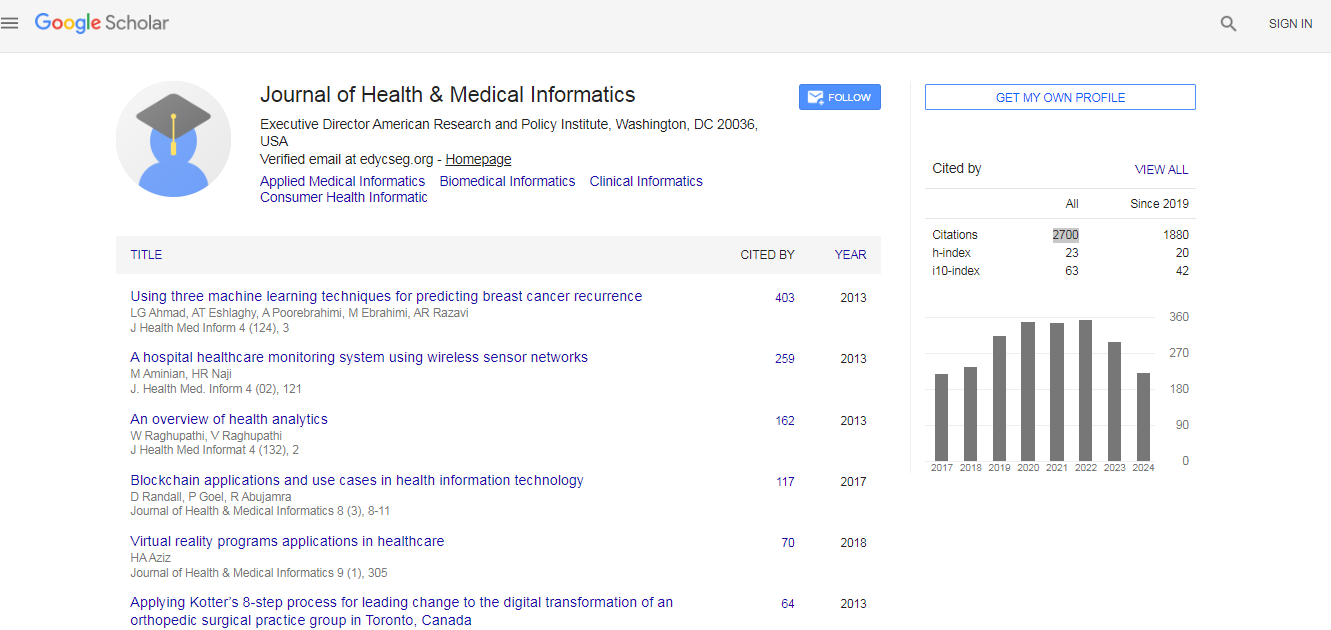
Journal of Health & Medical Informatics received 2700 citations as per Google Scholar report