Perspective - (2025) Volume 16, Issue 6
Received: 01-Nov-2025, Manuscript No. jhmi-26-178898;
Editor assigned: 03-Nov-2025, Pre QC No. P-178898;
Reviewed: 17-Nov-2025, QC No. Q-178898;
Revised: 24-Nov-2025, Manuscript No. R-178898;
Published:
29-Nov-2025
, DOI: 10.37421/2157-7420.2025.16.623
Citation: Karimi, Hossein A.. ”Digital Twins: Revolutionizing Healthcare Informatics and Personalized Care.” J Health Med Informat 16 (2025):623.
Copyright: © 2025 Karimi A. Hossein This is an open-access article distributed under the terms of the Creative Commons Attribution License, which permits unrestricted use, distribution and reproduction in any medium, provided the original author and source are credited.
Digital twin models are revolutionizing healthcare informatics by creating virtual replicas of patients, organs, or even entire healthcare systems. These models enable personalized treatment planning, predictive diagnostics, and operational optimization, leading to improved patient outcomes and resource allocation. They facilitate 'in silico' experimentation, reducing the need for real-world trials and accelerating medical research and development.[1] The integration of digital twins within hospital informatics systems offers a powerful platform for enhancing patient care. By mirroring real-time patient data, these twins allow clinicians to simulate interventions, predict disease progression, and optimize treatment pathways. This personalized approach can significantly improve diagnostic accuracy and therapeutic effectiveness, ultimately leading to better patient safety and quality of care.[2] Digital twin models are instrumental in the development of intelligent healthcare systems. They enable the creation of dynamic, data-driven simulations that can adapt to changing patient conditions and operational demands. This adaptability is crucial for proactive decision-making, resource management, and the seamless integration of artificial intelligence within clinical workflows.[3] Creating and maintaining digital twins of physiological systems requires sophisticated data integration and modeling techniques. This involves harmonizing diverse data sources, from electronic health records to wearable sensor data, to build accurate and dynamic virtual representations. The challenge lies in ensuring the fidelity and continuous updating of these models to reflect real-world biological complexity.[4] The application of digital twins extends to the simulation of complex medical procedures and surgical interventions. Surgeons can use these virtual models to plan operations, identify potential risks, and optimize surgical approaches before entering the operating room. This 'pre-operative rehearsal' significantly enhances surgical precision and patient safety.[5] Digital twins play a crucial role in healthcare system management by enabling the simulation of operational workflows and resource allocation. By creating virtual models of hospitals or clinics, administrators can identify bottlenecks, optimize patient flow, and improve staff scheduling. This leads to greater efficiency and cost-effectiveness within healthcare institutions.[6] The ethical implications and data privacy concerns associated with digital twin models in healthcare are paramount. Ensuring the security of sensitive patient data used to build and maintain these twins is critical. Establishing clear guidelines for data governance and consent is essential for building trust and widespread adoption.[7] Digital twin technology facilitates the development of robust predictive models for disease outbreaks and population health management. By simulating various scenarios and analyzing epidemiological data, these models can help public health officials anticipate and respond to health crises more effectively, informing policy and resource allocation.[8] The development of digital twins for drug discovery and development offers a significant acceleration in bringing new therapies to market. By simulating drug-target interactions and predicting drug efficacy and toxicity in virtual patient models, researchers can streamline the preclinical stages and identify promising candidates more efficiently.[9] The ultimate goal of digital twins in healthcare informatics is to create a comprehensive, dynamic virtual representation of each patient. This 'patient digital twin' would integrate all aspects of an individual's health, enabling truly personalized preventive care, precise diagnosis, and adaptive treatment strategies throughout their lifetime.[10]
Digital twin models are revolutionizing healthcare informatics by creating virtual replicas of patients, organs, or even entire healthcare systems. These models enable personalized treatment planning, predictive diagnostics, and operational optimization, leading to improved patient outcomes and resource allocation. They facilitate 'in silico' experimentation, reducing the need for real-world trials and accelerating medical research and development.[1] The integration of digital twins within hospital informatics systems offers a powerful platform for enhancing patient care. By mirroring real-time patient data, these twins allow clinicians to simulate interventions, predict disease progression, and optimize treatment pathways. This personalized approach can significantly improve diagnostic accuracy and therapeutic effectiveness, ultimately leading to better patient safety and quality of care.[2] Digital twin models are instrumental in the development of intelligent healthcare systems. They enable the creation of dynamic, data-driven simulations that can adapt to changing patient conditions and operational demands. This adaptability is crucial for proactive decision-making, resource management, and the seamless integration of artificial intelligence within clinical workflows.[3] Creating and maintaining digital twins of physiological systems requires sophisticated data integration and modeling techniques. This involves harmonizing diverse data sources, from electronic health records to wearable sensor data, to build accurate and dynamic virtual representations. The challenge lies in ensuring the fidelity and continuous updating of these models to reflect real-world biological complexity.[4] The application of digital twins extends to the simulation of complex medical procedures and surgical interventions. Surgeons can use these virtual models to plan operations, identify potential risks, and optimize surgical approaches before entering the operating room. This 'pre-operative rehearsal' significantly enhances surgical precision and patient safety.[5] Digital twins play a crucial role in healthcare system management by enabling the simulation of operational workflows and resource allocation. By creating virtual models of hospitals or clinics, administrators can identify bottlenecks, optimize patient flow, and improve staff scheduling. This leads to greater efficiency and cost-effectiveness within healthcare institutions.[6] The ethical implications and data privacy concerns associated with digital twin models in healthcare are paramount. Ensuring the security of sensitive patient data used to build and maintain these twins is critical. Establishing clear guidelines for data governance and consent is essential for building trust and widespread adoption.[7] Digital twin technology facilitates the development of robust predictive models for disease outbreaks and population health management. By simulating various scenarios and analyzing epidemiological data, these models can help public health officials anticipate and respond to health crises more effectively, informing policy and resource allocation.[8] The development of digital twins for drug discovery and development offers a significant acceleration in bringing new therapies to market. By simulating drug-target interactions and predicting drug efficacy and toxicity in virtual patient models, researchers can streamline the preclinical stages and identify promising candidates more efficiently.[9] The ultimate goal of digital twins in healthcare informatics is to create a comprehensive, dynamic virtual representation of each patient. This 'patient digital twin' would integrate all aspects of an individual's health, enabling truly personalized preventive care, precise diagnosis, and adaptive treatment strategies throughout their lifetime.[10]
Digital twins are transforming healthcare informatics by creating virtual replicas of patients, organs, and systems to enable personalized treatment, predictive diagnostics, and operational optimization. This technology facilitates in silico experimentation, accelerating research and development. By integrating with hospital systems, digital twins enhance patient care through real-time data mirroring, allowing for simulated interventions and optimized treatment pathways. They are crucial for intelligent healthcare systems, supporting dynamic simulations and seamless AI integration. Building these twins requires sophisticated data integration and modeling techniques to ensure accuracy and fidelity. Digital twins also aid in surgical planning and simulation, enhancing precision and patient safety. Furthermore, they optimize healthcare operations by simulating workflows and resource allocation for improved efficiency. Ethical considerations and data privacy are paramount, necessitating robust governance and consent mechanisms. The technology is also valuable for predictive modeling of disease outbreaks and population health management, and accelerates drug discovery and development through virtual simulations. The overarching vision is to create comprehensive patient digital twins for lifelong personalized healthcare.
None
None
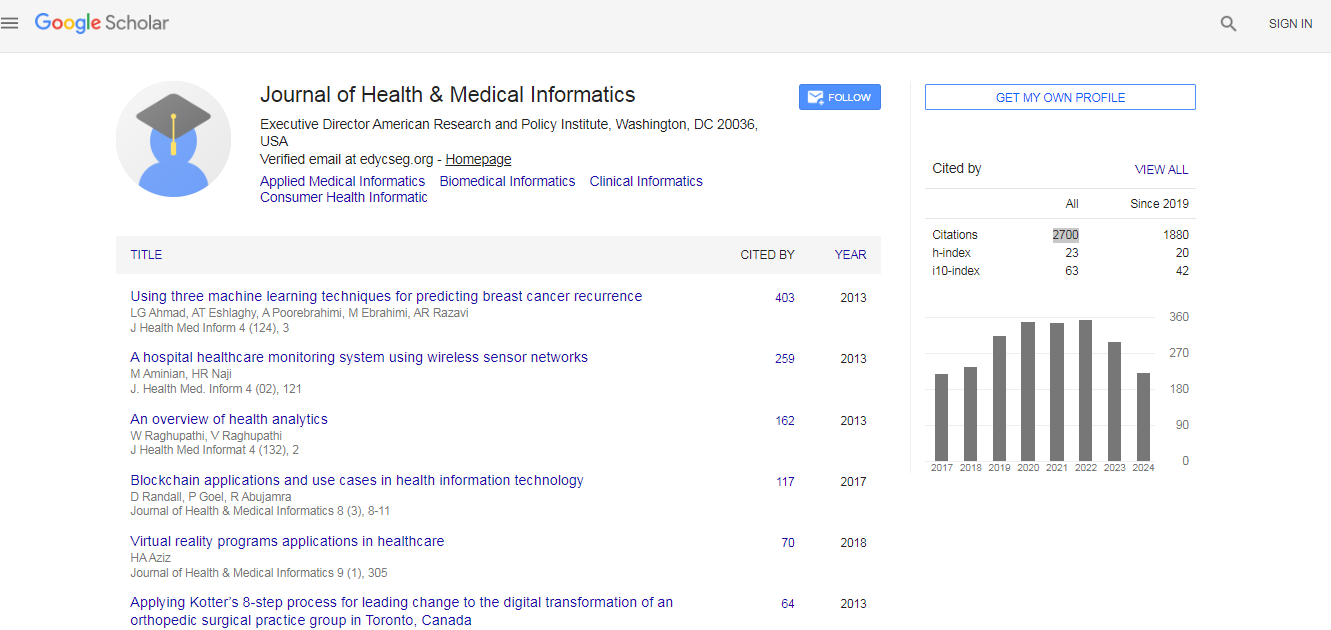
Journal of Health & Medical Informatics received 2700 citations as per Google Scholar report