Brief Report - (2025) Volume 14, Issue 3
Received: 01-May-2025, Manuscript No. iem-26-179777;
Editor assigned: 04-May-2025, Pre QC No. P-179777;
Reviewed: 14-May-2025, QC No. Q-179777;
Revised: 21-May-2025, Manuscript No. R-179777;
Published:
29-May-2025
, DOI: 10.37421/2169- 0316.2025.14.300
Citation: Gonzalez, Maria. Digital Transformation for Resilient, Agile Supply Chains. J Ind Eng Manag 14 (2025):300.
Copyright: © 2025 Gonzalez M. This is an open-access article distributed under the terms of the Creative Commons Attribution License, which permits unrestricted use,
distribution and reproduction in any medium, provided the original author and source are credited.
The field of supply chain management is undergoing a profound transformation, driven by technological advancements and the increasing complexity of global commerce. Industrial engineers are at the forefront of adopting modern strategies to enhance operational efficiency, build resilience, and foster sustainability within these intricate networks. Digital technologies, encompassing areas like data analytics, artificial intelligence, and the Internet of Things, are becoming indispensable tools for navigating the challenges of contemporary supply chains [1].
The integration of these digital solutions allows for real-time visibility and predictive capabilities, enabling better forecasting and resource allocation. This shift is crucial for adapting to a volatile market and ensuring continuous operation. The strategic adoption of these tools is not merely about incremental improvements but a fundamental redesign of how supply chains function and interact. The pursuit of enhanced efficiency is closely linked to the ability to predict and respond to disruptions, making data-driven insights paramount. Furthermore, the drive towards more collaborative and transparent supply chain networks is a significant trend, aiming to mitigate risks and improve overall adaptability. This collaborative approach extends to sharing information and working closely with partners to achieve common goals. The dynamic nature of global trade necessitates a proactive stance on risk management, with a focus on building robust and flexible systems. The continuous evolution of consumer demands and geopolitical factors further emphasizes the need for agile and responsive supply chain operations. Therefore, understanding and implementing these advanced strategies is essential for industrial engineers to excel in this evolving landscape.
Modern supply chain operations are increasingly reliant on the sophisticated analysis of large datasets, often referred to as big data analytics, to inform critical decision-making processes. This analytical capability spans various aspects, from optimizing inventory levels to refining transportation routes and improving overall logistics efficiency [2].
To fully harness the potential of big data, organizations must invest in robust data infrastructure and cultivate analytical expertise within their workforce, ensuring that data can be effectively collected, processed, and interpreted. Practical applications of these analytical techniques include predictive maintenance, which anticipates equipment failures before they occur, and anomaly detection, which identifies unusual patterns that might indicate potential problems or inefficiencies within the supply chain. Furthermore, analyzing customer behavior through big data provides valuable insights for tailoring services and improving customer satisfaction. The concept of supply chain resilience is gaining prominence as businesses grapple with an increasing number of disruptions, ranging from natural disasters to geopolitical events and economic fluctuations. Strategies such as optimizing the design of supply chain networks, employing dual sourcing to reduce reliance on single suppliers, and enhancing overall visibility are crucial for mitigating these risks effectively [3].
A proactive approach to risk management, incorporating scenario planning and agile response mechanisms, is essential for building robust supply chains capable of weathering unforeseen challenges. Collaboration and information sharing among all supply chain partners are also vital components of resilience, fostering a collective ability to anticipate and respond to threats. The application of Artificial Intelligence (AI) and Machine Learning (ML) is revolutionizing the optimization of supply chain processes, offering advanced capabilities in areas such as demand forecasting, dynamic pricing strategies, inventory management, and intelligent logistics operations [4].
Despite challenges related to data quality and the need for specialized personnel, AI and ML offer significant gains in operational efficiency and cost reduction. Industry 4.0 technologies, including the Internet of Things (IoT), cloud computing, and advanced robotics, are instrumental in enhancing supply chain agility, enabling faster response times and greater flexibility in operations. Creating interconnected and data-driven supply chains is key to adapting quickly to changing market demands and disruptions, leading to improved customer satisfaction and operational efficiency [5].
The integration of sustainability principles into supply chain management is also a growing imperative, focusing on reducing environmental impact, optimizing resource utilization, and promoting ethical practices throughout the entire value chain. This includes adopting green logistics, circular economy models, and sustainable sourcing strategies, which not only benefit the environment but also enhance brand reputation and long-term profitability [6].
The globalization of supply chains has introduced new levels of complexity and volatility, driven by factors such as geopolitical shifts, evolving trade policies, and dynamic consumer preferences. Technologies like digital twins, blockchain, and advanced control towers are being leveraged to enhance visibility, traceability, and decision-making across these global networks, fostering greater agility and responsiveness [7].
Blockchain technology, in particular, is being explored for its ability to improve transparency, security, and traceability in supply chains, thereby combating counterfeiting and building trust among stakeholders. While challenges related to scalability and interoperability exist, blockchain offers the potential for streamlined processes, reduced fraud, and enhanced data integrity [8].
The Internet of Things (IoT) plays a crucial role in enabling real-time visibility and control within supply chains, as IoT devices collect and transmit data on inventory, asset location, and environmental conditions, facilitating proactive management and rapid responses to deviations. This leads to improved efficiency, reduced waste, and better-informed decision-making through IoT-enabled supply chains [9].
Finally, a significant trend is the shift towards customer-centric supply chains, where understanding and meeting customer needs and expectations are paramount. This involves implementing personalized logistics, flexible fulfillment options, and proactive communication strategies to deliver superior value, fostering customer loyalty and a competitive advantage [10].
This collection of research highlights the critical role of digital transformation, big data analytics, and advanced technologies in modern supply chain management. Key themes include enhancing efficiency and resilience through AI, machine learning, IoT, and blockchain, alongside a growing emphasis on sustainability and customer-centric approaches. Building agile and responsive supply chains capable of managing global complexities and disruptions is a central focus. The research collectively underscores the importance of data-driven decision-making, robust infrastructure, and collaborative networks for achieving competitive advantage and long-term success in the evolving supply chain landscape.
None
None
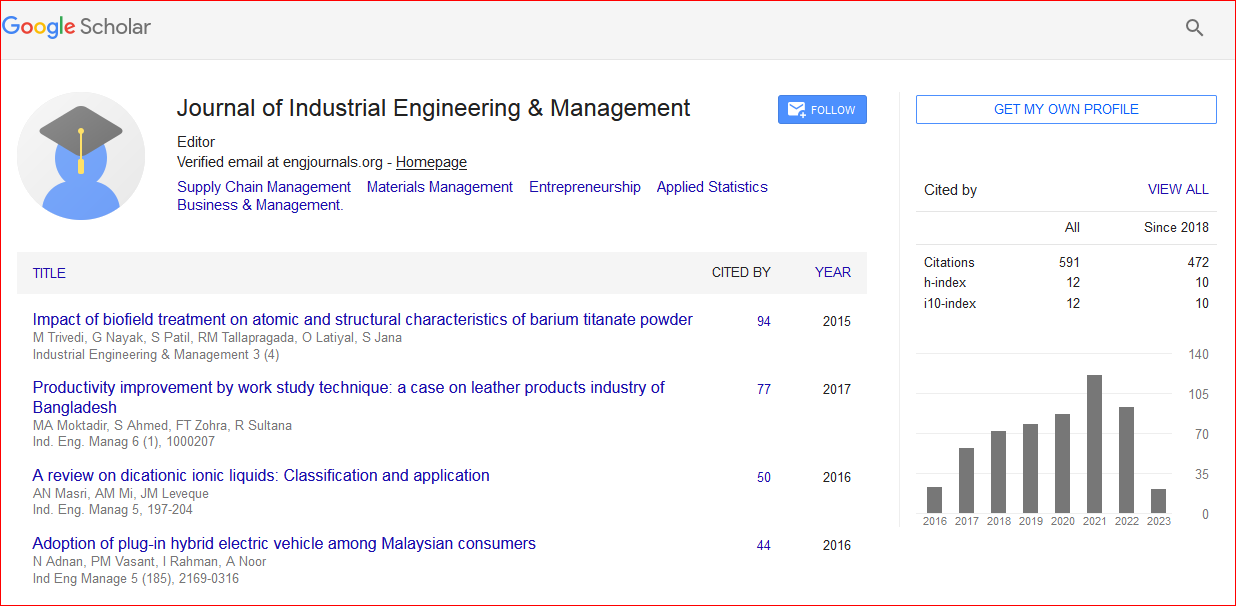
Industrial Engineering & Management received 739 citations as per Google Scholar report