Commentary - (2025) Volume 14, Issue 5
Received: 01-Sep-2025, Manuscript No. iem-26-179827;
Editor assigned: 03-Sep-2025, Pre QC No. P-179827;
Reviewed: 14-Sep-2025, QC No. Q-179827;
Revised: 22-Sep-2025, Manuscript No. R-179827;
Published:
29-Sep-2025
, DOI: 10.37421/2169- 0316.2025.14.320
Citation: Petrova, Elena. Digital Supply Chains: Resilience, Efficiency, and Sustainability. J Ind Eng Manag 14 (2025):320.
Copyright: © 2025 Petrova E. This is an open-access article distributed under the terms of the Creative Commons Attribution License, which permits unrestricted use, distribution and reproduction in any medium, provided the original author and source are credited.
The landscape of modern supply chains is undergoing a profound transformation, driven by the increasing adoption of digital technologies and agile methodologies aimed at enhancing both resilience and efficiency. These advancements encompass sophisticated forecasting techniques, real-time visibility facilitated by the Internet of Things (IoT), and the integration of Artificial Intelligence (AI) for predictive analytics and automated decision-making. Collaboration across the entire extended supply chain, including crucial partnerships with suppliers and customers, is paramount for optimizing inventory levels, significantly reducing lead times, and effectively mitigating potential disruptions. Furthermore, sustainability considerations are rapidly becoming an integral component of supply chain strategy, actively driving the adoption of circular economy principles and the implementation of eco-friendly logistics solutions across global operations [1].
Industrial engineers are identified as central figures in the design and implementation of robust supply chain strategies that are vital for organizational success. Their expertise is applied to optimizing network design, improving the efficiency of logistics operations, and effectively managing inherent risks within the supply chain. The application of advanced analytical tools, simulation modeling, and lean management principles is deemed essential for fostering continuous improvement and securing a competitive advantage in the dynamic and often volatile global marketplace that characterizes contemporary business environments [2].
The integration of Industry 4.0 technologies, which prominently include the Internet of Things (IoT), artificial intelligence (AI), and big data analytics, is fundamentally reshaping the paradigms of supply chain management. These cutting-edge technologies empower supply chains with real-time monitoring capabilities, facilitate predictive maintenance of critical assets, and enable optimized resource allocation. The cumulative effect of these technological integrations is the creation of supply chains that are markedly more agile, responsive, and capable of adapting to evolving market demands and unexpected operational challenges [3].
In contemporary business discourse, sustainability within supply chains has transcended its status as a niche concern to become a strategic imperative that demands immediate attention and dedicated resources. Industrial engineers are playing a pivotal role in the development and practical implementation of sustainable practices. This includes concerted efforts to reduce carbon emissions, optimize waste management processes, and champion ethical sourcing initiatives, thereby contributing significantly to both environmental protection and long-term economic viability for businesses [4].
The recent advent of blockchain technology presents unprecedented opportunities for enhancing transparency, bolstering security, and improving traceability throughout complex supply chains. The application of blockchain can lead to the streamlining of transactions, a significant reduction in fraudulent activities, and an overall improvement in trust among diverse supply chain partners. These benefits collectively contribute to more efficient, reliable, and secure supply chain operations that can withstand scrutiny and foster stronger business relationships [5].
Advanced analytical techniques, with a particular emphasis on Artificial Intelligence (AI) and machine learning algorithms, are currently revolutionizing critical aspects of supply chain management such as demand forecasting and inventory optimization. These sophisticated tools empower businesses to predict future demand with a considerably higher degree of accuracy, thereby minimizing instances of stockouts and preventing costly overstocking. This leads to more informed and strategic decisions regarding procurement, production planning, and resource deployment [6].
Supply chain risk management has emerged as a field of considerable prominence and strategic importance in recent years, reflecting the increasing complexity and interconnectedness of global supply networks. Industrial engineers are instrumental in the proactive identification of potential risks, accurate assessment of their potential impact on operations, and the development of comprehensive mitigation strategies. This involves the critical task of building agile and resilient supply chain networks that are robustly capable of withstanding a wide array of disruptions, ranging from geopolitical instability to severe natural disasters [7].
The widespread implementation of Internet of Things (IoT) devices is fundamentally enabling real-time tracking and continuous monitoring of goods as they move through various stages of the supply chain. This enhanced capability significantly improves overall visibility, leads to more effective inventory management practices, and allows for proactive and timely responses to potential operational issues. Examples include addressing deviations in temperature-sensitive cargo or identifying and responding to logistical delays before they escalate [8].
Agile supply chain principles are recognized as being absolutely crucial for enabling organizations to effectively adapt to rapidly fluctuating market demands and navigate unforeseen disruptions that can impact operations. Adopting these principles involves the implementation of flexible manufacturing systems, the development of highly responsive logistics networks, and the cultivation of close, collaborative relationships with both suppliers and customers. The ultimate goal is to ensure rapid order fulfillment and to consistently minimize lead times, thereby enhancing customer satisfaction and operational efficiency [9].
The circular economy model represents a significant paradigm shift in supply chain thinking, placing a strong emphasis on resource efficiency, comprehensive waste reduction strategies, and the extension of product longevity. Industrial engineers are positioned as key stakeholders in the redesign of supply chains to effectively accommodate processes such as remanufacturing, recycling, and reuse. This integrated approach aims to create a supply chain system that is not only more sustainable but also demonstrably more economically viable in the long term, contributing to a more responsible use of global resources [10].
The modern supply chain is increasingly characterized by the pervasive integration of digital technologies and the adoption of agile methodologies. These innovations are specifically designed to bolster resilience against disruptions and enhance overall operational efficiency. Key components of this digital transformation include sophisticated demand forecasting systems, real-time visibility provided by the Internet of Things (IoT) sensors, and the strategic application of Artificial Intelligence (AI) for advanced predictive analytics and automated decision-making processes. Crucially, fostering strong collaboration across the entire extended supply chain, from raw material suppliers to end consumers, is essential for effective inventory management, reducing lead times, and proactively mitigating potential disruptions. Furthermore, the growing imperative of sustainability is now a core consideration, driving the adoption of circular economy principles and the implementation of environmentally conscious logistics solutions [1].
Industrial engineers are recognized as pivotal professionals in the strategic design and practical implementation of robust supply chain strategies. Their responsibilities span the optimization of supply chain network configurations, the enhancement of logistics operations, and the comprehensive management of associated risks. The effective application of advanced analytical techniques, simulation modeling for scenario planning, and the principles of lean management are all indispensable for driving continuous improvement initiatives and for maintaining a significant competitive edge within the volatile and unpredictable global market landscape [2].
The contemporary supply chain environment is witnessing a significant reshaping due to the integration of Industry 4.0 technologies. These include the widespread deployment of the Internet of Things (IoT) for data collection, the application of artificial intelligence (AI) for intelligent automation and decision support, and the utilization of big data analytics for deriving actionable insights. These interconnected technologies collectively empower supply chains with enhanced real-time monitoring capabilities, facilitate proactive predictive maintenance, and enable more precise and efficient resource allocation, ultimately leading to supply chains that are inherently more agile and responsive to market dynamics [3].
Sustainability considerations have evolved from a peripheral concern to a fundamental strategic imperative within the realm of supply chain management. Industrial engineers are at the forefront of developing and implementing sustainable practices, which encompass a broad range of activities. These include dedicated efforts to reduce carbon emissions throughout the supply chain, optimizing waste management protocols to minimize environmental impact, and ensuring the promotion of ethical sourcing of materials and products. Such initiatives not only contribute to environmental protection but also bolster the long-term economic viability of businesses [4].
The emergence and increasing adoption of blockchain technology present transformative opportunities for significantly enhancing transparency, fortifying security measures, and improving the traceability of goods and transactions within supply chains. The application of blockchain technology can lead to a more streamlined and efficient processing of transactions, a marked reduction in instances of fraud, and an overall strengthening of trust among all participating supply chain partners. These advancements contribute to the establishment of more efficient, reliable, and secure operational frameworks [5].
Advanced analytical methodologies, particularly those leveraging Artificial Intelligence (AI) and machine learning, are fundamentally revolutionizing key supply chain functions such as demand forecasting and inventory optimization. These sophisticated tools enable organizations to predict consumer demand with significantly greater accuracy, which in turn helps to minimize both stockouts and the costs associated with overstocking. This leads to more informed and strategic decision-making concerning procurement, production scheduling, and overall resource deployment across the supply chain [6].
Supply chain risk management has become a critically important area of focus, given the inherent complexities and potential vulnerabilities of globalized networks. Industrial engineers are tasked with the crucial role of identifying potential risks, meticulously assessing their potential impact on supply chain operations, and formulating effective mitigation strategies. This process is vital for developing agile and resilient supply chain networks that are better equipped to withstand a wide spectrum of potential disruptions, ranging from geopolitical events to natural disasters [7].
The practical implementation of Internet of Things (IoT) devices is a key enabler of real-time tracking and continuous monitoring of products as they traverse the supply chain. This technological advancement significantly enhances supply chain visibility, improves the accuracy and efficiency of inventory management, and allows for prompt and proactive responses to emergent operational issues, such as maintaining optimal temperature conditions for perishable goods or addressing unexpected logistical delays [8].
Agile supply chain principles are paramount for organizations seeking to effectively adapt to the dynamic nature of market demands and to navigate unexpected disruptions that can impact operations. The adoption of agility involves developing flexible manufacturing processes, establishing responsive logistics systems, and fostering close collaborative relationships with both upstream suppliers and downstream customers. The primary objective is to ensure the rapid fulfillment of orders and to consistently minimize lead times, thereby enhancing customer satisfaction and competitive positioning [9].
The circular economy model offers a fundamentally different approach to supply chain management, prioritizing resource efficiency, minimizing waste generation, and maximizing product longevity through innovative design and operational strategies. Industrial engineers are instrumental in redesigning supply chain processes to effectively support activities such as remanufacturing, recycling, and product reuse. This holistic approach aims to foster a more sustainable and economically viable supply chain system that contributes to a circular flow of resources [10].
Modern supply chains are increasingly embracing digital technologies like IoT and AI to boost resilience and efficiency through advanced forecasting, real-time visibility, and predictive analytics. Collaboration across the supply chain is vital for optimizing inventory and reducing lead times, while sustainability principles are becoming integral. Industrial engineers play a key role in designing robust strategies, optimizing networks, and managing risks using advanced analytics and lean principles. Industry 4.0 technologies are transforming SCM with real-time monitoring and optimized resource allocation. Sustainability is a strategic imperative, with industrial engineers driving practices for carbon reduction and waste management. Blockchain technology enhances transparency, security, and traceability, streamlining operations and reducing fraud. AI and machine learning are revolutionizing demand forecasting and inventory management. Supply chain risk management is crucial, with industrial engineers developing mitigation strategies for agile and resilient networks. IoT devices provide real-time tracking for enhanced visibility and inventory management. Agile principles are essential for adapting to market changes and disruptions through flexible manufacturing and responsive logistics. The circular economy model focuses on resource efficiency and waste reduction, with industrial engineers redesigning supply chains for remanufacturing and recycling.
None
None
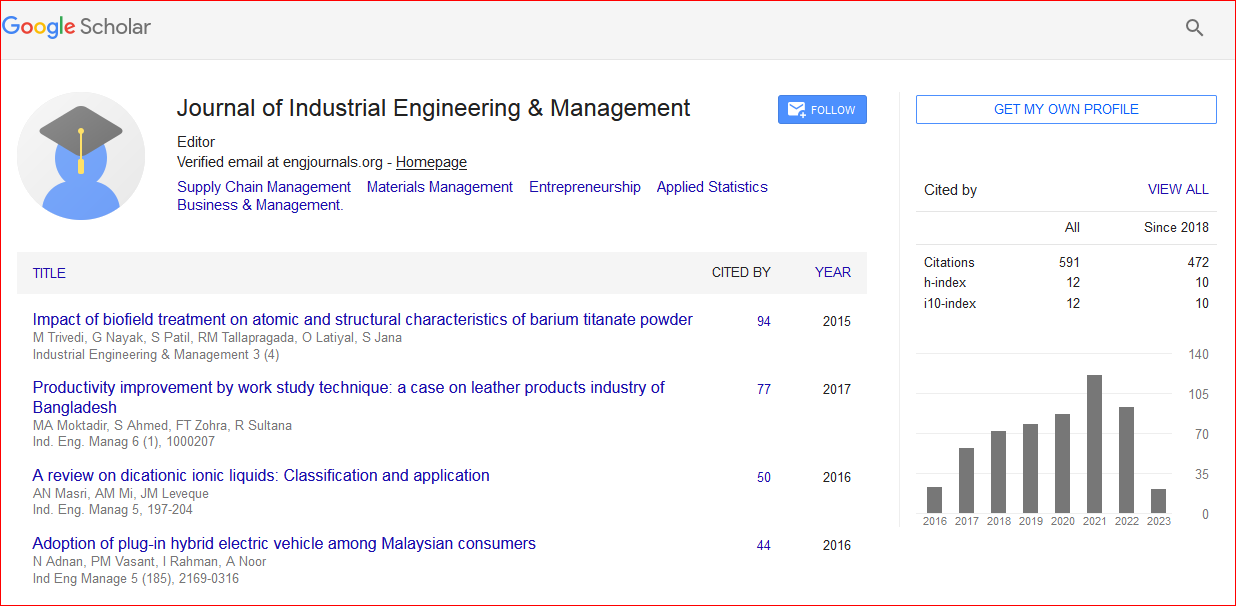
Industrial Engineering & Management received 739 citations as per Google Scholar report