Commentary - (2025) Volume 11, Issue 4
Received: 01-Jul-2025, Manuscript No. ohcr-25-174281;
Editor assigned: 03-Jul-2025, Pre QC No. P-174281;
Reviewed: 17-Jul-2025, QC No. Q-174281;
Revised: 22-Jul-2025, Manuscript No. R-174281;
Published:
29-Jul-2025
, DOI: 10.37421/2471-8726.2025.11.201
Citation: Patel, Jonathan. ”Digital Prosthodontics: Advancements, Outcomes, Patient Care.” Oral Health Case Rep 11 (2025):201.
Copyright: © 2025 Patel J. This is an open-access article distributed under the terms of the Creative Commons Attribution License, which permits unrestricted use, distribution and reproduction in any medium, provided the original author and source are credited.
The digital transformation in dentistry is profoundly impacting prosthodontic practices. A key area is the management of complete edentulism, where systematic reviews delve into the evolving digital workflows. These studies elucidate how advanced digital technologies, such as intraoral scanning and Computer-Aided Design/Computer-Aided Manufacturing (CAD/CAM) fabrication, are revolutionizing the creation of complete dentures. The promise here is streamlined processes, leading to potentially enhanced accuracy and greater patient satisfaction when compared to traditional, more labor-intensive methods. These investigations offer a thorough examination of the various procedural steps and the underlying evidence supporting their clinical application [1].
Continuing with the theme of digital integration, another significant area of inquiry involves the comparison between digital and conventional impression techniques, particularly for single-tooth implant-supported crowns. Systematic reviews and meta-analyses consistently indicate that digital impressions provide accuracy that is either comparable to or, in many cases, superior to conventional methods. Moreover, patients often experience greater comfort, and there is a potential for reduced chair time, underscoring the increasingly vital role of digital solutions in contemporary implant prosthodontics treatment [2].
Beyond technological advancements, understanding the long-term prognosis of prosthodontic interventions is paramount for clinicians and patients alike. Comprehensive systematic reviews and meta-analyses offer crucial insights into the survival and complication rates associated with various fixed prosthodontic options. This includes treatments such as single crowns, fixed partial dentures, and implant-supported prostheses. These studies, often based on mean observation periods of at least five years, are invaluable for establishing the long-term predictability and identifying potential issues, thereby informing clinical treatment planning and managing patient expectations effectively [3].
In the realm of removable prosthodontics, the success and longevity of removable partial dentures (RPDs) are critical for patient function and comfort. Systematic reviews meticulously evaluate the survival and success rates of RPDs, specifically focusing on the impact of different retainer types. Such investigations provide essential guidance for clinicians in selecting appropriate retainer designs, emphasizing specific factors that contribute positively to the long-term functional performance and durability of RPDs. Ultimately, this evidence supports more informed and predictable treatment decisions [4].
Patient perception and satisfaction are fundamental metrics for evaluating the overall success of prosthodontic rehabilitation. A systematic review and meta-analysis dedicated to this topic explores patient satisfaction across a wide range of prosthodontic modalities. This research identifies and emphasizes key factors that profoundly influence how patients perceive their treatment outcomes. These factors typically include aesthetics, functional capability, overall comfort, and the quality of communication with their prosthodontist, thereby offering vital insights for improving patient-centered care and treatment approaches [5].
The precision of digital technology extends to complex full-arch rehabilitations. Systematic reviews have specifically addressed the accuracy of digital impressions for complete-arch implant-supported prostheses. This body of research sheds light on the significant advancements made in intraoral scanning technologies, while also acknowledging their current limitations in accurately capturing precise data for such intricate implant cases. The ability to achieve high precision is fundamentally crucial for ensuring the optimal fit and long-term success of full-arch rehabilitations, directly influencing clinical outcomes [6].
Material science plays a pivotal role in the durability and aesthetic appeal of dental restorations. A systematic review and meta-analysis thoroughly assesses the clinical performance of various ceramic materials when utilized for posterior fixed dental prostheses. This research offers an evidence-based comparative analysis of their respective survival rates, fracture resistance capabilities, and aesthetic outcomes. Such detailed comparisons are invaluable, providing prosthodontists with the necessary guidance to select the most suitable material for a diverse array of clinical scenarios [7].
The precision and fit of restorations are critical for their longevity and the prevention of secondary complications. Systematic reviews and meta-analyses specifically evaluate the marginal and internal fit of monolithic zirconia crowns fabricated using chairside Computer-Aided Design/Computer-Aided Manufacturing (CAD/CAM) systems. These findings are of immense importance for comprehending the inherent precision achievable with digital fabrication methods in prosthodontics. A superior fit directly contributes to the long-term success of restorations by effectively minimizing issues like cement washout and the incidence of secondary caries, reinforcing the value of digital precision [8].
Addressing the needs of specific patient demographics, particularly the elderly, is a vital aspect of prosthodontic care. A systematic review focuses on the oral health-related quality of life (OHRQoL) and overall patient satisfaction following prosthodontic rehabilitation in this demographic. This review underscores the critical importance of considering geriatric-specific needs and expectations. It highlights how successful and well-adapted prosthodontic interventions can profoundly improve the quality of life for older adults, emphasizing a holistic approach to their dental care [9].
Finally, advancements in treatment protocols are continually being assessed for efficacy and predictability. A systematic review and meta-analysis examines the clinical outcomes of full-arch implant-supported fixed prostheses that utilize immediate loading protocols. This research rigorously evaluates both the success rates and potential complications associated with this accelerated approach to prosthodontic rehabilitation for edentulous arches. It provides crucial evidence-based insights into the predictability and overall effectiveness of immediate loading, guiding clinicians in its appropriate application [10].
Modern prosthodontics is increasingly defined by the integration of digital technologies. Digital workflows for managing complete edentulism, encompassing intraoral scanning and CAD/CAM fabrication, are actively explored for their capacity to streamline processes and potentially enhance accuracy and patient satisfaction compared to traditional techniques [1]. Furthermore, a direct comparison of digital versus conventional impression techniques for single-tooth implant-supported crowns reveals that digital methods offer comparable or even superior accuracy and patient comfort, often reducing chair time and reinforcing their growing significance in modern implant prosthodontics [2]. For more complex cases, such as complete-arch implant-supported prostheses, the accuracy of digital impressions is critically examined, highlighting both the advancements and existing limitations of intraoral scanners in capturing the precise data essential for the fit and longevity of these extensive rehabilitations [6]. The precision achievable with digital fabrication extends to specific restorations; the marginal and internal fit of monolithic zirconia crowns produced by chairside CAD/CAM systems has been evaluated, underscoring the direct impact of digital precision on restoration longevity and success by minimizing issues like cement washout and secondary caries [8].
Long-term predictability and clinical outcomes are paramount in evaluating prosthodontic treatments. Systematic reviews provide insights into the survival and complication rates of various fixed prosthodontic options, including single crowns, fixed partial dentures, and implant-supported prostheses, typically over observation periods of at least five years. These analyses are crucial for clinicians to understand the long-term performance and potential issues, thereby informing treatment planning and setting realistic patient expectations [3]. Similarly, for removable prostheses, the survival and success rates of removable partial dentures (RPDs) with different types of retainers have been meticulously evaluated. This research offers valuable insights for clinicians when selecting retainer designs, emphasizing factors that contribute to the RPDs' longevity and functional performance, which ultimately aids in more informed treatment decisions [4]. In the context of full-arch rehabilitations, the clinical outcomes of full-arch implant-supported fixed prostheses, particularly those employing immediate loading protocols, have been investigated. This work assesses success rates and potential complications, providing evidence-based insights into the predictability and efficacy of this accelerated approach for edentulous arches [10].
Material science and fabrication precision are fundamental to prosthodontic success. The clinical performance of various ceramic materials used for posterior fixed dental prostheses has been assessed through systematic reviews and meta-analyses. These studies offer an evidence-based comparison of their survival rates, fracture resistance, and aesthetic outcomes, which helps prosthodontists select the most appropriate material for diverse clinical situations [7]. Furthermore, as highlighted previously, the evaluation of the marginal and internal fit of monolithic zirconia crowns fabricated using chairside CAD/CAM systems underscores the critical importance of precision in digital fabrication, directly influencing the longevity and success of restorations by mitigating risks such as cement washout and secondary caries [8].
Crucially, the ultimate success of prosthodontic rehabilitation is often measured by patient experience. Patient satisfaction with prosthodontic rehabilitation, across various modalities, has been a subject of systematic review and meta-analysis. This research identifies key factors that shape patient perceptions of treatment outcomes, including aesthetics, function, comfort, and the quality of communication with the prosthodontist, providing crucial insights for improving patient-centered care [5]. Special consideration is given to specific patient groups; for instance, a systematic review focuses on oral health-related quality of life (OHRQoL) and patient satisfaction following prosthodontic rehabilitation in elderly patients. This work emphasizes the significance of accounting for geriatric-specific needs and expectations, illustrating how successful prosthodontic interventions can markedly enhance the quality of life for older adults, advocating for tailored and empathetic care [9].
Recent advancements in prosthodontics are significantly influenced by digital technologies, which streamline workflows from intraoral scanning to CAD/CAM fabrication for complete edentulism, potentially enhancing accuracy and patient satisfaction [1]. Digital impression techniques offer comparable or superior accuracy and comfort for single-tooth implant-supported crowns [2] and show promise for complete-arch implant prostheses [6]. Understanding the long-term predictability of various prosthodontic options is crucial. Studies detail survival and complication rates for single crowns, fixed partial dentures, and implant-supported prostheses over extended periods [3], along with the longevity of removable partial dentures with different retainers [4]. Material selection is a key area of research, with investigations into the clinical performance of ceramic materials for posterior fixed dental prostheses [7]. Precision in fabrication is critical, as evidenced by evaluations of the marginal and internal fit of monolithic zirconia crowns made using chairside CAD/CAM systems, directly impacting restoration success and longevity [8]. Patient-centered care remains a central focus, with research exploring overall patient satisfaction across various rehabilitation modalities [5], and specifically for elderly patients, the impact on oral health-related quality of life and satisfaction [9]. Clinical outcomes of full-arch implant-supported fixed prostheses with immediate loading protocols are also being assessed to provide evidence-based insights into this accelerated approach [10]. This collective body of work underscores ongoing efforts to improve prosthodontic treatments through technological advancements, material science, and a deep understanding of patient outcomes and long-term performance.
None
None
1. Abdullah A, Sultan MA, Abdullah A. "Digital workflow for complete edentulism: A systematic review.".Saudi Dent J 35 (2023):162-172.
Indexed at, Google Scholar, Crossref
2. Hanan MA, Mashael MA, Nora MA. "Digital versus conventional impression techniques for single-tooth implant-supported crowns: A systematic review and meta-analysis.".Saudi Dent J 34 (2022):665-673.
Indexed at, Google Scholar, Crossref
3. Matthias K, Michael S, Andreas S. "Survival and complication rates of single crowns, fixed partial dentures, and implant-supported fixed dental prostheses after a mean observation period of at least 5 years-A systematic review and meta-analysis.".J Dent 108 (2021):103632.
Indexed at, Google Scholar, Crossref
4. Jawad HA, Palanisamy S, Mustafa HA. "Survival and success of removable partial dentures with different retainers: A systematic review.".J Prosthodont 29 (2020):645-653.
Indexed at, Google Scholar, Crossref
5. Khaled A, Adel A, Thikriat A. "Patient satisfaction with prosthodontic rehabilitation: a systematic review and meta-analysis.".J Contemp Dent Pract 24 (2023):199-209.
Indexed at, Google Scholar, Crossref
6. Panos P, Konstantinos B, Agapi T. "Accuracy of digital impressions for complete-arch implant-supported prostheses: a systematic review.".Clin Oral Implants Res 32 (2021):160-178.
Indexed at, Google Scholar, Crossref
7. Abdulaziz AA, Mohamad A, Abdullah AA. "Clinical performance of ceramic materials for posterior fixed dental prostheses: A systematic review and meta-analysis.".J Prosthodont 31 (2022):883-894.
Indexed at, Google Scholar, Crossref
8. Rawan MA, Nawal A, Bashaer A. "Evaluation of the marginal and internal fit of monolithic zirconia crowns fabricated using chairside CAD/CAM system: A systematic review and meta-analysis.".Saudi Dent J 32 (2020):471-477.
Indexed at, Google Scholar, Crossref
9. Eman MA, Khaled A, Bashayer A. "Oral health-related quality of life and satisfaction with prosthodontic rehabilitation in elderly patients: A systematic review.".J Clin Exp Dent 11 (2019):e549-e557.
Indexed at, Google Scholar, Crossref
10. Saied AA, Abdulaziz A, Sulaiman A. "Clinical outcomes of full-arch implant-supported fixed prostheses with immediate loading: a systematic review and meta-analysis.".Clin Implant Dent Relat Res 25 (2023):477-490.
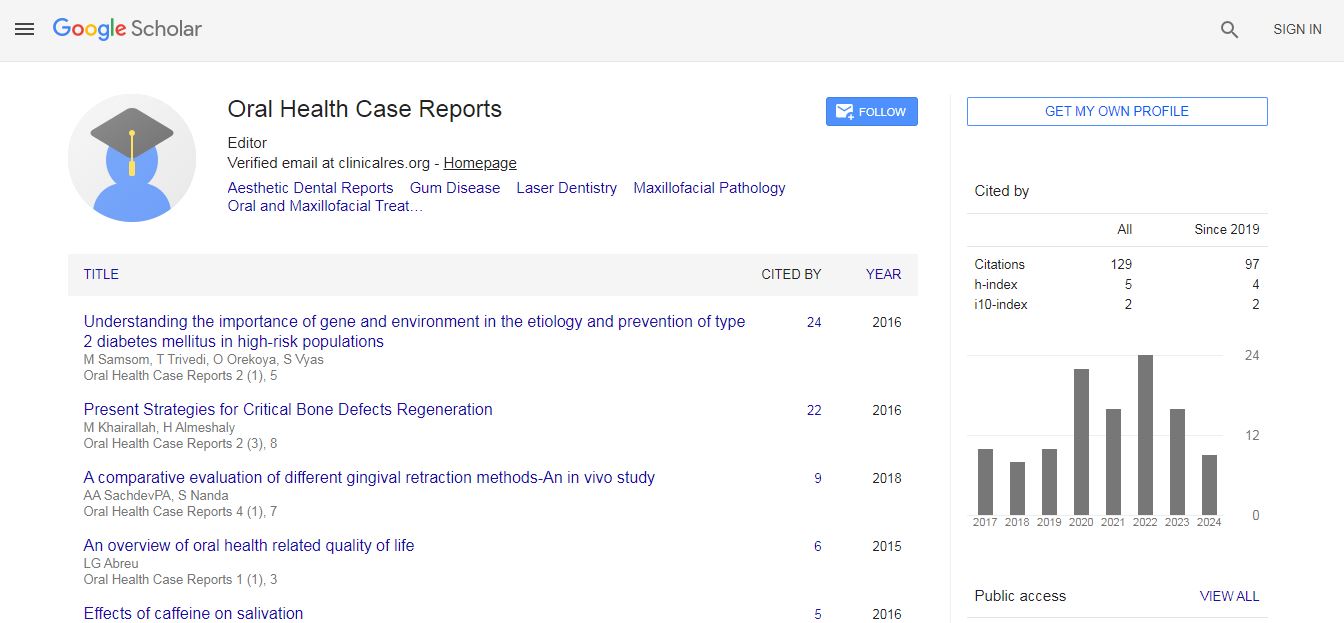
Oral Health Case Reports received 120 citations as per Google Scholar report