Perspective - (2025) Volume 14, Issue 4
Received: 01-Aug-2025, Manuscript No. jbfa-25-176814;
Editor assigned: 04-Aug-2025, Pre QC No. P-176814;
Reviewed: 18-Aug-2025, QC No. Q-176814;
Revised: 22-Aug-2025, Manuscript No. R-176814;
Published:
29-Aug-2025
, DOI: 10.37421/2167-0234.2025.14.546
Citation: Tremblay, Nicole. ”Digital Banking Transformation: Tech, Trust, Challenges.” J Bus Fin Aff 14 (2025):546.
Copyright: © 2025 Tremblay N. This is an open-access article distributed under the terms of the Creative Commons Attribution License, which permits unrestricted use, distribution and reproduction in any medium, provided the original author and source are credited.
Digital banking services are increasingly central to modern financial interactions, with studies highlighting their profound influence on customer satisfaction and loyalty, particularly among the millennial demographic. Here's the thing: convenience, efficiency, and the provision of personalized experiences through digital platforms are crucial factors. To effectively capture and retain these customers, banks must prioritize the development of intuitive user interfaces and ensure reliable service delivery within their digital offerings[1].
However, this digital evolution brings with it a spectrum of cybersecurity risks that demand constant vigilance. Threats like sophisticated data breaches, pervasive phishing scams, and malicious malware attacks are ever-present. What this really means is that robust security frameworks, continuous threat intelligence gathering, and comprehensive user education are absolutely critical to safeguard sensitive financial data and uphold the essential trust customers place in the evolving digital landscape[2].
Artificial Intelligence (AI) and Machine Learning (ML) are actively transforming various facets of digital banking. These advanced technologies are not only enhancing the precision of fraud detection mechanisms but also revolutionizing customer services through deep personalization and optimizing overall operational efficiencies within financial institutions. While the opportunities presented by AI and ML are immense, their implementation introduces significant challenges, including paramount concerns around data privacy, the imperative for ethical application, and the complexities of seamless integration into existing systems[3].
Blockchain technology represents another frontier in digital banking, promising to fundamentally reshape how transactions, settlements, and identity management are handled. Its inherent capabilities can significantly enhance security protocols, increase transparency across financial operations, and boost overall efficiency. Yet, widespread adoption faces considerable hurdles, notably navigating complex regulatory concerns and addressing critical scalability issues that impact its practical implementation across a broad user base[4].
The concept of sustainable digital banking is also gaining traction, with a focus on integrating Environmental, Social, and Governance (ESG) principles into core digital transformation strategies. This comprehensive framework emphasizes the strategic deployment of green technologies, the adoption of responsible data practices, and the development of inclusive digital services as foundational pillars for achieving long-term sustainability within the banking sector[5].
Open banking, a key area of innovation, is experiencing varied rates of adoption, largely influenced by the customer's perspective. Our understanding indicates that perceived benefits, a strong sense of trust in data sharing mechanisms, and the overall ease of use are crucial determinants. These insights are incredibly valuable for banks and FinTech companies looking to strategically expand and optimize their open banking services to meet evolving consumer demands[6].
Enhancing customer engagement in the digital banking sphere is directly linked to effective personalization strategies. This involves creating tailored product recommendations that resonate with individual needs, deploying customized communication channels, and developing adaptive user interfaces that intuitively respond to user behavior. Such personalized approaches foster more meaningful interactions, ultimately leading to higher customer satisfaction and strengthened loyalty[7].
In a world where Artificial Intelligence is increasingly prevalent and data processing volumes are soaring, building and maintaining customer trust in digital banking is paramount. This emphasizes the critical role of adhering to ethical AI principles and implementing robust data privacy measures. These foundations are essential not just for fostering customer confidence but also for ensuring responsible innovation and growth within the dynamic financial sector[8].
For developing countries, understanding the factors influencing mobile banking adoption is vital for advancing financial inclusion. Key drivers include the perceived usefulness of mobile banking services, their ease of use, the impact of social influence, and the fundamental element of trust. It is equally important to acknowledge and address the unique infrastructure challenges prevalent in these regions to facilitate broader adoption[9].
Finally, Regulatory Technology, or RegTech, is emerging as an indispensable tool in digital banking, designed to streamline complex compliance and risk management processes. These sophisticated RegTech solutions harness automation and Artificial Intelligence to empower banks in meeting stringent regulatory requirements, significantly reduce operational costs, and proactively manage the array of emerging financial risks characteristic of the digital era[10].
Digital banking continually reshapes financial services, heavily influenced by customer needs and technological advancements. A significant aspect is its direct impact on customer satisfaction, especially among millennials, who highly value convenience, efficiency, and personalized experiences. Banks are recognizing that to cultivate strong customer loyalty, they must invest in intuitive digital interfaces and ensure consistent, reliable service delivery in their online platforms[1].
Beyond general satisfaction, the adoption of specialized digital services presents unique dynamics. For instance, open banking adoption, from a customerâ??s viewpoint, critically hinges on perceived benefits, trust in sharing their data, and the sheer ease of using these new services. Understanding these determinants offers crucial guidance for financial institutions and FinTechs aiming to broaden their open banking offerings[6]. Similarly, in developing countries, the adoption of mobile banking is propelled by factors such as its perceived usefulness, user-friendliness, the influence of social norms, and the foundational element of trust. This also involves grappling with unique infrastructure challenges to foster greater financial inclusion across these regions[9].
The integration of advanced technologies like Artificial Intelligence (AI) and Machine Learning (ML) stands at the forefront of this transformation. These technologies are powerful tools for enhancing fraud detection systems, delivering personalized customer services, and optimizing operational efficiencies within banking[3]. Personalization strategies, in particular, are proving crucial for boosting customer engagement in digital banking. This involves creating tailored product recommendations that resonate with individual needs, deploying customized communications, and developing adaptive user interfaces that intuitively respond to user behavior. Such personalized approaches foster more meaningful interactions, ultimately driving higher satisfaction and strengthened loyalty[7]. However, this move towards AI-driven services and increased data processing raises critical questions about trust. Building and maintaining customer confidence is paramount, necessitating adherence to ethical AI principles and the implementation of robust data privacy measures to ensure responsible innovation within the financial sector[8].
Digital banking, while offering immense opportunities, also faces substantial challenges, particularly concerning cybersecurity. A systematic review reveals diverse risks such as data breaches, sophisticated phishing attacks, and malicious malware, which underscore the urgent need for strong security frameworks, continuous threat intelligence, and thorough user education. These measures are vital for safeguarding financial data and preserving customer confidence in digital platforms[2]. Another innovative technology, blockchain, is also being explored for its potential to fundamentally enhance security, transparency, and efficiency in banking transactions, settlements, and identity management. Despite its promising capabilities, widespread adoption is currently slowed by complex regulatory concerns and persistent scalability issues[4].
To ensure the long-term viability and positive societal impact of digital banking, a framework for sustainable practices is essential. This involves integrating Environmental, Social, and Governance (ESG) principles directly into digital transformation strategies. The focus here is on utilizing green technologies, promoting responsible data practices, and developing inclusive digital services, all contributing significantly to overall sustainability[5]. Furthermore, navigating the complex landscape of regulatory compliance in this digital environment is being revolutionized by RegTech, or regulatory technology. RegTech solutions employ automation and AI to help banks meet intricate regulatory requirements, reduce operational costs, and proactively manage the array of emerging financial risks inherent in the digital era[10].
Digital banking is undergoing significant transformation, driven by technological innovations and evolving customer expectations. Studies show that convenience, efficiency, and personalized experiences are key to boosting customer satisfaction and loyalty, particularly among millennials, necessitating intuitive user interfaces and reliable service delivery. Advancements like Artificial Intelligence (AI) and Machine Learning (ML) enhance fraud detection, personalize services, and optimize operations, though they bring challenges related to data privacy and ethical implementation. Blockchain technology offers potential for improved security, transparency, and efficiency in transactions and identity management, despite regulatory and scalability hurdles. The sector also grapples with critical cybersecurity risks, including data breaches and malware, underscoring the need for strong security frameworks and continuous threat intelligence. Building and maintaining customer trust is paramount, requiring ethical AI principles and robust data privacy measures. Sustainable digital banking integrates Environmental, Social, and Governance (ESG) principles through green technologies and responsible data practices. Furthermore, open banking adoption hinges on perceived customer benefits, trust in data sharing, and ease of use. Mobile banking adoption in developing countries is influenced by perceived usefulness, ease of use, social influence, and trust, while addressing infrastructure challenges. Regulatory technology (RegTech) plays an increasingly important role in streamlining compliance and risk management, leveraging automation and AI to manage complex financial risks in the digital era.
None
None
Indexed at, Google Scholar, Crossref
Indexed at, Google Scholar, Crossref
Indexed at, Google Scholar, Crossref
Indexed at, Google Scholar, Crossref
Indexed at, Google Scholar, Crossref
Indexed at, Google Scholar, Crossref
Indexed at, Google Scholar, Crossref
Indexed at, Google Scholar, Crossref
Indexed at, Google Scholar, Crossref
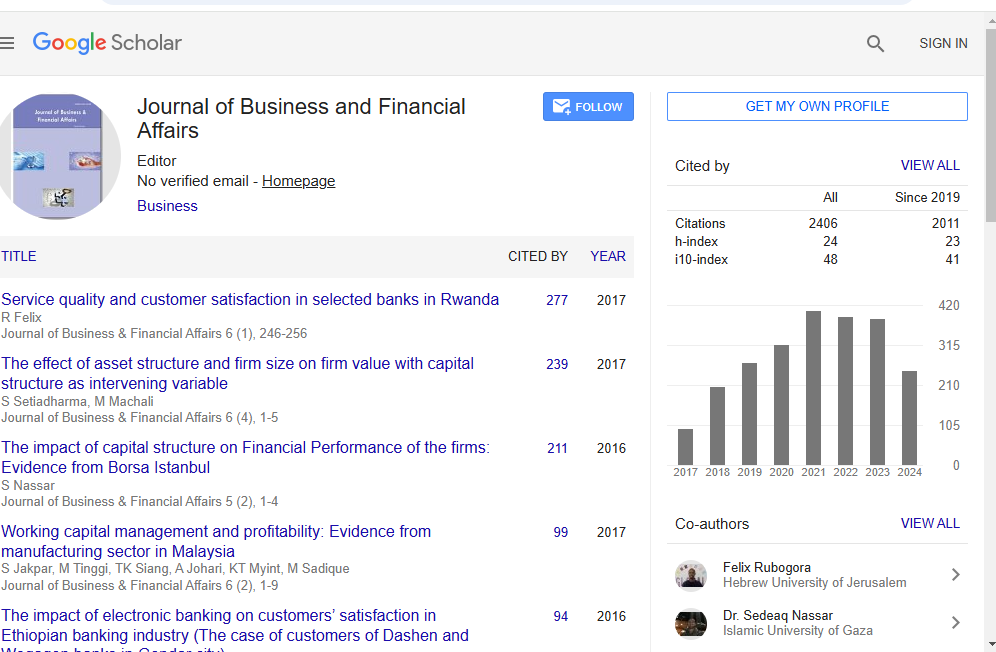
Journal of Business & Financial Affairs received 1726 citations as per Google Scholar report