Short Communication - (2025) Volume 14, Issue 4
Received: 01-Aug-2025, Manuscript No. jbfa-25-176815;
Editor assigned: 04-Aug-2025, Pre QC No. P-176815;
Reviewed: 18-Aug-2025, QC No. Q-176815;
Revised: 22-Aug-2025, Manuscript No. R-176815;
Published:
29-Aug-2025
, DOI: 10.37421/2167-0234.2025.14.547
Citation: Nunez, Pedro. "Digital Banking: Innovation, Trust, Adoption." J Bus Fin Aff 14 (2025):547.
Copyright: © 2025 Nunez P. This is an open-access article distributed under the terms of the Creative Commons Attribution License, which permits unrestricted use, distribution and reproduction in any medium, provided the original author and source are credited.
The landscape of banking is undergoing a profound transformation, driven by an accelerating pace of digital innovation that reshapes how financial services are delivered and consumed. At the heart of this evolution is the understanding that embracing digital technologies directly correlates with enhanced customer experiences. Digital transformation within the banking sector has been shown to significantly improve customer satisfaction and engagement, largely by facilitating personalized services and offering convenient digital channels that cater to modern consumer expectations [1].
This fundamental shift underscores the importance of delving into the specific factors that influence how consumers adopt these burgeoning FinTech services. Research highlights perceived usefulness, the ease with which these services can be navigated, and an inherent trust in the digital platforms as critical determinants in encouraging users to embrace modern financial solutions [2].
A pivotal concern in this digital pivot, particularly for regions with evolving digital infrastructures, is the aspect of security. Studies demonstrate that a robust perception of security is not just beneficial, but absolutely crucial for building user trust and subsequently encouraging the widespread adoption of digital banking services in developing economies. Without this foundational trust, the benefits of digital convenience remain largely untapped [3].
Moreover, the integration of advanced technologies like Artificial Intelligence (AI) is actively propelling customer satisfaction to new heights. Applications of Artificial Intelligence (AI), such as intelligent chatbots for instant support and personalized recommendations tailored to individual financial needs, are significantly enhancing service efficiency and refining individual client experiences within digital banking [4].
These innovations are not mere luxuries but increasingly central to competitive differentiation. Looking deeper into foundational technological shifts, blockchain technology presents a transformative potential for the banking sector. A systematic review reveals its capacity to revolutionize traditional payment systems, substantially enhance security protocols, and streamline a variety of complex financial operations, thereby offering efficiencies and new possibilities for the industry [5].
Parallel to these technological advancements, strategic policy and industry initiatives like open banking are playing a significant role in fostering broader digital innovation. Open banking encourages unprecedented collaboration within the financial sector, actively driving the development of new products and services, and ultimately sharpening competitive landscapes by enabling secure and structured data sharing among financial entities [6].
For financial institutions navigating this complex environment, it is imperative to identify and understand the various factors that either facilitate or impede the adoption of digital banking services. Empirical studies point to perceived benefits, alongside a clear recognition of perceived risks, and the overall technological readiness of the user base as critical elements influencing the penetration of digital services [7].
The rapid evolution of digital banking also brings forth a dynamic and often challenging regulatory environment. The evolving regulatory landscape, while posing compliance hurdles, also presents considerable opportunities for fostering innovation, provided a secure and adaptable framework is in place. Proactive adjustments in regulation are deemed key for sustaining sector growth and ensuring consumer protection [8].
On the consumer side, understanding user intention remains paramount. An extended Technology Acceptance Model (TAM) applied to mobile payment and digital wallet services underscores that perceived ease of use, perceived usefulness, and trust are consistently significant drivers of adoption for these vital digital banking tools [9].
This comprehensive understanding of user acceptance is complemented by the recognition of broader societal factors. Hereâ??s the thing, digital literacy emerges as a critical enabler for financial inclusion, especially within developing economies. What this really means is that by enhancing digital skills among populations, the reach and impact of digital financial services can be maximized, ensuring equitable access to modern financial tools and fostering economic participation [10].
The collective insights from these studies underscore a multifaceted and rapidly evolving digital banking ecosystem, where technological innovation, consumer psychology, regulatory oversight, and societal preparedness converge to redefine financial services for the future.
The digital transformation journey in the banking sector is a complex interplay of technological adoption, consumer behavior, and evolving regulatory frameworks. A core theme across recent research centers on how digital shifts are re-shaping the customer experience and driving service innovation. For instance, the strategic adoption of digital technologies is shown to significantly enhance customer satisfaction and engagement through the provision of personalized services and convenient digital channels [1]. This move towards digital channels highlights a broader industry trend where financial institutions are leveraging technology to build stronger, more intimate relationships with their clientele. Parallel to this, the uptake of FinTech services within digital banking is heavily influenced by key psychological and practical factors. Consumers are more likely to embrace these modern financial solutions when they perceive them as useful, easy to use, and trustworthy [2]. This emphasis on usability and reliability is critical for the widespread integration of new financial tools into daily life.
Security remains a paramount concern, particularly in regions where digital infrastructure might still be developing. Perceived security directly impacts the adoption of digital banking services in emerging economies. Building a strong user trust through robust security measures is not just good practice, it is essential for the growth and acceptance of digital financial platforms [3]. This concern extends to the advanced technologies being integrated into banking. Artificial Intelligence (AI) applications, such as sophisticated chatbots and personalized recommendation engines, are playing an increasingly crucial role in boosting customer satisfaction within digital banking. These AI-powered tools not only improve service efficiency but also deliver highly individualized client experiences, demonstrating the practical benefits of advanced automation [4]. The foundational technologies enabling these transformations are also under scrutiny. Blockchain technology, for example, is identified as having significant potential across the banking sector. Reviews indicate its ability to revolutionize payment systems, substantially enhance security, and streamline various other financial operations, pointing to a future of more secure and efficient transactions [5].
Beyond individual technological adoptions, systemic changes like open banking are fostering broader industry innovation. Open banking initiatives promote greater collaboration among financial entities, which in turn drives the development of new products and services. By enabling secure data sharing, open banking reshapes competitive landscapes and encourages a more dynamic financial ecosystem [6]. For financial institutions aiming to deepen their digital service penetration, understanding the multifaceted factors affecting adoption is key. Empirical studies reveal that factors such as perceived benefits, the acknowledgment of perceived risks, and the overall technological readiness of consumers are crucial in influencing the embrace of digital banking [7]. This means banks need to articulate clear advantages, mitigate perceived dangers, and ensure their services are accessible to varying levels of digital proficiency.
The regulatory environment also plays a crucial role in shaping the digital banking landscape. Regulators face the challenge of creating frameworks that ensure compliance and stability while simultaneously fostering innovation. A proactive and adaptive regulatory approach is vital for supporting sector growth and ensuring a secure yet dynamic operational space for digital banking [8]. Complementing this, research into consumer psychology provides valuable insights into user behavior with specific digital tools. An extended Technology Acceptance Model (TAM) applied to mobile payment and digital wallet services consistently demonstrates that perceived ease of use, usefulness, and trust are significant drivers of user intention and adoption [9]. These findings reinforce the importance of intuitive design and reliable performance for digital financial products.
Finally, ensuring equitable access and maximizing the societal impact of digital banking initiatives requires addressing fundamental human capital needs. Digital literacy is a crucial enabler for promoting financial inclusion, particularly in developing economies. Efforts to enhance digital skills among the population are therefore paramount for truly realizing the full reach and positive effects of digital financial services [10]. What this really means is that the future of digital banking is not just about technology, but also about education and empowerment, ensuring that all segments of society can benefit from these advancements.
Digital transformation fundamentally reshapes the banking sector, enhancing customer satisfaction through personalized services and convenient digital channels [1]. The adoption of new financial technologies is primarily driven by perceived usefulness, ease of use, and trust [2]. A strong perception of security is also critical for building user confidence, especially in emerging markets, encouraging wider digital banking adoption [3]. Advanced technologies like Artificial Intelligence (AI) further boost customer satisfaction with tools such as chatbots and personalized recommendations, improving efficiency and individual client experiences [4]. Underpinning these shifts, blockchain technology holds significant potential to revolutionize payment systems and enhance overall security and operational efficiency within banking [5]. Open banking initiatives play a vital role in fostering digital innovation, promoting collaboration, and driving new product development through data sharing, thereby sharpening competitive landscapes [6]. For banks, understanding key adoption factorsâ??including perceived benefits, risks, and technological readinessâ??is crucial for increasing digital service penetration [7]. The evolving regulatory landscape presents both challenges for compliance and opportunities for innovation within a secure framework, necessitating proactive adjustments [8]. Consumer intention to use mobile payment and digital wallet services is consistently driven by perceived ease of use, usefulness, and trust, as highlighted by extended Technology Acceptance Model (TAM) studies [9]. Moreover, enhancing digital literacy is essential for promoting financial inclusion through digital banking in developing economies, maximizing the reach and impact of these services [10]. These insights collectively illustrate a dynamic digital banking ecosystem where technology, user perception, policy, and societal readiness converge to define the future of finance.
None
None
Indexed at, Google Scholar, Crossref
Indexed at, Google Scholar, Crossref
Indexed at, Google Scholar, Crossref
Indexed at, Google Scholar, Crossref
Indexed at, Google Scholar, Crossref
Indexed at, Google Scholar, Crossref
Indexed at, Google Scholar, Crossref
Indexed at, Google Scholar, Crossref
Indexed at, Google Scholar, Crossref
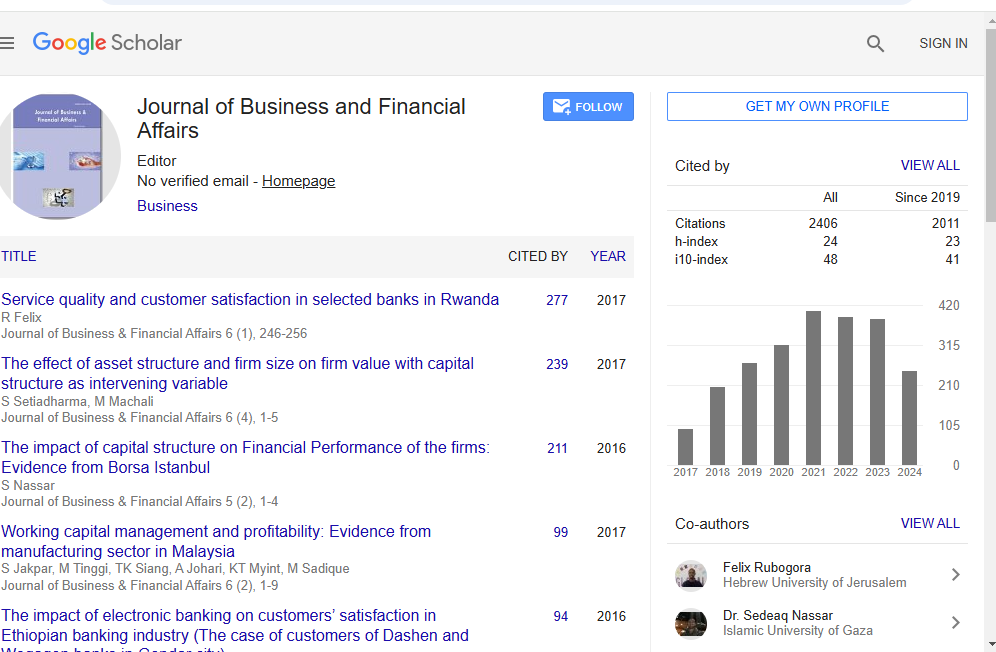
Journal of Business & Financial Affairs received 1726 citations as per Google Scholar report