Brief Report - (2025) Volume 18, Issue 6
Received: 28-Oct-2025, Manuscript No. jcsb-25-176476;
Editor assigned: 03-Nov-2025, Pre QC No. P-176476;
Reviewed: 11-Nov-2025, QC No. Q-176476;
Revised: 18-Nov-2025, Manuscript No. R-176476;
Published:
25-Nov-2025
, DOI: 10.37421/0974-7230.2025.18.619
Citation: Thompson, Noah. ”Deep Learning: Indispensable for Genomic Insights.” J Comput Sci Syst Biol 18 (2025):619.
Copyright: © 2025 Thompson N. This is an open-access article distributed under the terms of the Creative Commons Attribution License, which permits unrestricted use, distribution and reproduction in any medium, provided the original author and source are credited.
Deep learning models are profoundly transforming functional genomics, fundamentally changing how we approach biological research. These models significantly improve predictions of gene function and regulatory element activity, marking a substantial advance in the field. However, it is important to note that certain computational and experimental hurdles still need to be addressed to fully integrate these powerful methods into mainstream genomic research practices. Understanding these challenges is key to unlocking their full potential across various genomic applications[1].
Deep learning is a major driver in advancing genomic analysis, holding particular relevance for precision medicine initiatives. These sophisticated methods are incredibly important for effectively handling the complex, high-dimensional genomic data that modern research generates. They are instrumental in identifying crucial disease biomarkers, which in turn facilitates the personalization of treatment strategies for individual patients. This foundational work is actively laying the groundwork for numerous future clinical applications and personalized healthcare interventions[2].
Deep learning models are quickly becoming essential tools for making sense of the vast and often intricate genomic landscape. What this really means is, deep learning possesses immense power in accurately identifying disease-causing genetic variants and precisely predicting the functional impact of these genetic changes. This capability is not just important for academic research but is also vital for practical clinical diagnostics, enabling more accurate diagnoses and better patient care. Their ability to interpret complex genetic information makes them indispensable[3].
The application of deep learning extends significantly to the field of epigenomics. Here, these computational methods prove critical for analyzing complex epigenetic modifications, which are crucial for understanding gene expression and cellular identity. Specifically, deep learning helps researchers predict chromatin states, unravel intricate gene regulation mechanisms, and uncover the complex disease pathways that are intrinsically linked to epigenetic changes, providing a deeper biological understanding[4].
In the realm of single-cell genomics, deep learning methods offer a distinct comparative advantage in handling high-resolution data. They are incredibly useful for fundamental tasks such as identifying different cell types, reducing the dimensionality of large datasets to reveal underlying patterns, and inferring developmental or disease trajectories of cells. These powerful applications are key for comprehensively deciphering the underlying cellular heterogeneity within complex biological systems, opening new avenues for discovery[5].
A particularly significant development involves deep learning frameworks specifically designed to accurately detect somatic mosaicism, a phenomenon that has historically presented a challenging task in genomics. This advancement holds profound importance for understanding a wide range of biological phenomena, including the etiology of developmental disorders, the intricate progression of cancer, and the complex processes of aging. This is achieved by precisely identifying genetic variations present only in a subset of an individual's cells, offering new diagnostic and research capabilities[6].
Another critical area of research focuses on how deep learning methods can effectively decode the impact of non-coding genetic variants. These variants, often overlooked in traditional genomic analyses, actually play extremely significant roles in gene regulation and the development of various diseases. The innovative work in this area provides advanced tools to better prioritize and understand these complex variations, moving scientific understanding beyond just protein-coding regions and into the vast non-coding genome[7].
The role of deep learning continues to expand dynamically, especially in enhancing our understanding of human disease genomics. This comprehensive overview emphasizes how these sophisticated techniques are being applied across multiple stages of healthcare: for accurate disease prediction, precise diagnosis, and the development of novel therapeutics. All these applications are driven by the analysis of vast and complex genomic data, offering invaluable insights into both current trends and future directions for medical research and clinical practice[8].
A recent comprehensive review sheds light on how deep learning is rapidly accelerating the process of genomic drug discovery. Its applications span multiple critical stages of pharmaceutical development, including the identification of potential drug targets, the discovery of initial active compounds (known as hit identification), the subsequent optimization of these compounds (lead optimization), and, very importantly, predicting patient response to various drugs. What this really means is, deep learning has the transformative potential to significantly streamline and enhance the efficiency of pharmaceutical research and development, bringing new therapies to patients faster[9].
Finally, the integration of deep learning methods into the core discipline of population genetics is profoundly transforming the field. These advanced approaches greatly improve our capacity to accurately infer demographic history, effectively detect signals of natural selection across populations, and precisely identify population structure from increasingly large and diverse genomic datasets. This deeper, data-driven understanding provides crucial evolutionary context and insight into disease susceptibility and prevalence within different human populations[10].
Deep learning models are profoundly transforming how researchers approach genomics, significantly improving predictions for gene function and regulatory element activity [1]. These sophisticated methods are crucial for navigating the complexities of the vast genomic landscape, helping to pinpoint disease-causing variants and understand the functional impact of genetic changes [3]. Such capabilities are critical for both ongoing academic research and practical clinical diagnostics, making them indispensable tools in the modern biological toolkit. What this really means is, the ability to interpret and predict from genomic data has been vastly enhanced by these computational advancements. Despite their powerful capabilities, the full integration of deep learning into all facets of genomic research still faces various computational and experimental hurdles, which demand ongoing attention and innovation to overcome [1].
Deep learning is a major driving force in advancing genomic analysis, with particular relevance to precision medicine initiatives [2]. These approaches are essential for effectively processing the incredibly complex and high-dimensional genomic data generated today. They play a pivotal role in accurately identifying disease biomarkers, which in turn enables the development of highly personalized treatment strategies for individual patients [2]. This work lays foundational groundwork for numerous future clinical applications and more tailored healthcare interventions.
Beyond precision medicine, deep learning plays a vital and expanding role in understanding human disease genomics more broadly. It assists extensively in disease prediction, precise diagnosis, and the development of novel therapeutics by analyzing vast amounts of genomic data [8]. This expanding utility offers significant insights into future directions for medical applications, promising more targeted and effective healthcare solutions that can genuinely impact patient outcomes. Moreover, deep learning frameworks are now capable of decoding the impact of non-coding genetic variants, elements often overlooked but which play critical roles in gene regulation and disease development [7]. These tools help prioritize and understand these complex variations, filling crucial gaps in our genetic understanding.
The application of deep learning also extends robustly to specialized genomic fields. In epigenomics, for instance, these methods are critical for analyzing complex epigenetic modifications. This involves tasks like predicting chromatin states, understanding gene regulation, and uncovering disease mechanisms intrinsically linked to epigenetics [4]. In single-cell genomics, deep learning provides a comparative advantage by offering highly effective solutions for cell type identification, dimensionality reduction, and trajectory inference, all of which are essential for deciphering cellular heterogeneity within biological systems [5]. These capabilities are opening up new avenues for understanding biological processes at an unprecedented resolution.
Furthermore, significant advancements have been made in developing deep learning frameworks specifically designed to accurately detect somatic mosaicism, a phenomenon that has historically presented a considerable challenge in genomics [6]. This advancement holds profound importance for understanding a wide range of biological phenomena, including the etiology of developmental disorders, the intricate progression of cancer, and the complex processes of aging, by precisely identifying genetic variations present only in a subset of an individual's cells. Finally, the technology accelerates genomic drug discovery, covering applications from target identification and hit identification to lead optimization and predicting drug response, thereby streamlining pharmaceutical research [9]. Its integration into population genetics also improves our ability to infer demographic history, detect natural selection, and identify population structure from large genomic datasets [10]. This broad application across multiple genomic disciplines clearly highlights its transformative potential and pervasive impact.
Deep learning models are profoundly transforming the field of genomics, offering powerful tools to analyze complex biological data and advance precision medicine. These methods are crucial for improving predictions of gene function and regulatory element activity, while also helping interpret the vast genomic landscape to identify disease-causing variants and understand their functional impact. Here's the thing, deep learning is essential for handling intricate genomic data, pinpointing disease biomarkers, and tailoring treatment strategies. The approaches extend to epigenomics, where they predict chromatin states, unravel gene regulation, and uncover disease mechanisms. In single-cell genomics, deep learning aids in cell type identification, dimensionality reduction, and trajectory inference, which helps decode cellular heterogeneity. This technology also facilitates the accurate detection of somatic mosaicism, vital for understanding developmental disorders, cancer progression, and aging. Moreover, deep learning decodes the impact of often-overlooked non-coding genetic variants, playing significant roles in gene regulation and disease. Its expanding role in human disease genomics is clear, used for disease prediction, diagnosis, and therapeutic development. It also accelerates genomic drug discovery by assisting in target identification, lead optimization, and predicting drug response. What this really means is, deep learning enhances our ability to infer demographic history, detect natural selection, and identify population structure from large genomic datasets in population genetics. Overall, deep learning is proving to be an indispensable tool across various genomic applications, from basic research to clinical diagnostics and drug development, though computational and experimental hurdles remain.
None
None
Jizhou Z, Feng-Chao W, Fan L. "Deep learning for functional genomics: Advances and challenges".Nat Rev Genet 21 (2020):427-440.
Indexed at, Google Scholar, Crossref
Gökcen E, Jonathan MA, Florian GB. "Deep learning in genomics and precision medicine".Nat Cancer 1 (2019):34-41.
Indexed at, Google Scholar, Crossref
Karthik J, Aaron RK, Daniel MM. "Deep learning for interpreting the genome".Genome Biol 20 (2019):223.
Indexed at, Google Scholar, Crossref
Hongtao Z, Pengfei S, Jiaqi L. "Deep learning approaches for epigenomics: a review".Brief Bioinform 22 (2020):bbaa143.
Indexed at, Google Scholar, Crossref
Yizhou Z, Xingjie M, Jie Q. "Deep learning in single-cell genomics: a comparative review".Genome Biol 22 (2021):160.
Indexed at, Google Scholar, Crossref
Linhua Y, Meng Y, Junjie S. "Deep learning for detecting somatic mosaicism".Nat Biotechnol 39 (2021):759-768.
Indexed at, Google Scholar, Crossref
Hong M, Jiajun Z, Xianghao K. "Deep learning-based approaches for interpreting non-coding genetic variants".Nat Commun 14 (2023):7401.
Indexed at, Google Scholar, Crossref
Harsh S, Deepali R, Ajay S. "Deep learning in human disease genomics: an overview of current trends and future perspectives".J Biomed Sci 29 (2022):85.
Indexed at, Google Scholar, Crossref
Li Z, Weiqian S, Xiaofeng W. "Deep learning in genomic drug discovery: a comprehensive review".Brief Bioinform 23 (2022):bbac327.
Indexed at, Google Scholar, Crossref
Michael JG, Matthew ME, Matthew LS. "Deep learning approaches for population genetics".Trends Genet 36 (2020):692-704.
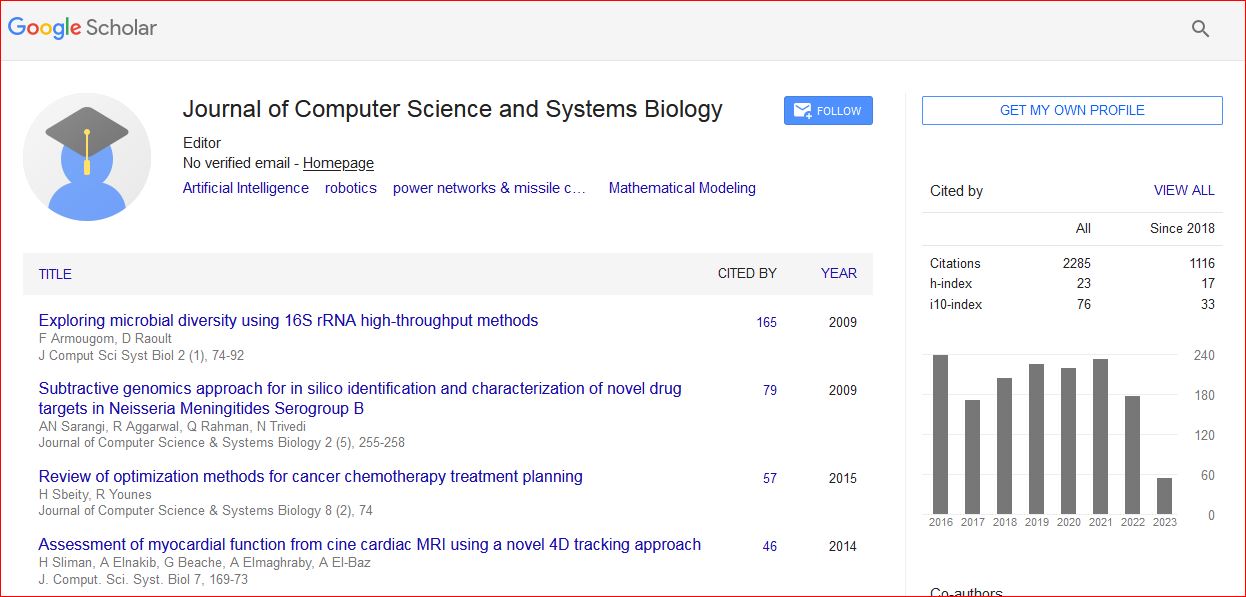
Journal of Computer Science & Systems Biology received 2279 citations as per Google Scholar report