Short Communication - (2025) Volume 16, Issue 6
Received: 01-Nov-2025, Manuscript No. jhmi-26-178902;
Editor assigned: 03-Nov-2025, Pre QC No. P-178902;
Reviewed: 17-Nov-2025, QC No. Q-178902;
Revised: 24-Nov-2025, Manuscript No. R-178902;
Published:
29-Nov-2025
, DOI: 10.37421/2157-7420.2025.16.625
Citation: Sokolov, Pavel I.. ”Data-Driven Health: Personalized Interventions, Proactive Care.” J Health Med Informat 16 (2025):625.
Copyright: © 2025 Sokolov I. Pavel This is an open-access article distributed under the terms of the Creative Commons Attribution License, which permits unrestricted use, distribution and reproduction in any medium, provided the original author and source are credited.
Personalized health management is undergoing a significant transformation driven by advancements in data-driven informatics, which are paving the way for highly tailored interventions and proactive healthcare strategies. This innovative approach harnesses a wide array of data sources, including electronic health records, data from wearable devices, and genomic information, to construct detailed and comprehensive patient profiles. The profound insights derived from these profiles enable the practice of precision medicine, optimizing treatment plans and ultimately leading to improved health outcomes by anticipating individual health needs and potential risks [1].
The integration of sophisticated technologies such as artificial intelligence (AI) and machine learning (ML) into the realm of health informatics is proving to be a critical factor in extracting valuable patterns from extensive datasets. These powerful technologies are instrumental in facilitating predictive analytics, enabling the accurate stratification of disease risks, and supporting the development of personalized treatment strategies. This progress is fundamentally enhancing the efficiency and effectiveness of healthcare delivery, steering the industry toward a more proactive and individualized model of care [2].
Wearable devices and the practice of remote patient monitoring have emerged as indispensable data sources for the advancement of personalized health management. These technologies provide a continuous stream of real-time physiological data, allowing healthcare providers to detect subtle physiological changes promptly, thereby enabling early and effective interventions. This ongoing feedback loop is absolutely essential for the effective management of chronic conditions and the promotion of overall wellness through a rigorously data-informed approach [3].
The integration of genomic data with existing clinical information is unlocking the immense potential for truly personalized medicine. A deep understanding of an individual's genetic predispositions allows for the formulation of highly targeted preventive strategies and the precise selection of the most effective treatments, while simultaneously minimizing the likelihood of adverse side effects. This precision-oriented approach represents a foundational cornerstone of contemporary personalized health management [4].
The ethical considerations and robust data privacy protocols are of paramount importance in the implementation of personalized health management systems. The establishment and maintenance of strong security measures, coupled with transparent data governance frameworks, are absolutely critical for cultivating patient trust and ensuring the responsible utilization of sensitive personal health information. Effectively addressing these complex challenges is vital for the widespread adoption and ultimate success of data-driven health informatics initiatives [5].
Achieving seamless interoperability among diverse health information systems presents a significant challenge, yet it is also a key enabler for the effective delivery of personalized health management. The ability for data to flow freely and securely between different platforms and healthcare providers ensures the creation of a holistic view of the patient, which in turn facilitates coordinated and well-informed care decisions, leading to better patient outcomes [6].
Active patient engagement is an absolutely crucial factor for the successful implementation and sustained effectiveness of personalized health management strategies. Empowering individuals by providing them with readily accessible health data and user-friendly tools for self-management actively fosters greater adherence to prescribed treatment plans and encourages the adoption of healthier lifestyles, contributing to improved long-term health [7].
The application of advanced big data analytics within the domain of public health is opening up entirely new avenues for understanding broad population health trends and for designing interventions that are specifically targeted to address identified needs. This powerful data-driven methodology is instrumental in identifying existing health disparities and in informing crucial policy decisions aimed at enhancing the overall well-being of communities [8].
The development and deployment of clinical decision support systems (CDSS), significantly enhanced by informatics, are actively transforming the landscape of patient care. These sophisticated systems meticulously analyze patient data to furnish clinicians with evidence-based recommendations, thereby improving diagnostic accuracy and enhancing the efficacy of treatments in a manner that is highly personalized to each individual patient [9].
Blockchain technology presents a highly promising solution for the secure and transparent management of health data, a critical requirement for effective personalized health. The inherent capabilities of its distributed ledger system can significantly bolster data integrity, enhance patient control over their personal health information, and streamline the processes involved in sharing health records across different entities, ensuring both security and efficiency [10].
Personalized health management is being revolutionized by data-driven informatics, which enables the delivery of tailored interventions and proactive care strategies. This approach effectively leverages a diverse range of data sources, including electronic health records, wearable devices, and genomic information, to construct comprehensive patient profiles. The insights gleaned from these profiles are instrumental in enabling precision medicine, thereby optimizing treatment plans and enhancing health outcomes by anticipating individual needs and risks [1].
The integration of artificial intelligence and machine learning into health informatics is a pivotal development for extracting meaningful patterns from extensive datasets. These advanced technologies facilitate predictive analytics, allow for the accurate stratification of disease risks, and support the development of personalized treatment strategies. Ultimately, this integration enhances the efficiency and effectiveness of healthcare delivery by promoting a shift towards a more proactive and individualized model of care [2].
Wearable devices and remote patient monitoring are critical data sources that are vital for the practice of personalized health management. They provide continuous, real-time physiological data, which can alert healthcare providers to subtle physiological changes, thereby enabling early intervention. This continuous feedback loop is essential for managing chronic conditions and for promoting overall wellness through a data-informed approach [3].
Genomic data, when successfully integrated with existing clinical information, unlocks the profound potential for achieving highly personalized medicine. Understanding an individual's genetic predispositions allows for the development of targeted preventive strategies and the selection of the most effective treatments with a minimized risk of side effects. This precision-based approach is a fundamental cornerstone of modern personalized health management [4].
The ethical considerations and data privacy are of paramount importance in the successful implementation of personalized health management systems. Robust security measures and transparent data governance frameworks are essential to build and maintain patient trust and to ensure the responsible use of sensitive health information. Addressing these critical challenges is vital for the widespread adoption and ultimate success of data-driven health informatics initiatives [5].
Interoperability of health information systems represents a significant challenge but is also a key enabler for the effective provision of personalized health management. Seamless and secure data exchange between different platforms and healthcare providers ensures the creation of a holistic view of the patient, which in turn facilitates coordinated and informed care decisions, leading to improved patient outcomes [6].
Patient engagement is a crucial factor for the successful implementation and sustained effectiveness of personalized health management. Empowering individuals by providing them with direct access to their health data and user-friendly tools for self-management actively fosters greater adherence to treatment plans and promotes healthier lifestyles, contributing to overall well-being [7].
The application of big data analytics in public health offers new and valuable avenues for understanding population health trends and for designing targeted interventions. This data-driven approach can effectively identify health disparities and inform crucial policy decisions aimed at improving community well-being and public health outcomes [8].
The development of clinical decision support systems (CDSS), powered by informatics, is actively transforming patient care delivery. These systems meticulously analyze patient data to provide clinicians with evidence-based recommendations, thereby enhancing diagnostic accuracy and improving treatment efficacy in a manner that is highly personalized to each individual patient [9].
Blockchain technology holds significant promise for enabling secure and transparent health data management, which is absolutely essential for the effective delivery of personalized health. Its inherent distributed ledger capabilities can substantially enhance data integrity, empower patients with greater control over their information, and streamline the process of health record sharing across various entities, ensuring both security and efficiency [10].
Data-driven informatics is revolutionizing personalized health management by enabling tailored interventions and proactive care. This approach integrates diverse data sources like EHRs, wearables, and genomics to create comprehensive patient profiles for precision medicine. AI and machine learning are crucial for extracting patterns, facilitating predictive analytics, and developing personalized treatments, thus enhancing healthcare efficiency. Wearable devices and remote monitoring provide continuous data for early intervention, particularly for chronic conditions. Genomic data integration allows for targeted prevention and optimized treatments. Ethical considerations and data privacy are paramount, requiring robust security and transparent governance. Interoperability of health systems is key for holistic patient views and coordinated care. Patient engagement through data access and self-management tools fosters treatment adherence and healthier lifestyles. Big data analytics in public health aids in understanding trends and designing targeted interventions. Clinical decision support systems powered by informatics improve diagnostic accuracy and treatment efficacy. Blockchain technology offers secure and transparent health data management, enhancing data integrity and patient control.
None
None
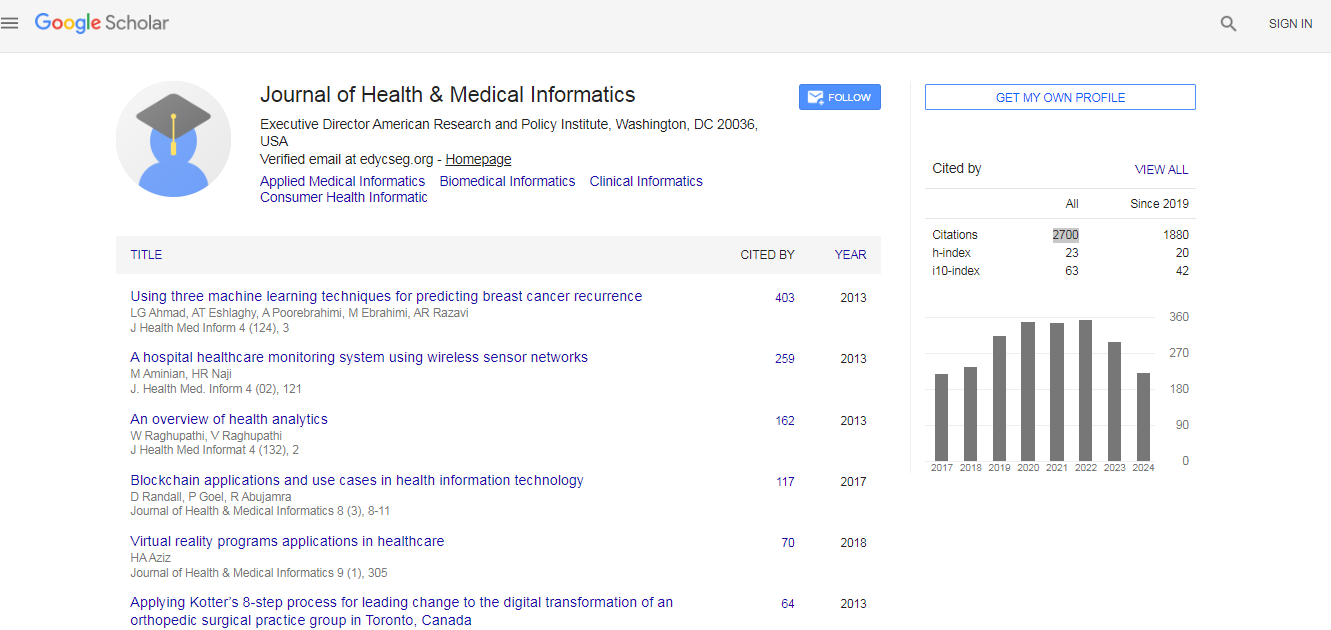
Journal of Health & Medical Informatics received 2700 citations as per Google Scholar report