Short Communication - (2025) Volume 16, Issue 3
Received: 02-May-2025, Manuscript No. jhmi-26-178844;
Editor assigned: 05-May-2025, Pre QC No. P-178844;
Reviewed: 19-May-2025, QC No. Q-178844;
Revised: 23-May-2025, Manuscript No. R-178844;
Published:
30-May-2025
, DOI: 10.37421/2157-7420.2025.16.595
Citation: Al-Qahtani, Noura A.. ”Data Mining and Machine Learning: Revolutionizing Disease Surveillance.” J Health Med Informat 16 (2025):595.
Copyright: © 2025 Al-Qahtani A. Noura This is an open-access article distributed under the terms of the Creative Commons Attribution License, which permits unrestricted use, distribution and reproduction in any medium, provided the original author and source are credited.
The escalating complexity of global health challenges necessitates the adoption of advanced analytical methodologies to bolster disease surveillance and epidemiological research. Traditional methods, while foundational, often struggle to keep pace with the rapid dissemination of information and the sheer volume of data generated in the modern era. Therefore, the exploration and implementation of sophisticated data mining techniques have become paramount in enhancing our capacity to monitor, understand, and respond to public health threats effectively. This work critically examines the pivotal role of data mining methodologies in the advancement of disease surveillance and epidemiological studies. It underscores how sophisticated analytical approaches offer a significant advantage over conventional techniques by enabling the identification of subtle patterns, the prediction of impending outbreaks, and the more efficient formulation of public health interventions. The overarching aim is to leverage extensive and diverse datasets to achieve profound insights into the dynamics of disease transmission, identify associated risk factors, and track population health trends with unprecedented accuracy and timeliness [1].
Furthering this discourse, the application of machine learning algorithms, a specialized subset of data mining, is meticulously analyzed for its inherent potential to forecast the occurrence and spread of infectious disease outbreaks. This research meticulously discusses the distinct advantages conferred by predictive models, which are trained on a rich tapestry of historical data, pertinent environmental factors, and observable social behaviors. Such models are instrumental in furnishing early warnings, thereby facilitating a more proactive and effective response from public health authorities [2].
In parallel, a focused investigation into the utility of clustering techniques is presented, specifically for the critical task of identifying geographic hotspots where particular diseases exhibit a heightened prevalence. By adeptly grouping disease cases based on their spatial location and other germane attributes, public health officials are empowered to more judiciously allocate vital resources and implement precisely targeted interventions in areas identified as high-risk, thereby substantially improving the overall efficiency of surveillance operations [3].
Moreover, the effectiveness of association rule mining is thoroughly examined as a potent method for uncovering intricate relationships between various diseases and their associated risk factors. This particular approach is invaluable for revealing hidden correlations that might otherwise remain obscured when relying solely on traditional statistical methods, ultimately contributing to a more comprehensive and nuanced understanding of disease etiology and pathogenesis [4].
The integration of natural language processing (NLP) for the extraction of crucial epidemiological information from unstructured textual data sources, such as clinical notes and public health reports, is a significant area of exploration. NLP offers the unique capability to unlock invaluable insights embedded within free-form text, thereby enabling a more timely, comprehensive, and nuanced approach to disease surveillance and public health monitoring [5].
Complementing these efforts, anomaly detection techniques are discussed for their critical role in identifying unusual disease occurrences or deviations from established patterns. Such anomalies can serve as early indicators of emerging outbreaks or the manifestation of novel public health threats, making the early detection of these irregularities a cornerstone of rapid response and effective containment strategies [6].
The research also delves into the innovative application of social media data mining for the practice of syndromic surveillance. By systematically analyzing public posts, trends, and discussions on social platforms, it becomes feasible to detect nascent signs of disease outbreaks. This approach serves to augment traditional surveillance systems by incorporating real-time, crowdsourced information, providing an invaluable layer of data for public health situational awareness [7].
The effectiveness of sophisticated visualization techniques in the clear and comprehensible presentation of complex epidemiological data is critically evaluated. The development and deployment of clear, intuitive, and informative visualizations are absolutely essential for effectively communicating surveillance findings to a diverse range of stakeholders, including policymakers and the general public, thereby facilitating better understanding, informed decision-making, and ultimately, impactful action [8].
Finally, the study explores the significant benefits derived from the integration of heterogeneous data sources to achieve enhanced disease surveillance. By adeptly combining data from disparate origins, such as electronic health records, environmental sensors, and demographic information, it becomes possible to construct a more holistic, accurate, and robust understanding of disease patterns, their underlying drivers, and the associated risk factors, leading to more effective public health strategies [9].
The domain of public health surveillance is undergoing a profound transformation, driven by the integration of advanced data mining methodologies that promise to enhance accuracy, timeliness, and comprehensiveness. Traditional epidemiological approaches, while historically significant, are increasingly being augmented by sophisticated analytical tools capable of sifting through vast datasets to uncover hidden patterns and predict future trends. This shift is crucial for navigating the complexities of modern infectious disease dynamics and non-communicable disease management. Data mining methodologies are instrumental in elevating disease surveillance and epidemiological studies beyond conventional limitations. By employing advanced analytical techniques, researchers and public health officials can more effectively identify subtle patterns indicative of disease spread, predict the likelihood and trajectory of outbreaks, and inform the design and implementation of public health interventions with greater precision than ever before. The ability to leverage large, diverse datasets is key to unlocking deeper insights into the intricate mechanisms of disease transmission, pinpointing critical risk factors, and monitoring evolving population health trends [1].
Machine learning algorithms, a powerful subset of data mining, are proving particularly adept at forecasting infectious disease outbreaks. The advantage lies in the development of predictive models trained on comprehensive historical data, encompassing epidemiological records, environmental variables, and even social behavior patterns. These models serve as early warning systems, allowing public health agencies to prepare and respond proactively, thereby mitigating the impact of potential epidemics and pandemics [2].
Geospatial analysis, particularly through clustering techniques, offers a vital tool for disease surveillance. These methods enable the precise identification of geographic hotspots where specific diseases are concentrated. By grouping cases based on location and other relevant attributes, public health officials can optimize the allocation of resources and tailor interventions to high-risk areas, significantly improving the efficiency and effectiveness of surveillance efforts and disease control [3].
Association rule mining provides a unique lens through which to discover intricate relationships between diseases and their myriad risk factors. This analytical approach excels at unearthing hidden correlations that might escape detection through traditional statistical analyses. Such discoveries contribute substantially to a more profound and comprehensive understanding of disease etiology, paving the way for more targeted prevention strategies [4].
Natural language processing (NLP) plays a crucial role in unlocking the wealth of information contained within unstructured text. By analyzing sources like clinical notes, public health reports, and even news articles, NLP techniques can extract critical epidemiological data that would otherwise be inaccessible. This capability enhances the timeliness and scope of surveillance, providing a richer dataset for informed decision-making [5].
Anomaly detection techniques are indispensable for public health surveillance. They are designed to identify unusual disease occurrences or deviations from expected patterns, which can serve as critical early indicators of emerging outbreaks or novel public health threats. The ability to rapidly detect such anomalies is fundamental to initiating swift and decisive containment measures [6].
The application of social media data mining for syndromic surveillance represents a significant advancement. By analyzing public posts, trending topics, and online discussions, it is possible to detect early signs of disease outbreaks in near real-time. This crowdsourced data complements traditional surveillance systems, offering a valuable layer of timely information for public health monitoring [7].
Effective communication of surveillance findings is as critical as the data collection and analysis itself. Visualization techniques are paramount in presenting complex epidemiological data in a clear, intuitive, and easily understandable manner. Well-designed visualizations are essential for conveying information to policymakers, healthcare professionals, and the public, thereby fostering comprehension and facilitating prompt, informed action [8].
Finally, the integration of heterogeneous data sources is a key strategy for achieving comprehensive disease surveillance. By combining data from diverse origins, including electronic health records, environmental monitoring systems, demographic databases, and other relevant sources, a more holistic and accurate picture of disease patterns and risk factors can be constructed. This integrated approach leads to more robust and effective public health strategies and interventions [9].
This collection of research highlights the transformative impact of data mining and machine learning on disease surveillance and epidemiology. Advanced analytical techniques are shown to be superior to traditional methods in identifying patterns, predicting outbreaks, and informing public health interventions. Key applications include forecasting disease spread using machine learning, identifying disease hotspots through geospatial clustering, and uncovering disease-risk factor associations with association rule mining. Natural language processing is utilized to extract epidemiological data from unstructured text, while anomaly detection helps identify emerging threats. Social media data mining offers real-time syndromic surveillance, and visualization techniques are crucial for communicating findings. The integration of diverse data sources enhances the comprehensiveness of surveillance efforts, ultimately leading to more effective public health strategies. Ethical considerations and privacy remain important aspects of data mining in this field.
None
None
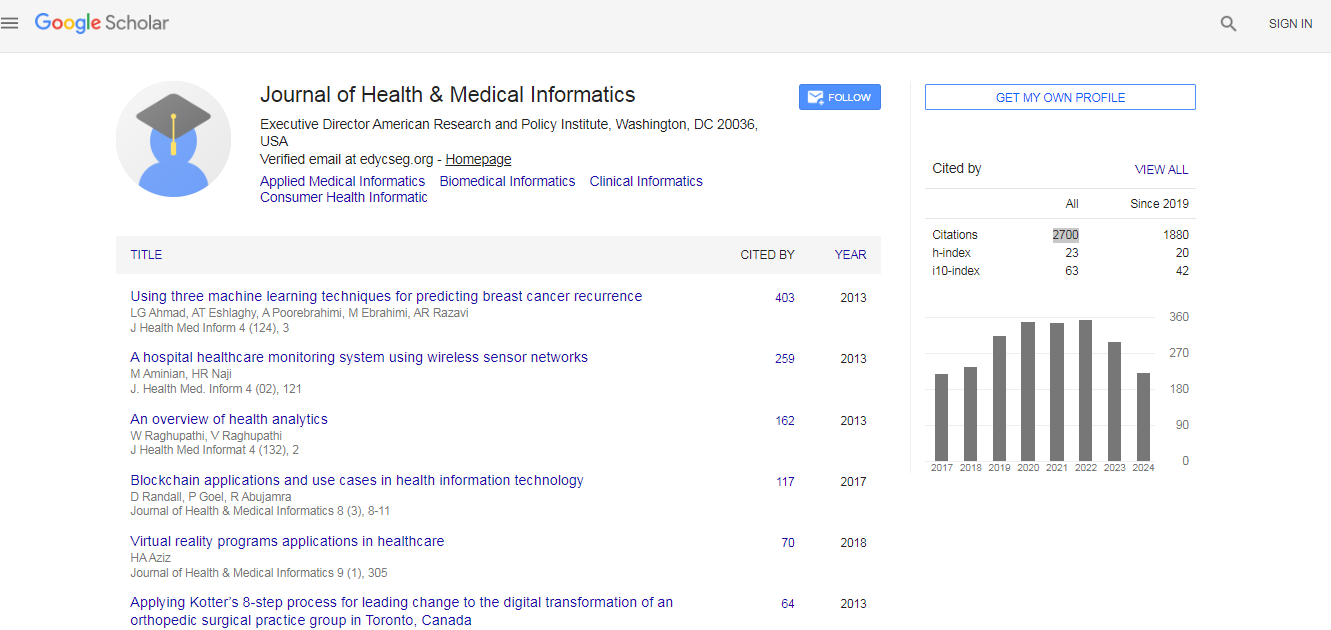
Journal of Health & Medical Informatics received 2700 citations as per Google Scholar report