Opinion - (2025) Volume 16, Issue 3
Received: 02-Jun-2025, Manuscript No. jvst-26-188025;
Editor assigned: 04-Jun-2025, Pre QC No. P-188025;
Reviewed: 18-Jun-2025, QC No. Q-188025;
Revised: 23-Jun-2025, Manuscript No. R-188025;
Published:
30-Jun-2025
, DOI: 10.37421/2157-7579.2025.16.303
Citation: Papadopoulos, George. ”Dairy Mastitis: Diagnosis,
Prevention, and Economic Impact.” J Vet Sci Techno 16 (2025):303.
Copyright: © 2025 Papadopoulos G. This is an open-access article distributed under the terms of the Creative Commons Attribution License, which permits unrestricted use,
distribution and reproduction in any medium, provided the original author and source are credited.
Mastitis in dairy cattle presents a significant economic burden and a critical animal welfare concern, necessitating comprehensive strategies for its management and control [1].
The early and accurate diagnosis of mastitis is paramount for effective treatment, relying on clinical signs and diagnostic tools such as somatic cell counts and microbiological cultures [1].
Subclinical mastitis, frequently undetected, exerts a considerable negative impact on milk yield and quality, underscoring the need for advanced diagnostic techniques [2].
Advanced diagnostic methods, including real-time PCR and enzyme-linked immunosorbent assays (ELISA), offer rapid and sensitive detection of causative pathogens, facilitating timely interventions [2].
The escalating issue of antimicrobial resistance (AMR) in mastitis pathogens demands a critical re-evaluation of existing treatment protocols and the implementation of robust antimicrobial stewardship programs [3].
Preventing mastitis effectively is intrinsically linked to meticulous management of the dairy environment and the milking process, encompassing hygiene and equipment maintenance [4].
The economic implications of mastitis for dairy farms are substantial, encompassing reduced milk production, compromised quality, and increased treatment expenditures [5].
Understanding the innate and adaptive immune responses in dairy cows is crucial for identifying strategies to enhance resistance to mastitis and modulate susceptibility [6].
The diverse range of mastitis-causing pathogens, including bacteria, fungi, and mycoplasmas, necessitates a tailored diagnostic and therapeutic approach to effectively address varied etiological agents [7].
Optimizing milking hygiene practices, from udder preparation to post-milking teat disinfection, is an evidence-based strategy to significantly reduce mastitis incidence by minimizing bacterial contamination and the risk of intramammary infections [8].
Mastitis in dairy cattle poses a considerable economic challenge and impacts animal welfare, making its diagnosis and management a focal point for research and practice [1].
Early and precise diagnosis of mastitis is essential for successful treatment, and this involves a combination of clinical observation and diagnostic tools such as somatic cell counts and microbiological cultures [1].
Subclinical mastitis, often insidious, significantly diminishes milk yield and quality, driving the exploration of more sensitive and rapid diagnostic methods [2].
Technological advancements in diagnostics, such as real-time PCR and ELISA, enable swift and accurate identification of pathogens responsible for subclinical mastitis, informing targeted treatment [2].
The growing threat of antimicrobial resistance (AMR) among mastitis-causing bacteria necessitates a reassessment of current treatment strategies and the promotion of antimicrobial stewardship [3].
Effective mastitis prevention hinges on a holistic approach that integrates rigorous hygiene protocols, proper milking techniques, and environmental management within dairy operations [4].
The economic consequences of mastitis on dairy farms are multifaceted, encompassing losses in milk production, reduced milk quality, and substantial veterinary and treatment costs [5].
The immune system's role in dairy cattle's susceptibility and resistance to mastitis is a critical area of study, offering potential avenues for immunomodulatory interventions [6].
Given the variety of pathogens that can cause mastitis, including bacteria, fungi, and mycoplasmas, diagnostic and therapeutic strategies must be adapted to the specific etiological agent involved [7].
Enhancing milking hygiene practices, including thorough udder preparation, effective teat disinfection, and appropriate post-milking management, is a proven method to reduce the incidence of mastitis by limiting pathogen exposure [8].
Mastitis in dairy cattle is a significant economic and welfare issue. Effective management requires early and accurate diagnosis through clinical signs and tools like somatic cell counts and microbiological cultures. Subclinical mastitis impacts milk yield and quality, necessitating advanced diagnostics such as real-time PCR and ELISA. Antimicrobial resistance is a growing concern, driving the need for stewardship programs and alternative treatments. Prevention is key, focusing on robust hygiene, proper milking techniques, and environmental management. Economic losses from mastitis are substantial, emphasizing the importance of cost-effective interventions. The cow's immune response plays a vital role, and understanding it can lead to better control strategies. Diverse pathogens require tailored approaches, and optimizing milking hygiene is a proven preventive measure. Novel strategies like intramammary probiotics and improved vaccination protocols are also being explored.
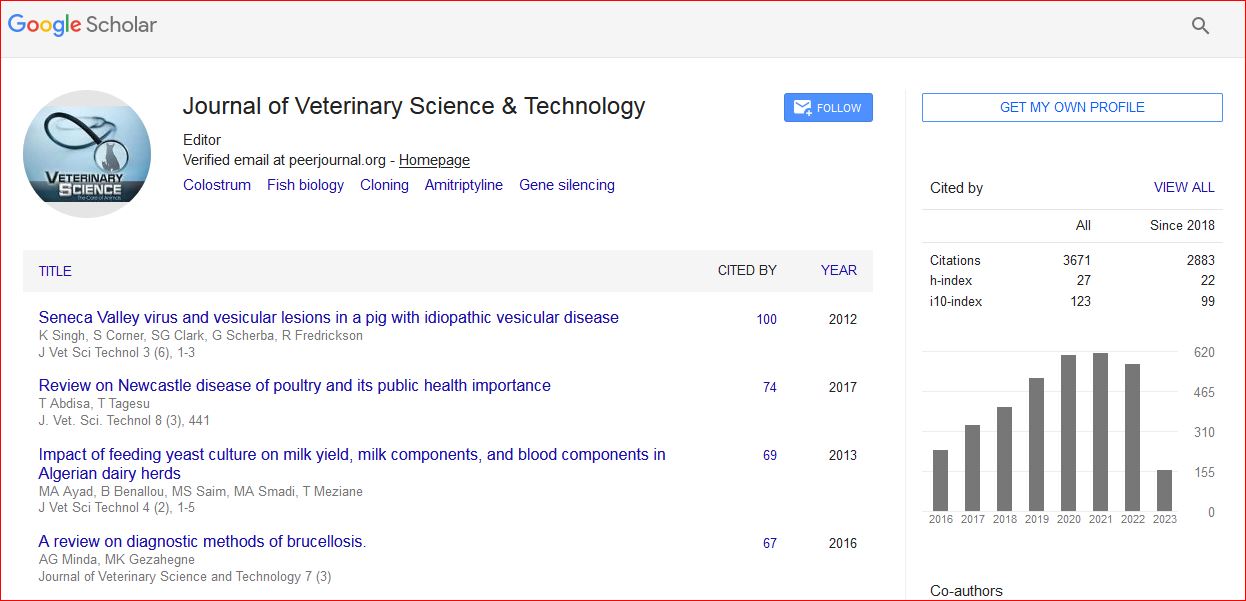
Veterinary Science & Technology received 4472 citations as per Google Scholar report