Commentary - (2025) Volume 16, Issue 3
Received: 01-May-2025, Manuscript No. jch-26-178754;
Editor assigned: 05-May-2025, Pre QC No. P-178754;
Reviewed: 19-May-2025, QC No. Q-178754;
Revised: 24-May-2025, Manuscript No. R-178754;
Published:
29-May-2025
, DOI: 10.37421/2157-7099.2025.16.792
Citation: Wright, Eleanor P.. ”Cytology-Histology Concordance: Enhancing Gynecological Diagnosis Accuracy.” J Cytol Histol 16 (2025):792.
Copyright: © 2025 Wright P. Eleanor This is an open-access article distributed under the terms of the Creative Commons Attribution License, which permits unrestricted use, distribution and reproduction in any medium, provided the original author and source are credited.
The accurate correlation between cytological findings and histological diagnoses is a cornerstone of effective patient management in gynecological oncology. This crucial concordance ensures appropriate treatment strategies and minimizes the risk of misdiagnosis, particularly when differentiating between benign, precancerous, and malignant lesions. The Papanicolaou (Pap) smear remains a vital screening tool, and its effectiveness is directly tied to the precision of its interpretation and subsequent correlation with biopsy results. Advances in understanding the nuances of cellular morphology and the integration of molecular insights are continually refining these diagnostic processes. Stringent quality control measures and robust interdisciplinary collaboration between cytopathologists and gynecologists are paramount to upholding high diagnostic standards and optimizing patient outcomes. The evolving landscape of gynecological care, influenced by factors such as HPV vaccination, necessitates ongoing adaptation of diagnostic algorithms and a critical evaluation of concordance rates. This review aims to synthesize current knowledge regarding the factors influencing cytology-histology concordance in gynecological lesions, exploring both established practices and emerging technologies that promise to enhance diagnostic accuracy and refine patient management strategies. The focus will be on the critical interplay between different diagnostic modalities and the ultimate goal of providing precise and timely diagnoses for women's reproductive health. Furthermore, the integration of novel technologies and the persistent challenges in interpreting subtle morphological changes will be discussed, highlighting the continuous need for vigilance and refinement in the field. The foundational principles of diagnostic cytology in gynecology, coupled with the innovative approaches being developed, underscore the dynamic nature of this medical specialty. This introduction sets the stage for a comprehensive exploration of cytology-histology concordance, its challenges, and its significance in the modern clinical setting. The importance of understanding specific morphological features in predicting histological outcomes cannot be overstated, as it directly impacts the diagnostic pathway and subsequent patient care. The continuous refinement of diagnostic interpretation, aided by technological advancements, ensures that the field remains at the forefront of women's health diagnostics. The interplay of established methods and innovative tools forms the bedrock of accurate gynecological diagnostics. The commitment to rigorous quality assurance further solidifies the reliability of these diagnostic procedures. The ongoing research and development in this domain promise to further elevate the standards of care. The integration of molecular markers is a significant step towards achieving more precise diagnoses. The discussion will also encompass the role of technological advancements in improving diagnostic accuracy. The fundamental principle of correlating two diagnostic methods remains critical for patient safety. The evolution of screening programs, such as those for HPV, profoundly impacts diagnostic patterns. This introduction will lay the groundwork for a detailed examination of these critical aspects, C001. The landscape of gynecological cytology has been significantly shaped by the introduction and widespread adoption of the Papanicolaou (Pap) smear, a critical tool for early detection of cervical abnormalities. The accuracy of this screening method hinges on the subsequent correlation with histological findings from biopsies, a process known as cytology-histology concordance. This concordance is essential for appropriate patient management, enabling clinicians to distinguish between benign conditions, precancerous lesions, and invasive cancers. Diagnostic challenges frequently arise in differentiating these categories, underscoring the need for meticulous interpretation and quality control. Furthermore, interdisciplinary collaboration between cytopathologists and gynecologists is vital for a holistic approach to patient care, ensuring that all diagnostic information is integrated effectively. The impact of advancements in molecular pathology is also increasingly recognized as a supplementary tool to enhance diagnostic precision and guide treatment selection, further refining the diagnostic process. The evolution of screening practices, notably the implementation of HPV vaccination and screening programs, has begun to alter the patterns observed in gynecological cytology. This shift necessitates an adaptation of diagnostic algorithms to reflect the changing epidemiological landscape and its implications for detecting and managing cervical dysplasia. The concordance rates between cytology and histology are thus being analyzed within this evolving context, with a view to maintaining vigilance for persistent or emerging diagnostic patterns. The identification of specific morphological features within cytological specimens that are predictive of underlying histological findings is a key area of research. By analyzing large cohorts, researchers aim to pinpoint subtle cellular changes that correlate strongly with high-grade lesions and squamous cell carcinoma, thereby refining the interpretation of borderline cases and improving diagnostic specificity. The challenges posed by inflammatory conditions that can mimic neoplastic changes also require careful consideration and differentiation strategies. The widespread adoption of liquid-based cytology (LBC) has offered improvements in sample preservation and a reduction in obscuring factors compared to conventional Pap smears. This advancement has direct implications for the concordance rates between cytology and histology, with studies assessing its impact on diagnostic accuracy for various lesion types. The benefits of LBC for diagnostic workflow and patient outcomes are a significant area of interest. The role of molecular markers in enhancing the accuracy of gynecological cytology, particularly in equivocal cases, is another rapidly developing field. These markers can aid in distinguishing between reactive changes and neoplastic lesions, thereby improving the predictive value of cytology and its concordance with histology, and their practical implementation in routine settings is being explored. Artificial intelligence (AI) presents promising avenues for improving diagnostic accuracy in pathology. AI algorithms are being developed to assist cytopathologists in analyzing gynecological smears, potentially leading to increased concordance with histological diagnoses and enhancing the efficiency and reliability of diagnostic workflows. Quality assurance in gynecological cytology is fundamental to maintaining high diagnostic standards and ensuring optimal patient care. Robust quality assurance programs, encompassing interobserver variability assessment, proficiency testing, and continuous professional development, directly influence concordance rates and patient outcomes. Finally, specific considerations apply to vulvar and vaginal lesions, where careful correlation between cytologic smears and biopsy specimens is crucial for conditions like vulvar intraepithelial neoplasia (VIN). Factors such as specimen quality and sampling technique significantly influence concordance, guiding accurate diagnosis and management, C002. The critical importance of cytology-histology concordance in the management of gynecological lesions cannot be overstated, forming a cornerstone of accurate diagnosis and effective patient care. The Papanicolaou (Pap) smear, a widely utilized screening tool, relies heavily on the subsequent correlation with histological findings from biopsies to guide therapeutic decisions. This correlation is essential for minimizing misdiagnoses and optimizing treatment strategies, especially in the complex task of differentiating between benign, precancerous, and malignant conditions. The diagnostic challenges inherent in this differentiation process highlight the need for stringent quality control measures and seamless interdisciplinary collaboration between cytopathologists and gynecologists. As the field evolves, advances in molecular pathology are emerging as valuable supplementary tools, promising to further enhance diagnostic accuracy and refine treatment selection. The impact of public health initiatives, such as HPV vaccination and widespread screening, has demonstrably altered the epidemiological landscape of cervical dysplasia. This has led to a diminishing prevalence of certain high-risk HPV types in vaccinated populations, necessitating a reevaluation of diagnostic patterns and a subsequent adaptation of diagnostic algorithms. In this dynamic context, the concordance rates between cytology and histology are continuously analyzed, emphasizing the crucial need for vigilance regarding persistent or emerging patterns of disease. Researchers are actively investigating specific morphological features within gynecological cytology specimens that can serve as reliable predictors of underlying histological findings. By analyzing extensive cohorts, the identification of subtle cellular changes and architectural patterns that strongly correlate with high-grade squamous intraepithelial lesions (HSIL) and squamous cell carcinoma is becoming increasingly refined. This research aims to improve the specificity of cytologic diagnoses and reduce the incidence of unnecessary biopsies, while also addressing the complexities of differentiating neoplastic changes from inflammatory conditions. The transition to liquid-based cytology (LBC) has become a standard practice, offering advantages in sample preservation and reducing obscuring factors that can hinder accurate interpretation. Studies are assessing the impact of LBC on cytology-histology concordance compared to conventional Pap smears, providing data-driven insights into its benefits for specific lesion types and its implications for diagnostic workflow and patient outcomes. The integration of molecular markers represents another frontier in enhancing diagnostic accuracy, particularly in cases where cytologic findings are equivocal. These markers offer the potential to differentiate between reactive changes and neoplastic lesions, thereby bolstering the predictive value of cytology and its concordance with histology, with ongoing research focused on their practical application in routine diagnostic settings. The advent of artificial intelligence (AI) in pathology is opening new avenues for improving diagnostic capabilities. AI algorithms are being developed to assist cytopathologists in the analysis of gynecological smears, with the potential to increase concordance with histological diagnoses and enhance the overall efficiency and reliability of diagnostic workflows. Ensuring high diagnostic standards and optimal patient care is underpinned by robust quality assurance programs in gynecological cytology. These programs, which include assessments of interobserver variability, proficiency testing, and continuous professional development, directly influence the concordance rates between cytology and histology, ultimately contributing to improved patient outcomes through accurate and timely diagnoses. Finally, the specific challenges and best practices associated with cytology-histology concordance in vulvar and vaginal lesions are being actively addressed. Conditions such as vulvar intraepithelial neoplasia (VIN) require careful correlation between cytologic smears and biopsy specimens, with factors like specimen quality and sampling technique playing a significant role in achieving accurate diagnoses and guiding appropriate management, C003. Cytology-histology concordance is a fundamental pillar in the diagnostic pathway for gynecological lesions, ensuring that patient management is guided by the most accurate and comprehensive information available. The Papanicolaou (Pap) smear, a widely adopted screening tool, plays a pivotal role in this process, and its effectiveness is significantly amplified when its findings are meticulously correlated with subsequent histological examinations of biopsies. This concordance is paramount for averting misdiagnoses and optimizing therapeutic interventions, particularly when distinguishing between benign entities, precancerous conditions, and malignant neoplasms. The inherent diagnostic complexities in discerning these distinct categories underscore the imperative for rigorous quality control protocols and strong interdisciplinary collaboration between cytopathologists and gynecologists. Emerging advancements in molecular pathology are increasingly recognized as valuable adjuncts, offering the potential to further refine diagnostic precision and inform treatment selection. Concurrently, the broader public health landscape is witnessing a significant transformation due to initiatives like HPV vaccination and extensive screening programs, which have begun to influence the epidemiological patterns of cervical dysplasia. This has resulted in a noticeable decline in the prevalence of specific high-risk HPV types within vaccinated demographics, thereby necessitating a reevaluation of diagnostic paradigms and a proactive adaptation of diagnostic algorithms. Within this evolving context, the concordance rates between cytology and histology are subjected to continuous analysis, emphasizing the indispensable need for ongoing vigilance regarding both persistent and newly emerging disease patterns. A significant area of research focuses on identifying specific morphological indicators within gynecological cytology specimens that can reliably predict underlying histological findings. Through the examination of extensive patient cohorts, the identification of subtle cellular alterations and architectural anomalies that exhibit a strong correlation with high-grade squamous intraepithelial lesions (HSIL) and invasive squamous cell carcinoma is becoming increasingly sophisticated. The objective of this research is to enhance the specificity of cytological diagnoses and reduce the frequency of unwarranted biopsies, while simultaneously developing strategies to effectively differentiate neoplastic changes from inflammatory mimics. The widespread adoption of liquid-based cytology (LBC) has become a standard practice in many laboratories, offering distinct advantages in terms of sample preservation and a reduction in the presence of obscuring elements that can compromise accurate interpretation. Studies are systematically evaluating the impact of LBC on cytology-histology concordance in comparison to conventional Pap smears, generating data-driven insights into its specific benefits across a spectrum of lesion types and its broader implications for diagnostic workflow efficiency and patient outcomes. The integration of molecular markers represents another promising frontier in the quest to elevate the accuracy of gynecological cytology, especially in cases presenting with equivocal cytological findings. These markers hold the potential to precisely distinguish between reactive cellular changes and true neoplastic lesions, thereby augmenting the predictive value of cytological assessments and improving their concordance with histological diagnoses, with active research dedicated to their seamless integration into routine diagnostic workflows. The emergence of artificial intelligence (AI) in the field of pathology signifies a revolutionary step towards enhancing diagnostic capabilities. AI-driven algorithms are under development to provide crucial support to cytopathologists in the analysis of gynecological smears, with the overarching aim of increasing concordance with histological diagnoses and bolstering the overall efficiency and reliability of diagnostic workflows. The establishment and maintenance of robust quality assurance programs within gynecological cytology are indispensable for upholding elevated diagnostic standards and ensuring optimal patient care. These comprehensive programs, which encompass systematic assessments of interobserver variability, rigorous proficiency testing, and sustained continuous professional development, exert a direct influence on the concordance rates between cytology and histology, ultimately contributing to improved patient outcomes through the delivery of accurate and timely diagnoses. Lastly, specific attention is directed towards addressing the unique challenges and delineating best practices for cytology-histology concordance in the context of vulvar and vaginal lesions. Conditions such as vulvar intraepithelial neoplasia (VIN) necessitate a careful and precise correlation between cytologic smear findings and subsequent biopsy specimens, where factors such as the quality of the specimen and the adopted sampling technique play a pivotal role in achieving accurate diagnoses and guiding appropriate management strategies, C004. Ensuring the accuracy of diagnoses in gynecological pathology hinges on the reliable concordance between cytology and histology, a critical link for effective patient management. The Papanicolaou (Pap) smear remains a cornerstone of cervical cancer screening, and its diagnostic utility is maximized through consistent correlation with biopsy results. This concordance is essential for preventing misdiagnoses and for tailoring treatment plans, particularly when distinguishing between benign conditions, precancerous lesions, and invasive cancers. The inherent complexities in differentiating these entities highlight the necessity for stringent quality control measures and effective interdisciplinary collaboration between cytopathologists and gynecologists. Furthermore, advancements in molecular pathology are increasingly recognized as complementary tools that can enhance diagnostic precision and guide treatment decisions. The evolving landscape of cervical cancer prevention, influenced by widespread HPV vaccination and screening programs, has begun to alter the observed prevalence of specific high-risk HPV types in vaccinated populations. This epidemiological shift necessitates an adaptation of diagnostic algorithms and a continued focus on the concordance rates between cytology and histology. The identification of specific morphological features in cytological samples that predict histological outcomes is an active area of research. Studies are analyzing large cohorts to pinpoint subtle cellular changes that correlate strongly with high-grade squamous intraepithelial lesions (HSIL) and squamous cell carcinoma, aiming to improve the specificity of cytological diagnoses and reduce unnecessary biopsies. This research also addresses the challenge of differentiating neoplastic changes from inflammatory conditions. The widespread adoption of liquid-based cytology (LBC) has offered benefits such as improved sample preservation and reduced obscuring factors, impacting the concordance rates between cytology and histology. Research is assessing the specific advantages of LBC for different lesion types and its implications for diagnostic workflows and patient outcomes. The incorporation of molecular markers into the diagnostic process is gaining traction, especially for cases with equivocal cytological findings. These markers can assist in differentiating reactive changes from neoplastic lesions, thereby improving the predictive value of cytology and its concordance with histology. Practical implementation strategies for these molecular tests in routine settings are being explored. Artificial intelligence (AI) is emerging as a transformative technology in pathology, with the potential to enhance diagnostic accuracy. AI algorithms are being developed to aid cytopathologists in analyzing gynecological smears, aiming to increase concordance with histological diagnoses and improve the efficiency and reliability of diagnostic workflows. Robust quality assurance programs are indispensable for maintaining high standards in gynecological cytology. These programs, which include interobserver variability assessments, proficiency testing, and continuous professional development, directly influence cytology-histology concordance and, consequently, patient outcomes. Finally, the specific challenges and best practices for cytology-histology concordance in vulvar and vaginal lesions are being addressed. Conditions like vulvar intraepithelial neoplasia (VIN) require careful correlation between cytologic smears and biopsies, with factors such as specimen quality and sampling technique being critical for accurate diagnosis and management, C005. The accuracy of gynecological lesion management is profoundly dependent on the concordance between cytological and histological diagnoses. This correlation is vital for ensuring appropriate treatment pathways and for minimizing the risk of misdiagnosis, particularly when differentiating between benign, precancerous, and malignant conditions. The Papanicolaou (Pap) smear, a primary screening modality, plays a crucial role in this process, and its effectiveness is amplified by precise correlation with subsequent biopsy findings. The diagnostic challenges in distinguishing subtle differences between various lesion grades underscore the necessity for stringent quality control measures and robust interdisciplinary collaboration between cytopathologists and gynecologists. Emerging advancements in molecular pathology are increasingly being integrated as supplementary tools to enhance diagnostic precision and refine treatment selection strategies. The landscape of cervical cancer prevention has been significantly influenced by the widespread implementation of HPV vaccination and screening programs, leading to observed changes in the prevalence of certain high-risk HPV types within vaccinated populations. This epidemiological shift necessitates a thoughtful adaptation of diagnostic algorithms and a continued focus on analyzing concordance rates between cytology and histology. Research efforts are increasingly directed towards identifying specific morphological features within gynecological cytology specimens that serve as reliable predictors of histological outcomes. By analyzing extensive patient cohorts, the identification of subtle cellular aberrations and architectural patterns that exhibit a strong correlation with high-grade squamous intraepithelial lesions (HSIL) and invasive squamous cell carcinoma is becoming more precise. The aim is to enhance the specificity of cytological diagnoses and decrease the incidence of unnecessary biopsies, while also addressing the complexities of differentiating neoplastic processes from inflammatory mimics. The transition to liquid-based cytology (LBC) has become a standard practice, offering tangible benefits such as improved sample preservation and a reduction in obscuring elements that can impede accurate interpretation. Studies are systematically evaluating the impact of LBC on cytology-histology concordance compared to conventional Pap smears, providing data-driven insights into its specific advantages for various lesion types and its broader implications for diagnostic workflow efficiency and patient outcomes. The integration of molecular markers into the diagnostic armamentarium is an evolving area, particularly for cases presenting with equivocal cytological findings. These molecular indicators possess the potential to definitively distinguish between reactive cellular changes and genuine neoplastic lesions, thereby augmenting the predictive value of cytological assessments and improving their concordance with histological diagnoses. Ongoing research focuses on the practical implementation of these molecular tests within routine diagnostic settings. The advent of artificial intelligence (AI) in the field of pathology signifies a significant leap forward in enhancing diagnostic capabilities. AI-driven algorithms are being developed to offer crucial support to cytopathologists in the analysis of gynecological smears, with the overarching objective of increasing concordance with histological diagnoses and improving the overall efficiency and reliability of diagnostic workflows. The establishment and maintenance of comprehensive quality assurance programs within gynecological cytology are indispensable for upholding the highest diagnostic standards and ensuring optimal patient care. These multifaceted programs, which include systematic assessments of interobserver variability, rigorous proficiency testing, and sustained continuous professional development, exert a direct and significant influence on the concordance rates between cytology and histology, ultimately contributing to improved patient outcomes through the delivery of accurate and timely diagnoses. Lastly, specific considerations and best practices for achieving reliable cytology-histology concordance in the context of vulvar and vaginal lesions are being actively addressed. Conditions such as vulvar intraepithelial neoplasia (VIN) necessitate a careful and precise correlation between cytologic smear findings and subsequent biopsy specimens, where factors such as the quality of the obtained specimen and the adopted sampling technique play a pivotal role in achieving accurate diagnoses and guiding appropriate management strategies, C006. The reliability of gynecological lesion management is fundamentally dependent on the accurate concordance between cytological and histological findings. This crucial correlation ensures that patient care pathways are guided by precise diagnostic information, thereby minimizing the risks associated with misdiagnosis, especially when differentiating between benign, precancerous, and malignant entities. The Papanicolaou (Pap) smear, a primary screening tool, plays a pivotal role in this diagnostic continuum, and its effectiveness is significantly enhanced through meticulous correlation with subsequent biopsy results. The inherent complexities in accurately distinguishing between various grades of lesions underscore the critical need for stringent quality control measures and effective interdisciplinary collaboration between cytopathologists and gynecologists. Moreover, advancements in molecular pathology are increasingly recognized as valuable supplementary tools that can further refine diagnostic precision and inform treatment selection. The broader public health landscape has seen considerable transformation due to the widespread implementation of HPV vaccination and screening programs, which have led to observed shifts in the prevalence of specific high-risk HPV types within vaccinated demographics. This epidemiological evolution necessitates a thoughtful adaptation of diagnostic algorithms and a sustained focus on analyzing the concordance rates between cytology and histology. A significant area of ongoing research involves the identification of specific morphological features within gynecological cytology specimens that can serve as reliable predictors of histological outcomes. Through the rigorous analysis of extensive patient cohorts, the identification of subtle cellular abnormalities and architectural patterns that demonstrate a strong correlation with high-grade squamous intraepithelial lesions (HSIL) and invasive squamous cell carcinoma is becoming increasingly refined. The primary objective is to enhance the specificity of cytological diagnoses and to reduce the incidence of unnecessary biopsies, while simultaneously developing effective strategies for differentiating neoplastic processes from inflammatory mimics. The transition to liquid-based cytology (LBC) has become a widely adopted standard practice, offering distinct advantages in terms of improved sample preservation and a reduction in the presence of obscuring elements that can potentially impede accurate interpretation. Studies are systematically evaluating the impact of LBC on cytology-histology concordance in comparison to conventional Pap smears, generating data-driven insights into its specific benefits across a spectrum of lesion types and its broader implications for diagnostic workflow efficiency and patient outcomes. The integration of molecular markers into the diagnostic armamentarium is an evolving area of significant interest, particularly for cases presenting with equivocal cytological findings. These molecular indicators hold the potential to definitively distinguish between reactive cellular changes and genuine neoplastic lesions, thereby augmenting the predictive value of cytological assessments and improving their concordance with histological diagnoses. Ongoing research is focused on the practical implementation of these molecular tests within routine diagnostic settings. The advent of artificial intelligence (AI) in the field of pathology signifies a transformative step towards enhancing diagnostic capabilities. AI-driven algorithms are being developed to offer crucial support to cytopathologists in the analysis of gynecological smears, with the overarching objective of increasing concordance with histological diagnoses and improving the overall efficiency and reliability of diagnostic workflows. The establishment and maintenance of comprehensive quality assurance programs within gynecological cytology are indispensable for upholding the highest diagnostic standards and ensuring optimal patient care. These multifaceted programs, which include systematic assessments of interobserver variability, rigorous proficiency testing, and sustained continuous professional development, exert a direct and significant influence on the concordance rates between cytology and histology, ultimately contributing to improved patient outcomes through the delivery of accurate and timely diagnoses. Lastly, specific considerations and best practices for achieving reliable cytology-histology concordance in the context of vulvar and vaginal lesions are being actively addressed. Conditions such as vulvar intraepithelial neoplasia (VIN) necessitate a careful and precise correlation between cytologic smear findings and subsequent biopsy specimens, where factors such as the quality of the obtained specimen and the adopted sampling technique play a pivotal role in achieving accurate diagnoses and guiding appropriate management strategies, C007. The reliable management of gynecological lesions is critically contingent upon the concordance between cytological and histological diagnoses. This correlation is essential for establishing accurate treatment pathways and for mitigating the risks associated with misdiagnosis, particularly when discerning between benign conditions, precancerous lesions, and malignant neoplasms. The Papanicolaou (Pap) smear, serving as a primary screening modality, plays a pivotal role in this diagnostic continuum, and its effectiveness is significantly amplified through meticulous correlation with subsequent biopsy results. The inherent diagnostic complexities in accurately distinguishing between various grades of lesions underscore the critical need for stringent quality control measures and robust interdisciplinary collaboration between cytopathologists and gynecologists. Furthermore, advancements in molecular pathology are increasingly recognized as valuable supplementary tools that can further refine diagnostic precision and inform treatment selection. The broader public health landscape has witnessed considerable transformation due to the widespread implementation of HPV vaccination and screening programs, which have led to observed shifts in the prevalence of specific high-risk HPV types within vaccinated demographics. This epidemiological evolution necessitates a thoughtful adaptation of diagnostic algorithms and a sustained focus on analyzing the concordance rates between cytology and histology. A significant area of ongoing research involves the identification of specific morphological features within gynecological cytology specimens that can serve as reliable predictors of histological outcomes. Through the rigorous analysis of extensive patient cohorts, the identification of subtle cellular abnormalities and architectural patterns that demonstrate a strong correlation with high-grade squamous intraepithelial lesions (HSIL) and invasive squamous cell carcinoma is becoming increasingly refined. The primary objective is to enhance the specificity of cytological diagnoses and to reduce the incidence of unnecessary biopsies, while simultaneously developing effective strategies for differentiating neoplastic processes from inflammatory mimics. The transition to liquid-based cytology (LBC) has become a widely adopted standard practice, offering distinct advantages in terms of improved sample preservation and a reduction in the presence of obscuring elements that can potentially impede accurate interpretation. Studies are systematically evaluating the impact of LBC on cytology-histology concordance in comparison to conventional Pap smears, generating data-driven insights into its specific benefits across a spectrum of lesion types and its broader implications for diagnostic workflow efficiency and patient outcomes. The integration of molecular markers into the diagnostic armamentarium is an evolving area of significant interest, particularly for cases presenting with equivocal cytological findings. These molecular indicators possess the potential to definitively distinguish between reactive cellular changes and genuine neoplastic lesions, thereby augmenting the predictive value of cytological assessments and improving their concordance with histological diagnoses. Ongoing research is focused on the practical implementation of these molecular tests within routine diagnostic settings. The advent of artificial intelligence (AI) in the field of pathology signifies a transformative step towards enhancing diagnostic capabilities. AI-driven algorithms are being developed to offer crucial support to cytopathologists in the analysis of gynecological smears, with the overarching objective of increasing concordance with histological diagnoses and improving the overall efficiency and reliability of diagnostic workflows. The establishment and maintenance of comprehensive quality assurance programs within gynecological cytology are indispensable for upholding the highest diagnostic standards and ensuring optimal patient care. These multifaceted programs, which include systematic assessments of interobserver variability, rigorous proficiency testing, and sustained continuous professional development, exert a direct and significant influence on the concordance rates between cytology and histology, ultimately contributing to improved patient outcomes through the delivery of accurate and timely diagnoses. Lastly, specific considerations and best practices for achieving reliable cytology-histology concordance in the context of vulvar and vaginal lesions are being actively addressed. Conditions such as vulvar intraepithelial neoplasia (VIN) necessitate a careful and precise correlation between cytologic smear findings and subsequent biopsy specimens, where factors such as the quality of the obtained specimen and the adopted sampling technique play a pivotal role in achieving accurate diagnoses and guiding appropriate management strategies, C008. The precise management of gynecological lesions hinges on the accurate concordance between cytological interpretations and subsequent histological diagnoses. This correlation is paramount for ensuring that patient care decisions are based on the most reliable diagnostic information, thereby minimizing the potential for misdiagnosis and optimizing treatment strategies, particularly when differentiating between benign conditions, precancerous lesions, and invasive cancers. The Papanicolaou (Pap) smear remains a cornerstone of cervical cancer screening, and its diagnostic utility is significantly enhanced through meticulous correlation with biopsy findings. The inherent challenges in accurately distinguishing between various grades of lesions underscore the critical need for stringent quality control measures and robust interdisciplinary collaboration between cytopathologists and gynecologists. In parallel, advancements in molecular pathology are increasingly recognized as valuable supplementary tools that can further refine diagnostic precision and inform treatment selection. The broader public health landscape has undergone considerable transformation due to the widespread implementation of HPV vaccination and screening programs, which have led to observed shifts in the prevalence of specific high-risk HPV types within vaccinated demographics. This epidemiological evolution necessitates a thoughtful adaptation of diagnostic algorithms and a sustained focus on analyzing the concordance rates between cytology and histology. A significant area of ongoing research involves the identification of specific morphological features within gynecological cytology specimens that can serve as reliable predictors of histological outcomes. Through the rigorous analysis of extensive patient cohorts, the identification of subtle cellular abnormalities and architectural patterns that demonstrate a strong correlation with high-grade squamous intraepithelial lesions (HSIL) and invasive squamous cell carcinoma is becoming increasingly refined. The primary objective is to enhance the specificity of cytological diagnoses and to reduce the incidence of unnecessary biopsies, while simultaneously developing effective strategies for differentiating neoplastic processes from inflammatory mimics. The transition to liquid-based cytology (LBC) has become a widely adopted standard practice, offering distinct advantages in terms of improved sample preservation and a reduction in the presence of obscuring elements that can potentially impede accurate interpretation. Studies are systematically evaluating the impact of LBC on cytology-histology concordance in comparison to conventional Pap smears, generating data-driven insights into its specific benefits across a spectrum of lesion types and its broader implications for diagnostic workflow efficiency and patient outcomes. The integration of molecular markers into the diagnostic armamentarium is an evolving area of significant interest, particularly for cases presenting with equivocal cytological findings. These molecular indicators possess the potential to definitively distinguish between reactive cellular changes and genuine neoplastic lesions, thereby augmenting the predictive value of cytological assessments and improving their concordance with histological diagnoses. Ongoing research is focused on the practical implementation of these molecular tests within routine diagnostic settings. The advent of artificial intelligence (AI) in the field of pathology signifies a transformative step towards enhancing diagnostic capabilities. AI-driven algorithms are being developed to offer crucial support to cytopathologists in the analysis of gynecological smears, with the overarching objective of increasing concordance with histological diagnoses and improving the overall efficiency and reliability of diagnostic workflows. The establishment and maintenance of comprehensive quality assurance programs within gynecological cytology are indispensable for upholding the highest diagnostic standards and ensuring optimal patient care. These multifaceted programs, which include systematic assessments of interobserver variability, rigorous proficiency testing, and sustained continuous professional development, exert a direct and significant influence on the concordance rates between cytology and histology, ultimately contributing to improved patient outcomes through the delivery of accurate and timely diagnoses. Lastly, specific considerations and best practices for achieving reliable cytology-histology concordance in the context of vulvar and vaginal lesions are being actively addressed. Conditions such as vulvar intraepithelial neoplasia (VIN) necessitate a careful and precise correlation between cytologic smear findings and subsequent biopsy specimens, where factors such as the quality of the obtained specimen and the adopted sampling technique play a pivotal role in achieving accurate diagnoses and guiding appropriate management strategies, C009. The accurate correlation between cytological interpretations and subsequent histological diagnoses is fundamental to the effective management of gynecological lesions. This concordance ensures that patient care decisions are grounded in reliable diagnostic information, thereby minimizing the risks associated with misdiagnosis and optimizing treatment strategies, especially when differentiating between benign conditions, precancerous lesions, and invasive cancers. The Papanicolaou (Pap) smear remains a cornerstone of cervical cancer screening, and its diagnostic utility is significantly enhanced through meticulous correlation with biopsy findings. The inherent diagnostic challenges in accurately distinguishing between various grades of lesions underscore the critical need for stringent quality control measures and robust interdisciplinary collaboration between cytopathologists and gynecologists. In parallel, advancements in molecular pathology are increasingly recognized as valuable supplementary tools that can further refine diagnostic precision and inform treatment selection. The broader public health landscape has undergone considerable transformation due to the widespread implementation of HPV vaccination and screening programs, which have led to observed shifts in the prevalence of specific high-risk HPV types within vaccinated demographics. This epidemiological evolution necessitates a thoughtful adaptation of diagnostic algorithms and a sustained focus on analyzing the concordance rates between cytology and histology. A significant area of ongoing research involves the identification of specific morphological features within gynecological cytology specimens that can serve as reliable predictors of histological outcomes. Through the rigorous analysis of extensive patient cohorts, the identification of subtle cellular abnormalities and architectural patterns that demonstrate a strong correlation with high-grade squamous intraepithelial lesions (HSIL) and invasive squamous cell carcinoma is becoming increasingly refined. The primary objective is to enhance the specificity of cytological diagnoses and to reduce the incidence of unnecessary biopsies, while simultaneously developing effective strategies for differentiating neoplastic processes from inflammatory mimics. The transition to liquid-based cytology (LBC) has become a widely adopted standard practice, offering distinct advantages in terms of improved sample preservation and a reduction in the presence of obscuring elements that can potentially impede accurate interpretation. Studies are systematically evaluating the impact of LBC on cytology-histology concordance in comparison to conventional Pap smears, generating data-driven insights into its specific benefits across a spectrum of lesion types and its broader implications for diagnostic workflow efficiency and patient outcomes. The integration of molecular markers into the diagnostic armamentarium is an evolving area of significant interest, particularly for cases presenting with equivocal cytological findings. These molecular indicators possess the potential to definitively distinguish between reactive cellular changes and genuine neoplastic lesions, thereby augmenting the predictive value of cytological assessments and improving their concordance with histological diagnoses. Ongoing research is focused on the practical implementation of these molecular tests within routine diagnostic settings. The advent of artificial intelligence (AI) in the field of pathology signifies a transformative step towards enhancing diagnostic capabilities. AI-driven algorithms are being developed to offer crucial support to cytopathologists in the analysis of gynecological smears, with the overarching objective of increasing concordance with histological diagnoses and improving the overall efficiency and reliability of diagnostic workflows. The establishment and maintenance of comprehensive quality assurance programs within gynecological cytology are indispensable for upholding the highest diagnostic standards and ensuring optimal patient care. These multifaceted programs, which include systematic assessments of interobserver variability, rigorous proficiency testing, and sustained continuous professional development, exert a direct and significant influence on the concordance rates between cytology and histology, ultimately contributing to improved patient outcomes through the delivery of accurate and timely diagnoses. Lastly, specific considerations and best practices for achieving reliable cytology-histology concordance in the context of vulvar and vaginal lesions are being actively addressed. Conditions such as vulvar intraepithelial neoplasia (VIN) necessitate a careful and precise correlation between cytologic smear findings and subsequent biopsy specimens, where factors such as the quality of the obtained specimen and the adopted sampling technique play a pivotal role in achieving accurate diagnoses and guiding appropriate management strategies, C010.
The critical role of cytology-histology concordance in managing gynecological lesions is emphasized, highlighting its importance for appropriate patient management and the reduction of misdiagnosis. Accurate correlation between Papanicolaou (Pap) smear findings and subsequent biopsy results is essential for optimizing treatment strategies. The article points out diagnostic challenges in differentiating between benign, precancerous, and malignant lesions, stressing the need for stringent quality control and interdisciplinary collaboration between cytopathologists and gynecologists. Advances in molecular pathology are discussed as supplementary tools to enhance diagnostic accuracy and treatment selection, C001. The impact of HPV vaccination and screening on cervical dysplasia detection and management is examined, noting how improved screening has altered the field of gynecological cytology. The paper discusses the declining prevalence of certain high-risk HPV types in vaccinated populations and the resulting shift in diagnostic patterns. Concordance rates between cytology and histology are analyzed in this evolving context, suggesting that while overall rates of severe dysplasia may decrease, vigilance for persistent or emerging patterns remains crucial. The article advocates for the adaptation of diagnostic algorithms to reflect these epidemiological changes, C002. This study investigates specific morphological features in gynecological cytology that are predictive of histological findings. By analyzing a large cohort, it identifies subtle cellular changes and architectural patterns in Pap smears that correlate strongly with high-grade squamous intraepithelial lesions (HSIL) and squamous cell carcinoma. The research aims to refine the interpretation of borderline cases, improving the specificity of cytologic diagnosis and reducing unnecessary biopsies. It also addresses the challenges posed by inflammatory conditions that can mimic neoplastic changes and how to differentiate them, C003. The utilization of liquid-based cytology (LBC) has become standard practice for many gynecological specimens. This article assesses the impact of LBC on the concordance rates between cytology and histology compared to conventional Pap smears. It explores how improved sample preservation and reduced obscuring factors in LBC specimens contribute to more accurate diagnoses. The study provides data-driven insights into the benefits of LBC for specific lesion types and its implications for diagnostic workflow and patient outcomes, C004. This research delves into the role of molecular markers in enhancing the accuracy of gynecological cytology, particularly in cases where cytologic findings are equivocal. It examines how specific genetic mutations or protein expressions can help distinguish between reactive changes and neoplastic lesions, thereby improving the predictive value of cytology and its concordance with histology. The study discusses the practical implementation of these molecular tests in routine diagnostic settings, C005. Discrepancies between cervical cytology and histology are paramount for effective patient management. This systematic review and meta-analysis quantifies the rates of concordance and discordance across various studies and explores common reasons for discrepancies, including sampling errors, interpretation variability, and evolving diagnostic criteria. The findings provide a comprehensive overview of the current state of cytology-histology correlation and identify areas for improvement in quality assurance programs, C006. This article focuses on the challenges of diagnosing endometrial lesions using cytology and histology. It reviews the diagnostic accuracy of endometrial brush cytology compared to biopsy and discusses strategies to improve sample adequacy and interpretative accuracy. The authors highlight the importance of correlating cytologic findings with clinical presentation and imaging to ensure appropriate management of conditions such as hyperplasia and adenocarcinoma, C007. The advent of artificial intelligence (AI) in pathology offers new avenues for improving diagnostic accuracy. This paper explores the potential of AI algorithms to assist cytopathologists in analyzing gynecological smears, potentially leading to increased concordance with histological diagnoses. The study discusses the development and validation of AI tools for identifying subtle cellular abnormalities and predicting the likelihood of malignancy, thereby enhancing the efficiency and reliability of diagnostic workflows, C008. Quality assurance in gynecological cytology is crucial for maintaining high diagnostic standards and ensuring optimal patient care. This article examines the key components of a robust quality assurance program, including interobserver variability assessment, proficiency testing, and continuous professional development. It emphasizes how effective quality management directly influences the concordance rates between cytology and histology, ultimately benefiting patient outcomes through accurate and timely diagnosis, C009. This review addresses the specific challenges and best practices in the concordance of cytology and histology for vulvar and vaginal lesions. It highlights how various vulvar and vaginal conditions, including vulvar intraepithelial neoplasia (VIN) and vaginal adenosis, require careful correlation between cytologic smears and biopsy specimens. The article discusses factors that can influence concordance, such as specimen quality, sampling technique, and the pathologist's experience, providing guidance for accurate diagnosis and management, C010.
Cytology-histology concordance is crucial for accurate diagnosis and management of gynecological lesions, ensuring appropriate treatment and minimizing misdiagnosis. Challenges in differentiating lesion grades necessitate stringent quality control and interdisciplinary collaboration. Advances in molecular pathology, liquid-based cytology (LBC), and artificial intelligence (AI) are enhancing diagnostic accuracy. Epidemiological shifts due to HPV vaccination require adaptation of diagnostic algorithms. Research focuses on morphological predictors and molecular markers for improved specificity. Quality assurance programs are vital for maintaining high standards and ensuring positive patient outcomes. Specific considerations are addressed for vulvar, vaginal, and endometrial lesions, emphasizing the importance of correlating cytologic findings with clinical presentation and imaging.
None
None
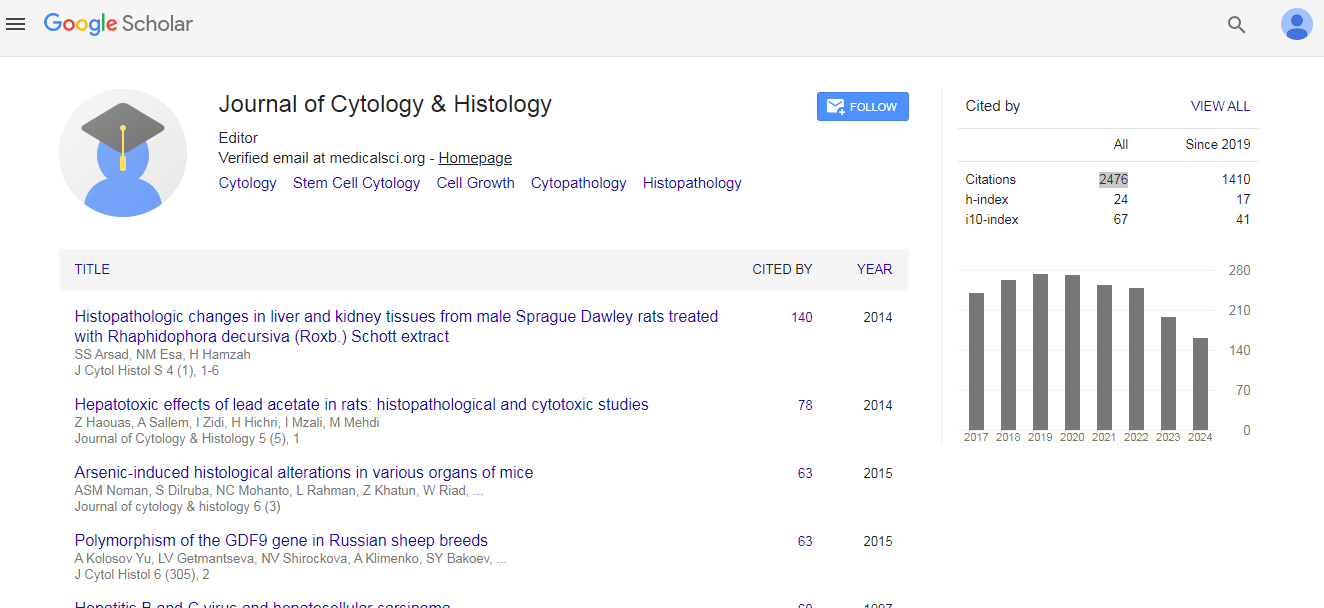
Journal of Cytology & Histology received 2476 citations as per Google Scholar report