Commentary - (2025) Volume 16, Issue 6
Received: 01-Nov-2025, Manuscript No. jch-26-178795;
Editor assigned: 03-Nov-2025, Pre QC No. P-178795;
Reviewed: 17-Nov-2025, QC No. Q-178795;
Revised: 22-Nov-2025, Manuscript No. R-178795;
Published:
29-Nov-2025
, DOI: 10.37421/2157-7099.2025.16.822
Citation: Petrova, Elena. ”Cytology: Diagnosing Head and Neck Lesions and Tumors.” J Cytol Histol 16 (2025):822.
Copyright: © 2025 Petrova E. This is an open-access article distributed under the terms of the Creative Commons Attribution License, which permits unrestricted use, distribution and reproduction in any medium, provided the original author and source are credited.
Cytological assessment serves as a fundamental tool in the diagnosis and management of head and neck lesions, providing a minimally invasive pathway to distinguish between benign and malignant conditions. Fine-needle aspiration biopsy (FNAB) coupled with cytological examination offers swift results, thereby assisting in treatment planning and prognosis assessment. [1] Significant advancements in cytological techniques, such as liquid-based cytology and immunocytochemistry, have demonstrably enhanced diagnostic accuracy over time. [1] The application of molecular diagnostics to cytology specimens is increasingly recognized for its importance in developing personalized treatment strategies, particularly for HPV-related oropharyngeal cancers and various salivary gland tumors. [1] Accurate cytological interpretation is paramount for the definitive identification of squamous cell carcinoma and its precursor lesions within the head and neck region. [2] The ability to differentiate between reactive atypia and true malignancy, alongside the precise classification of different squamous cell carcinoma subtypes, profoundly impacts patient management strategies. [2] A thorough understanding of the cytomorphological characteristics of diverse benign and malignant salivary gland tumors, including pleomorphic adenoma and adenoid cystic carcinoma, constitutes a key aspect of comprehensive cytological evaluation in this anatomical area. [2] The integration of Human Papillomavirus (HPV) testing into cytological analysis has revolutionized the assessment of oropharyngeal squamous cell carcinoma. [3] Cytological samples are now routinely utilized for both morphological evaluation and the molecular detection of HPV, facilitating the identification of high-risk lesions and guiding the implementation of HPV-targeted therapies. [3] This synergistic approach, combining cytology with molecular diagnostics, offers a more precise methodology for risk stratification and optimal treatment selection for HPV-associated head and neck cancers. [3] Liquid-based cytology (LBC) has progressively gained traction in the field of head and neck cytology, primarily due to its superior sample preservation capabilities and reduction in obscuring factors compared to traditional conventional smears. [4]
Cytological assessment is a pivotal component in the diagnostic and therapeutic management of head and neck lesions, offering a less invasive method for distinguishing between benign and malignant pathologies. Fine-needle aspiration biopsy (FNAB) followed by cytological examination provides rapid diagnostic insights, which are crucial for timely treatment planning and prognostic evaluation. [1] The evolution of cytological methodologies, including the adoption of liquid-based cytology and the application of immunocytochemistry, has significantly improved diagnostic precision. [1] Furthermore, the integration of molecular diagnostics with cytological specimens is becoming increasingly vital for tailoring personalized treatment approaches, especially in the context of HPV-related oropharyngeal cancers and tumors of the salivary glands. [1] The accurate cytological interpretation is indispensable for the detection of squamous cell carcinoma and its pre-malignant lesions within the head and neck. [2] Distinguishing between reactive atypia and malignant changes, as well as classifying the various subtypes of squamous cell carcinoma, are critical factors that influence patient management decisions. [2] A comprehensive understanding of the cytomorphological features characterizing a range of benign and malignant salivary gland tumors, such as pleomorphic adenoma and adenoid cystic carcinoma, is fundamental to the cytological evaluation of lesions in this region. [2] The introduction of HPV testing within cytological assessments has profoundly transformed the evaluation of oropharyngeal squamous cell carcinoma. [3] Cytological samples can be effectively utilized for both morphological assessment and the molecular identification of HPV, enabling the detection of high-risk lesions and guiding the administration of HPV-directed therapies. [3] This combined approach of cytology and molecular diagnostics provides a more refined strategy for risk stratification and the selection of appropriate treatments for HPV-driven head and neck cancers. [3] Liquid-based cytology (LBC) has become increasingly prevalent in head and neck cytology, offering advantages in terms of sample preservation and a reduction in factors that can obscure diagnostic interpretation when compared to conventional smears. [4]
Cytological assessment, particularly through fine-needle aspiration biopsy (FNAB), is a crucial, minimally invasive method for diagnosing head and neck lesions, aiding in treatment planning and prognosis. Advances like liquid-based cytology and immunocytochemistry enhance diagnostic accuracy. Molecular diagnostics are increasingly important for personalized treatments, especially in HPV-related oropharyngeal cancers and salivary gland tumors. Accurate interpretation is vital for identifying squamous cell carcinoma and its precursors, as well as for classifying various salivary gland tumors. HPV testing in cytology has revolutionized oropharyngeal cancer assessment, enabling targeted therapies. Liquid-based cytology offers improved sample quality and facilitates ancillary testing. Immunocytochemistry is essential for resolving equivocal diagnoses and classifying tumors. Thyroid nodules are primarily assessed by FNAB using the Bethesda System. Cytology also plays a key role in diagnosing metastatic head and neck lymphadenopathy. Quality assurance, including standardized reporting and continuous education, is paramount for reliable cytological services.
None
None
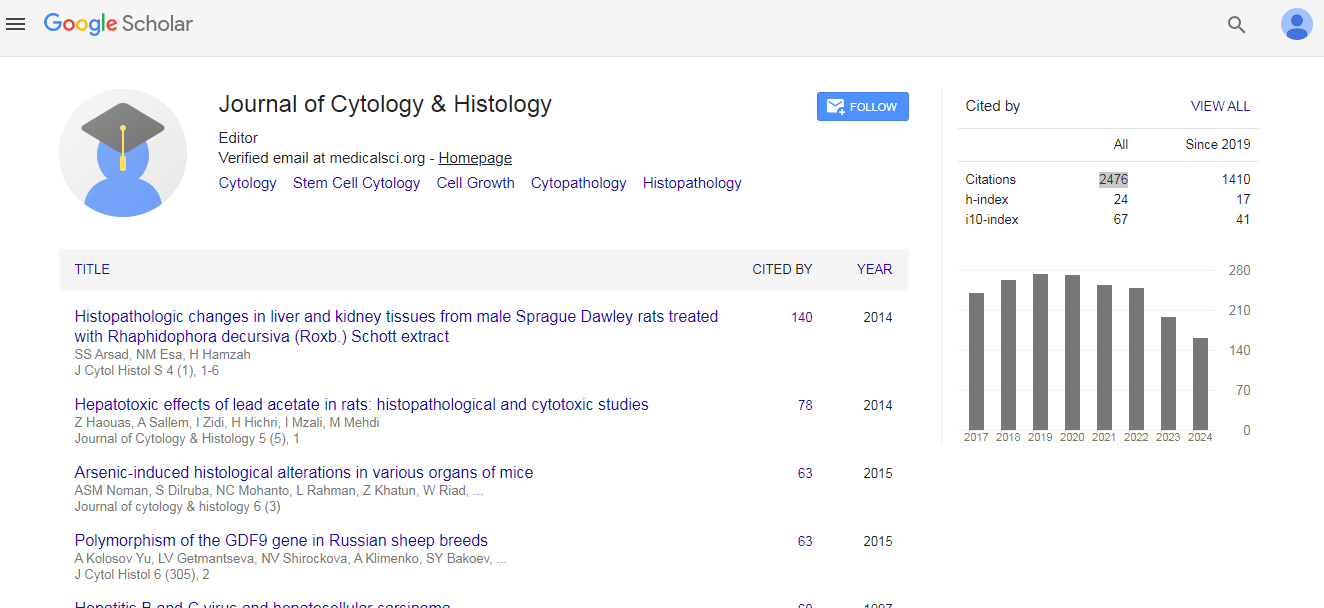
Journal of Cytology & Histology received 2476 citations as per Google Scholar report