Short Communication - (2025) Volume 11, Issue 3
Received: 01-Aug-2025, Manuscript No. jotr-25-175586;
Editor assigned: 04-Aug-2025, Pre QC No. P-175586;
Reviewed: 18-Aug-2025, QC No. Q-175586;
Revised: 22-Aug-2025, Manuscript No. R-175586;
Published:
29-Aug-2025
, DOI: 10.37421/2476-2261. 2025.11.312
Citation: Alvarez, Pedro. ”ctDNA: Reshaping Cancer Management, Improving Outcomes.” J Oncol Transl Res 11 (2025):312.
Copyright: © 2025 Alvarez P. This is an open-access article distributed under the terms of the Creative Commons Attribution License, which permits unrestricted use, distribution and reproduction in any medium, provided the original author and source are credited.
Circulating tumor DNA (ctDNA) is transforming the landscape of cancer management. This advanced tool offers comprehensive insights across the entire cancer journey, from initial detection to monitoring therapeutic efficacy and identifying potential recurrence. It's proving to be a truly innovative game-changer, enabling clinicians to make more informed decisions and significantly improve patient outcomes [1].
Here's the thing about ctDNA: it holds immense promise for detecting minimal residual disease (MRD) in patients with early-stage solid tumors. Reviews focusing on this aspect highlight its critical potential to reshape future adjuvant therapies. This provides doctors with a clearer, more precise path forward after a patient's initial treatment regimen [2].
What this really means is that ctDNA provides a dynamic and real-time mechanism to track how cancer evolves and responds to various treatments. Itâ??s instrumental in helping us understand resistance mechanisms as they emerge, allowing for the implementation of smarter, more adaptable therapeutic strategies tailored as a patientâ??s disease progresses over time [3].
This paper emphasizes ctDNA's expanding potential for much earlier cancer detection and vigilant monitoring of patients for any signs of disease recurrence. The core idea here is to stay ahead of the disease, enabling proactive management that ultimately leads to better long-term outcomes for individuals battling cancer [4].
Consider ctDNA a truly non-invasive liquid biopsy, a revolutionary approach in oncology. Itâ??s significantly aiding in profiling tumors at a molecular level and monitoring treatment responses in real-time. This capability allows doctors to tailor cancer therapies with unprecedented precision, aligning treatments more closely with each individual patient's unique molecular makeup [5].
This review specifically underscores ctDNA's growing importance for patients diagnosed with brain tumors. It offers a crucial, less invasive alternative for diagnosis, predicting the disease course, and monitoring treatment efficacy. This represents a major advantage, often reducing the need for more invasive brain biopsies [6].
For colorectal cancer, ctDNA is making substantial waves and advancing personalized care. Its utility spans from early disease detection and the identification of minimal residual disease to effectively tracking treatment effectiveness and accurately predicting recurrence. This technology is profoundly enhancing how healthcare providers deliver tailored, effective interventions [7].
This study explores the predictive power of ctDNA regarding the efficacy of immunotherapy in solid tumors. It presents a valuable, non-invasive method to potentially identify which patients are most likely to benefit from specific immunotherapies, while also allowing for ongoing assessment of treatment response and overall effectiveness [8].
Over the past few years, weâ??ve witnessed significant leaps in the analytical methods for ctDNA. These technological advancements have dramatically improved our ability to detect ctDNA with greater accuracy and heightened sensitivity. This progress is crucial, as it opens the door for its broader application across a wider spectrum of clinical situations and various cancer types [9].
This article unequivocally highlights ctDNAâ??s critical role as a reliable prognostic and predictive biomarker, especially for metastatic colorectal cancer. It actively assists clinicians in forecasting how the disease will progress and how patients will respond to therapeutic interventions, thereby facilitating more informed and strategic treatment decisions [10].
Circulating tumor DNA (ctDNA) represents a paradigm shift in cancer diagnosis, monitoring, and treatment. It acts as a non-invasive liquid biopsy, providing a dynamic window into the genetic landscape of a tumor through a simple blood test. This capability allows for real-time profiling of tumors and continuous monitoring of treatment responses [5]. Significant advancements in ctDNA analysis over recent years have dramatically improved its detection accuracy and sensitivity, broadening its applicability across diverse clinical scenarios and cancer types [9]. Its overall utility spans the entire patient journey, from initial early detection to ongoing management and assessment of treatment efficacy [1].
A key application of ctDNA lies in its unparalleled potential for early cancer detection and meticulous recurrence monitoring [4]. For patients with early-stage solid tumors, ctDNA is incredibly promising for detecting minimal residual disease, which can profoundly shape future adjuvant therapies and guide treatment intensification or de-escalation after initial interventions [2]. In specific cancers like colorectal cancer, ctDNA has proven instrumental in early disease spotting, identifying minimal residual disease, tracking treatment effectiveness, and accurately predicting recurrence, thereby significantly enhancing personalized patient care [7].
What this really means is that ctDNA provides a dynamic means to track how cancer changes and responds to treatments in real-time. This allows for a deeper understanding of resistance mechanisms as they emerge, paving the way for more adaptable and smarter therapeutic strategies as the disease progresses [3]. Moreover, ctDNA offers a non-invasive method to predict the efficacy of immunotherapy in solid tumors, helping to identify patients most likely to benefit from specific immunotherapies and enabling continuous monitoring of their response [8]. This predictive capability is crucial for optimizing therapeutic approaches.
The clinical utility of ctDNA extends to challenging areas such as brain tumors, where it offers a less invasive alternative for diagnosis, predicting disease course, and monitoring treatment, often bypassing the need for invasive brain biopsies [6]. Furthermore, ctDNA has established itself as a reliable prognostic and predictive biomarker in metastatic colorectal cancer, aiding clinicians in forecasting disease progression and patient response to treatment, leading to more informed and timely clinical decisions [10].
Collectively, these insights underscore ctDNA's transformative impact on oncology, moving towards a future where cancer management is more precise, personalized, and patient-centric. Its evolving capabilities promise to refine current practices and open new avenues for therapeutic interventions, ultimately leading to improved long-term outcomes across a wide spectrum of cancers.
Circulating tumor DNA (ctDNA) is fundamentally reshaping cancer management by offering a non-invasive, dynamic liquid biopsy. This technology provides comprehensive insights across the entire cancer journey, from early detection and identifying minimal residual disease to tracking treatment response, understanding resistance mechanisms, and monitoring for recurrence. Significant analytical advancements have enhanced its accuracy and sensitivity, broadening its application across various cancer types and clinical situations. For instance, ctDNA is proving invaluable in solid tumors for predicting the efficacy of immunotherapy, helping identify responders and track treatment progress. In colorectal cancer, it supports personalized care, from early disease spotting and minimal residual disease detection to assessing treatment effectiveness and predicting recurrence. Furthermore, ctDNA offers a less invasive diagnostic and monitoring tool for challenging cancers like brain tumors, often reducing the need for invasive biopsies. Ultimately, ctDNA is a game-changer, enabling more precise, adaptable, and informed therapeutic strategies through tailored, real-time molecular insights into tumor evolution and treatment effectiveness, leading to significantly improved patient outcomes across a wide spectrum of cancers.
None
None
Ting C, Weichen H, Zijie Z. "Clinical applications of circulating tumor DNA in cancer management: a systematic review".Front Oncol 13 (2023):1095982.
Indexed at, Google Scholar, Crossref
Emil O, Christian W, Isaac K. "Circulating tumor DNA in early-stage solid tumors: current landscape and future directions for minimal residual disease detection.".NPJ Precis Oncol 7 (2023):68.
Indexed at, Google Scholar, Crossref
Mariam J, Ibrahim A, Maria K. "Tracking cancer evolution and response to therapy using circulating tumor DNA.".Nat Med 28 (2022):477-488.
Indexed at, Google Scholar, Crossref
Ailing Y, Dandan S, Ji F. "Circulating Tumor DNA in Early Cancer Detection and Recurrence Monitoring".Cancer Res Treat 56 (2024):1-10.
Indexed at, Google Scholar, Crossref
Giovanni S, Silvia M, Salvatore S. "Circulating Tumor DNA: A Liquid Biopsy for Precision Oncology".Clin Cancer Res 27 (2021):1858-1868.
Indexed at, Google Scholar, Crossref
Yaqi W, Jian J, Shuping Y. "The clinical utility of circulating tumour DNA in patients with brain tumours: A systematic review.".Front Oncol 12 (2022):968516.
Indexed at, Google Scholar, Crossref
Siyi C, Hu W, Feng X. "Clinical Utility of Circulating Tumor DNA in Colorectal Cancer Management: Recent Advances and Future Perspectives".Cancers (Basel) 15 (2023):1812.
Indexed at, Google Scholar, Crossref
Ruijing J, Shenglin L, Yuling Y. "Circulating Tumor DNA and Tumor-Infiltrating Lymphocytes as Biomarkers for Predicting the Efficacy of Immunotherapy in Solid Tumors.".Front Oncol 11 (2021):794210.
Indexed at, Google Scholar, Crossref
Jillian P, Mark S, Valerie A. "Advances in circulating tumor DNA analysis.".Mol Oncol 14 (2020):220-227.
Indexed at, Google Scholar, Crossref
Dominik PM, Klaus P, Andrea S. "Circulating tumor DNA as a prognostic and predictive biomarker in metastatic colorectal cancer.".Ann Oncol 30 (2019):917-927.
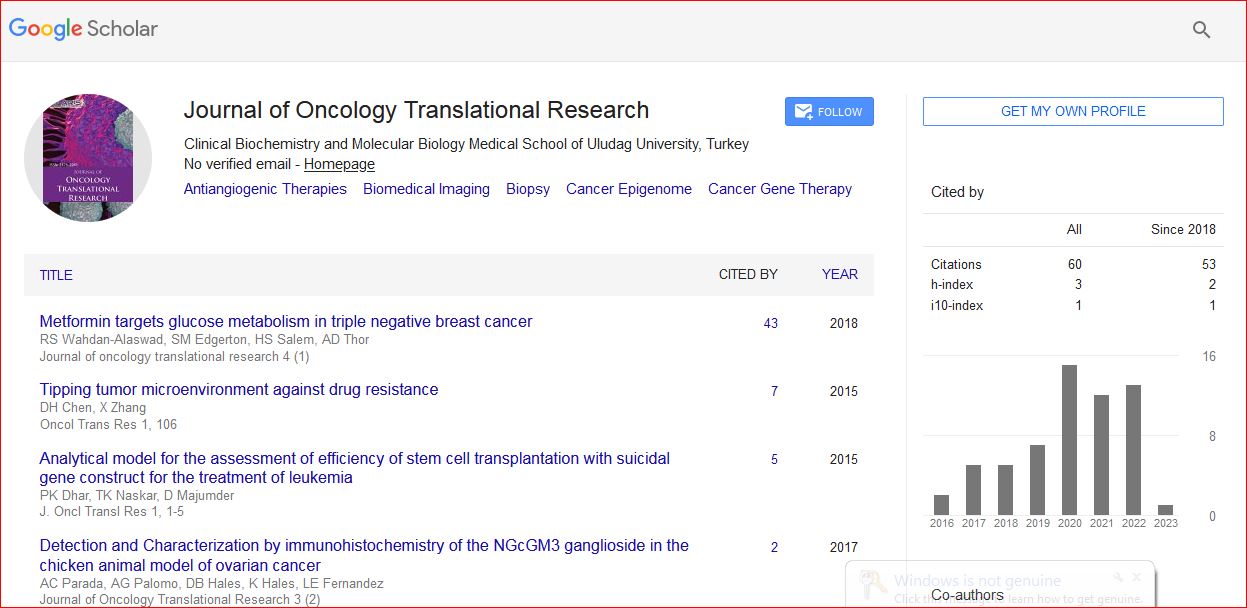
Journal of Oncology Translational Research received 93 citations as per Google Scholar report