Brief Report - (2025) Volume 16, Issue 4
Received: 01-Aug-2025, Manuscript No. jtse-26-184762;
Editor assigned: 03-Aug-2025, Pre QC No. P-184762;
Reviewed: 18-Aug-2025, QC No. Q-184762;
Revised: 22-Aug-2025, Manuscript No. R-184762;
Published:
29-Aug-2025
, DOI: 10.37421/2157-7552.2025.16.442
Citation: Ndlovu, Amara. ”Controlling Stem Cell Differentiation for Tissue Regeneration.” J Tissue Sci Eng 16 (2025):442.
Copyright: © 2025 Ndlovu A. This is an open-access article distributed under the terms of the Creative Commons Attribution License, which permits unrestricted use, distribution and reproduction in any medium, provided the original author and source are credited.
The field of tissue engineering has witnessed remarkable advancements, driven by the imperative to develop functional tissues for regenerative medicine and therapeutic applications. A central challenge lies in precisely guiding stem cell differentiation into specific lineages to create robust and well-vascularized engineered constructs. Biomaterials play a pivotal role in this process, offering platforms to mimic developmental cues and control the cellular microenvironment. Specifically, by carefully curating the biochemical signals and physical properties of biomaterial scaffolds, researchers can influence stem cell fate and promote desired differentiation pathways. This approach has been instrumental in developing more effective engineered tissues that can replace or repair damaged tissues and organs [1].
Beyond biochemical signals, mechanical forces are increasingly recognized as critical regulators of cell behavior and differentiation within engineered tissues. The mechanical properties of the surrounding environment, such as substrate stiffness and applied loads, can significantly impact cell phenotype and developmental trajectories. Understanding these mechanotransduction pathways is essential for designing scaffolds that can effectively translate mechanical cues into specific cellular responses, leading to the development of mechanically competent and functional engineered tissues [2].
Genetic engineering techniques offer another powerful avenue for controlling stem cell differentiation in tissue engineering. By modulating gene expression, researchers can directly steer progenitor cells towards desired fates, enhancing the therapeutic efficacy of engineered grafts. Strategies employing viral vectors and advanced gene-editing tools like CRISPR-Cas9 allow for precise manipulation of genetic pathways, ensuring specific lineage commitment and improving the overall regenerative potential of engineered tissues [3].
Advances in additive manufacturing, particularly 3D printing, have revolutionized the creation of complex tissue engineering scaffolds. These technologies enable precise control over scaffold architecture, porosity, and material composition, which are crucial for dictating cell behavior and differentiation. The ability to fabricate biomimetic scaffolds that promote cell infiltration, vascularization, and lineage commitment is a significant step towards creating advanced engineered tissues for clinical applications [4].
The extracellular matrix (ECM) serves as a natural scaffold, providing essential biochemical and physical cues that guide stem cell behavior and differentiation. Mimicking the native ECM, through the use of decellularized matrices or synthetic hydrogels, is a key strategy in tissue engineering. This approach allows for the recapitulation of crucial microenvironmental signals, promoting lineage-specific differentiation and facilitating the maturation of engineered tissues towards functional organs [5].
Small molecules and growth factors represent highly effective tools for precisely controlling stem cell differentiation in engineered tissues. By targeting specific signaling pathways, these agents can be used to activate or inhibit cellular processes, thereby directing cell fate towards desired phenotypes. This targeted approach offers a powerful means to tailor the properties of engineered tissues for specific therapeutic applications [6].
Microfluidic devices provide a sophisticated platform for creating highly controlled microenvironments essential for guiding cell differentiation in engineered tissues. These devices allow for the precise delivery of soluble factors, precise control of shear stress, and the generation of complex spatial gradients that closely mimic developmental conditions. Such controlled environments are vital for promoting specific cell lineages and optimizing tissue development [7].
Bioelectrical signals also play a significant role in regulating cell differentiation within engineered tissues. Electrical stimulation can influence ion channel activity and intracellular signaling pathways, which in turn can guide stem cell fate and promote tissue development and function. Understanding and harnessing these bioelectrical cues offers a novel approach to enhance the efficacy of tissue engineering strategies [8].
The concept of tissue-specific niche engineering is paramount for directing stem cell differentiation effectively for regenerative medicine. By meticulously recreating the native cellular and extracellular environment, researchers can create an optimal niche that promotes desired differentiation pathways. This targeted approach enhances the integration and functional outcomes of engineered tissues, bringing them closer to clinical translation [9].
Extracellular vesicles, including exosomes, are emerging as potent signaling agents capable of modulating stem cell differentiation in engineered tissues. These vesicles can deliver therapeutic molecules and influence intercellular communication, thereby promoting lineage commitment and facilitating tissue repair. Their role highlights a sophisticated biological mechanism that can be leveraged for advanced regenerative medicine applications [10].
Biomaterials are fundamental to tissue engineering, serving as dynamic platforms that dictate stem cell behavior and drive differentiation towards specific lineages. By meticulously controlling the microenvironment and delivering precise biochemical cues, researchers can guide stem cell fate within engineered tissues. Advanced biomaterials and growth factors are employed to recapitulate developmental processes, ultimately aiming to create more functional and vascularized engineered tissues suitable for regenerative medicine applications. The integration of these biomaterials with stem cells offers a promising avenue for addressing tissue loss and dysfunction [1].
Mechanical forces are integral to the development and functionality of engineered tissues, exerting significant influence over cell behavior and differentiation. Substrate stiffness, applied loads, and fluid shear stress are critical mechanical cues that can profoundly impact cell phenotype and tissue development. Understanding the intricate mechanisms of mechanotransduction is crucial for engineers aiming to create robust and functionally integrated engineered constructs that respond appropriately to mechanical stimuli encountered in vivo [2].
Genetic engineering strategies are increasingly being integrated into tissue engineering to achieve highly specific differentiation outcomes. By employing techniques such as viral vector-mediated gene delivery and CRISPR-Cas9 gene editing, researchers can precisely modulate gene expression in progenitor cells. This genetic control guides cells towards desired fates, significantly enhancing the therapeutic potential and efficacy of engineered grafts for regenerative medicine [3].
Three-dimensional (3D) printing technologies are transforming the fabrication of intricate scaffolds for tissue engineering. These advanced manufacturing methods allow for unparalleled control over scaffold architecture, porosity, and material composition. This precise control is essential for dictating cell behavior, promoting cell infiltration, vascularization, and lineage commitment, thereby offering sophisticated solutions for tissue regeneration [4].
The extracellular matrix (ECM) plays a vital role in orchestrating stem cell differentiation. Mimicking the native ECM through the use of decellularized biological scaffolds or synthetic hydrogels provides essential biochemical and physical cues. This biomimicry is critical for promoting lineage-specific differentiation and ensuring the proper maturation of engineered tissues, paving the way for more effective regenerative therapies [5].
Small molecules and growth factors are indispensable tools for achieving precise control over stem cell differentiation within engineered tissues. These agents act by modulating specific signaling pathways, steering cell fate towards desired phenotypes and tailoring the resultant tissue properties. This precise control allows for the development of engineered tissues with specific functional characteristics required for various therapeutic applications [6].
Microfluidic devices offer a powerful means to establish highly controlled microenvironments for guiding cell differentiation. These platforms enable the precise spatial and temporal delivery of soluble factors, fine-tuning of shear stress, and creation of complex gradients that mirror developmental conditions. This sophisticated control is vital for promoting specific cell lineages and optimizing the development of engineered tissues [7].
Bioelectrical signals represent an emergent modality for regulating cell differentiation in engineered tissues. Electrical stimulation can modulate ion channel activity and intracellular signaling cascades, thereby influencing stem cell fate and promoting robust tissue development and function. Harnessing bioelectrical phenomena provides a novel dimension to the field of tissue engineering and regenerative medicine [8].
Engineering the tissue-specific niche is a cornerstone strategy for directing stem cell differentiation for regenerative medicine applications. By accurately recreating the native cellular and extracellular milieu, researchers can effectively promote desired differentiation pathways. This approach not only enhances differentiation but also improves the integration and functional capacity of the resulting engineered tissues [9].
Exosomes and other extracellular vesicles are gaining prominence as signaling agents for modulating stem cell differentiation in engineered tissues. These vesicles effectively deliver therapeutic molecules and mediate intercellular communication, thereby promoting lineage commitment and supporting tissue repair. Their intricate biological functions offer new possibilities for advanced tissue engineering strategies [10].
This collection of research explores diverse strategies for controlling stem cell differentiation within engineered tissues, a critical aspect of regenerative medicine. Key themes include the use of biomaterials to mimic developmental cues [1], the influence of mechanical forces on cell fate [2], and the application of genetic engineering for targeted differentiation [3].
Advanced manufacturing techniques like 3D printing enable the creation of complex, biomimetic scaffolds [4] that replicate the extracellular matrix [5].
Small molecules and growth factors provide precise control over signaling pathways [6], while microfluidic devices create controlled microenvironments [7].
Bioelectrical signals also play a regulatory role [8].
The overarching goal is to engineer specific tissue niches [9] and leverage signaling agents like exosomes [10] to promote lineage commitment and functional tissue regeneration for therapeutic purposes.
None
None
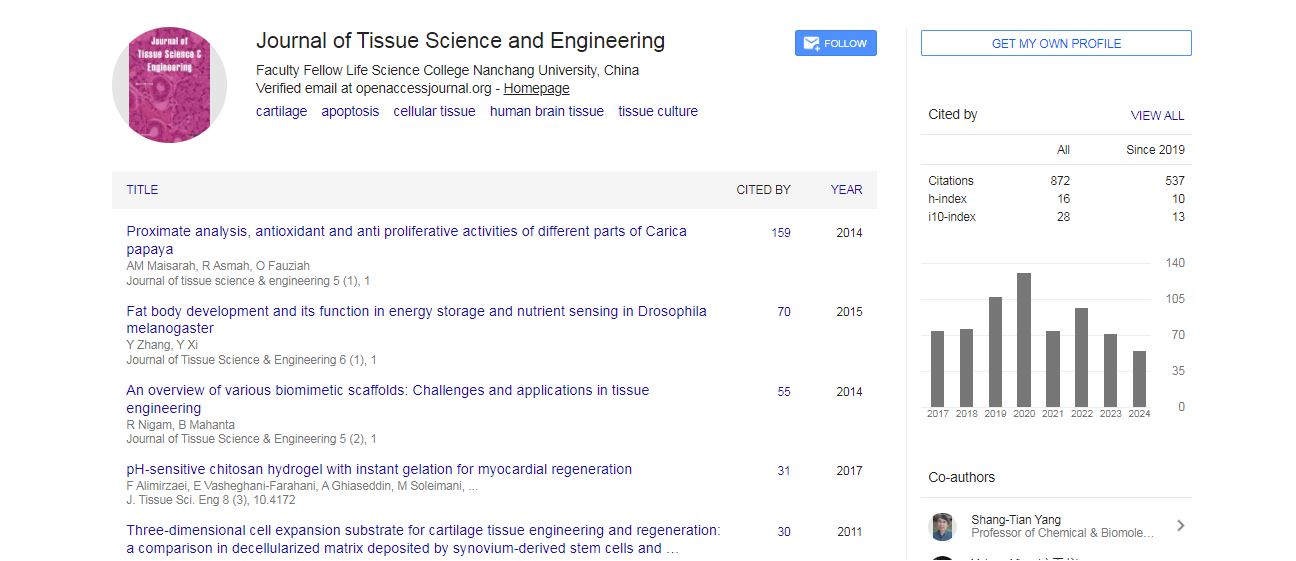
Journal of Tissue Science and Engineering received 807 citations as per Google Scholar report