Opinion - (2025) Volume 16, Issue 3
Received: 01-May-2025, Manuscript No. assj-25-172506;
Editor assigned: 05-May-2025, Pre QC No. P-172506;
Reviewed: 19-May-2025, QC No. Q-172506;
Revised: 22-May-2025, Manuscript No. R-172506;
Published:
29-May-2025
, DOI: 10.37421/2151-6200.2025.16.667
Citation: Malhotra, Arjun. ”Contemporary Economics: Challenges, Policies, Innovations.” Arts Social Sci 16 (2025):670.
Copyright: © 2025 Malhotra A. This is an open-access article distributed under the terms of the Creative Commons Attribution License, which permits unrestricted use, distribution and reproduction in any medium, provided the original author and source are credited.
The Federal Reserve faces intricate trade-offs in balancing maximum employment and stable prices, navigating various shocks and designing effective monetary policy rules under uncertainty [1].
The economic dimensions of climate change integrate policy, science, and societal impacts, requiring discussions on mitigation and adaptation instruments, economic efficiency, distributional effects, and international cooperation challenges, highlighting the urgency of robust economic models [2].
Competition policy in the rapidly expanding digital economy addresses network effects, data ownership, platform dominance, and consumer welfare implications, proposing frameworks to adapt traditional antitrust principles to new market structures and foster innovation [3].
The relationship between redistribution policies and income inequality involves synthesizing theoretical and empirical evidence, reviewing fiscal tools like progressive taxation and social transfers, and examining trade-offs between equity and efficiency [4].
Behavioral economics principles are applied to public policy design, focusing on 'nudges' and interventions that account for psychological biases in decision-making, evaluating their potential to improve outcomes in health, finance, and education while considering ethical implications [5].
International trade experiences fundamental shifts driven by the rise of Global Value Chains (GVCs), which reshape traditional trade patterns, influence national economic policies, and affect welfare distribution, providing a framework for understanding contemporary trade dynamics [6].
Automation and Artificial Intelligence (AI) have significant macroeconomic and labor market implications, affecting economic growth, the distribution of income between labor and capital, and employment levels, prompting a critical perspective on the 'race' between human skills and machine capabilities [7].
Methods for measuring poverty and assessing poverty reduction policies require re-evaluation, advocating for nuanced, multidimensional approaches that go beyond income-based metrics to address the root causes of deprivation [8].
Optimal taxation policies must consider individuals with behavioral biases, structuring taxes not only for revenue and wealth redistribution but also to 'nudge' individuals towards socially desirable behaviors, accounting for factors like inattention and self-control [9].
Deep learning techniques are being introduced to asset pricing, demonstrating how advanced machine learning models can uncover complex patterns in financial data, potentially improving forecasting of asset returns and risk, and offering new frontiers in market efficiency and investment strategies [10].
Modern economic policy confronts intricate issues, ranging from the Federal Reserve's delicate balance between maximum employment and stable prices amidst various economic shocks [1] to the evolving landscape of competition policy in the digital age. This rapidly expanding digital economy introduces unique challenges such as network effects, data ownership, and the dominance of platform enterprises. Crafting effective regulatory frameworks requires adapting traditional antitrust principles to these new market structures, aiming to foster innovation while simultaneously preventing anticompetitive practices and protecting consumer welfare [3].
Furthermore, contemporary public policy design increasingly incorporates insights from behavioral economics. This involves leveraging an understanding of psychological biases in decision-making to create 'nudges' and other interventions that aim to improve societal outcomes in critical areas like public health, financial literacy, and educational attainment, all while carefully considering the ethical implications of such interventions [5]. Complementing this, research on optimal taxation policies now accounts for behavioral agents, exploring how taxes can be structured not solely for revenue generation and wealth redistribution but also to subtly guide individuals towards socially desirable behaviors, addressing issues such as inattention and self-control problems [9].
Significant efforts are directed towards understanding and improving societal well-being and environmental sustainability. Research extensively synthesizes theoretical and empirical evidence regarding redistribution policies and income inequality. This body of work reviews the efficacy of diverse fiscal tools, including progressive taxation and social transfers, in mitigating economic disparities, and critically examines the complex trade-offs that exist between achieving equity and maintaining economic efficiency in policy implementation [4]. Parallel to this, the economic dimensions of climate change are thoroughly examined, integrating crucial insights from policy analysis, scientific research, and assessments of societal impacts. Discussions cover various policy instruments for both mitigation and adaptation, their economic efficiency, and their distributional effects across different segments of society, alongside the considerable challenges inherent in achieving robust international cooperation on climate action, emphasizing the urgent need for sophisticated economic models [2]. Additionally, the re-evaluation of methods for measuring poverty and assessing poverty reduction policies highlights the multidimensional nature of deprivation, advocating for more nuanced measurement approaches and innovative interventions that move beyond simple income-based metrics to tackle the underlying causes of poverty effectively [8].
The global economic landscape is being fundamentally reshaped by major shifts, particularly the widespread emergence of Global Value Chains (GVCs). These intricate networks are redefining traditional international trade patterns, profoundly influencing national economic policies, and affecting the distribution of welfare across nations. This offers a vital analytical framework for comprehending contemporary trade dynamics and their broad implications for national development strategies and industrial policy design [6]. Simultaneously, the rapid advancements in automation and Artificial Intelligence (AI) are exerting substantial macroeconomic and labor market impacts. These technological developments directly influence overall economic growth, alter the distribution of income between labor and capital, and affect employment levels across various sectors. This ongoing dynamic, often characterized as a 'race' between human skills and machine capabilities, demands a critical and forward-looking perspective on its consequences for future economies and labor markets [7].
A promising new frontier in economic analysis involves the sophisticated application of deep learning techniques within the field of financial economics, particularly asset pricing. Studies demonstrate how advanced machine learning models possess the capability to uncover complex and often hidden patterns within vast financial datasets. This innovative approach holds significant potential for enhancing the accuracy of forecasting asset returns and better understanding market risk. It signifies a new era in deciphering market efficiency and developing highly sophisticated investment strategies, bridging the gap between cutting-edge computational science and traditional financial theory [10]. This integration promises to dramatically refine our analytical capabilities and deepen our comprehension of intricate market behaviors.
This collection of articles offers a broad perspective on contemporary economic challenges and policy responses. It explores the Federal Reserve's complex task of balancing employment and price stability, navigating various shocks and designing effective monetary policy rules. The economic dimensions of climate change, including policy instruments for mitigation and adaptation, their efficiency, and the challenges of international cooperation, are also thoroughly discussed. The digital economy's impact on competition policy is examined, addressing issues like network effects, platform dominance, and consumer welfare, while simultaneously considering how redistribution policies, such as progressive taxation and social transfers, influence income inequality and the trade-offs between equity and efficiency. The application of behavioral economics to public policy, leveraging 'nudges' to account for psychological biases in decision-making for improved outcomes in health, finance, and education, is a prominent theme. Additionally, the re-evaluation of poverty measurement to adopt multidimensional approaches that go beyond income-based metrics is highlighted. Global Value Chains are shown to fundamentally reshape international trade patterns, affecting national policies and welfare distribution. Automation and Artificial Intelligence (AI) are analyzed for their significant macroeconomic and labor market consequences, particularly concerning economic growth, income distribution, and employment levels. Finally, the integration of deep learning techniques into asset pricing marks a significant advancement in uncovering complex financial patterns, improving forecasting of asset returns and risk, and informing sophisticated investment strategies. Together, these works highlight the interdisciplinary nature of modern economic inquiry, addressing core issues in macroeconomic policy, social equity, technological advancement, global trade, and novel analytical methods.
None
None
Indexed at, Google Scholar, Crossref
Indexed at, Google Scholar, Crossref
Indexed at, Google Scholar, Crossref
Indexed at, Google Scholar, Crossref
Indexed at, Google Scholar, Crossref
Indexed at, Google Scholar, Crossref
Indexed at, Google Scholar, Crossref
Indexed at, Google Scholar, Crossref
Indexed at, Google Scholar, Crossref
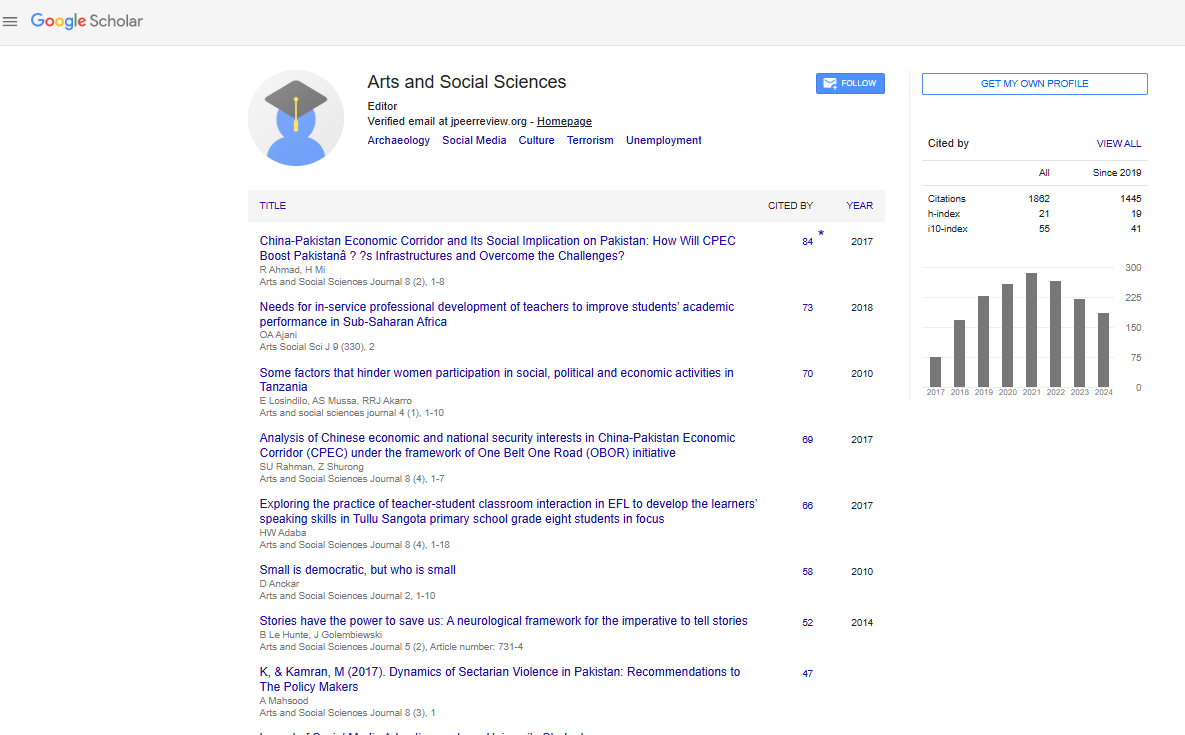
Arts and Social Sciences Journal received 1413 citations as per Google Scholar report