Short Communication - (2025) Volume 9, Issue 6
Received: 01-Dec-2025, Manuscript No. cmcr-25-178341;
Editor assigned: 03-Dec-2025, Pre QC No. P-178341;
Reviewed: 17-Dec-2025, QC No. Q-178341;
Revised: 22-Dec-2025, Manuscript No. R-178341;
Published:
29-Dec-2025
, DOI: 10.37421/2684-4915.2025.9.411
Citation: Yamamoto, Riku. ”Computational Methods: Transforming Biology and Medicine.” Clin Med Case Rep 09 (2025):411.
Copyright: © 2025 Yamamoto R. This is an open-access article distributed under the terms of the Creative Commons Attribution License, which permits unrestricted use, distribution and reproduction in any medium, provided the original author and source are credited.
The field of clinical genomics is being profoundly reshaped by Artificial Intelligence (AI), which is at the forefront of developments ranging from the precise diagnosis of rare diseases to the accurate prediction of individual treatment responses. Artificial Intelligence (AI) plays an increasingly critical role in navigating immense genomic datasets, uncovering crucial patterns that guide personalized patient care, marking a significant stride towards truly individualized medical approaches[1].
Concurrently, significant effort has gone into establishing robust methodologies for analyzing single-cell RNA sequencing data. This is particularly challenging given the inherent complexity and noise in such high-resolution datasets. Comprehensive guidelines now cover crucial steps from initial quality control to detailed cell type identification and sophisticated trajectory inference, aiming to provide a standardized framework that ensures consistent and reliable research outcomes across various laboratories[2].
Machine Learning's expanding influence on drug discovery is another key area, fundamentally streamlining the entire process. This includes its application in identifying promising drug candidates, predicting their efficacy with greater accuracy, and optimizing the design and execution of clinical trials. Despite recognized hurdles such as maintaining data quality and ensuring model interpretability, these computational methods are actively poised to revolutionize pharmaceutical research in the foreseeable future[3].
Focusing on specific technical complexities, another critical review addresses the computational hurdles within quantitative proteomics, particularly when dealing with large-scale mass spectrometry data. Issues highlighted include the efficient management of vast datasets, the accurate identification and quantification of proteins, and effective strategies for handling missing data. This work underscores current limitations in bioinformatics tools and points toward areas requiring significant development to fully exploit proteomics for profound biological discoveries[4].
The precision and efficacy of CRISPR-Cas9 gene editing technology are now heavily dependent on advanced bioinformatics tools. These computational aids are indispensable for tasks ranging from the careful design of guide RNAs, aimed at minimizing unwanted off-target effects, to the thorough analysis of editing outcomes, and the overall optimization of the entire gene editing workflow. The core message here is that achieving accurate and error-reduced gene editing critically relies on sophisticated computational strategies[5].
Bioinformatics is also proving central to deciphering the intricate complexities of the microbiome. It offers a diverse array of computational methods for analyzing extensive sequencing data from microbial communities, enabling not only accurate species identification but also a deeper understanding of their functional roles. By highlighting emerging trends and persistent challenges, experts suggest that superior bioinformatics tools are fundamental to realizing the full potential of microbiome research for both human health and disease contexts[6].
A landmark achievement in structural biology, AlphaFold, demonstrates a deep learning system capable of highly accurate protein structure prediction directly from amino acid sequences. This innovation represents a monumental leap, fundamentally altering how scientists approach understanding protein function and design novel therapeutics. What this really means is that a historically daunting grand challenge in biology has been largely overcome, thereby unlocking immense new avenues for scientific inquiry and application[7].
Furthermore, network biology, an essential component within the broader field of bioinformatics, is actively being employed in the quest for novel drug targets. Instead of concentrating solely on individual molecular components, this approach involves a comprehensive analysis of complex biological networks to pinpoint critical nodes or pathways. Modulating these identified points could lead to effective disease treatments, emphasizing an understanding of the biological system holistically rather than merely isolated parts, often resulting in more potent and less toxic drug candidates[8].
The transformative impact of translational bioinformatics on advancing precision medicine cannot be overstated. This crucial field effectively bridges the critical gap between foundational research and practical clinical application, integrating diverse 'omics' data with comprehensive patient information to inform and guide treatment decisions. Discussions on current strategies and future directions highlight how indispensable this discipline is for customizing medical interventions to meet the specific needs of individual patients[9].
Lastly, the bioinformatics landscape includes a specialized focus on tools for epigenomic data analysis, which provides crucial insights into gene expression regulation independently of changes in the underlying DNA sequence. This encompasses a range of computational tools for processing and interpreting complex datasets derived from techniques like ChIP-seq and ATAC-seq. The emphasis here lies on the persistent challenges and significant opportunities in integrating these diverse data types to unravel complex disease mechanisms and fundamental developmental processes[10].
Artificial Intelligence (AI) and Machine Learning (ML) are rapidly redefining the landscape of biomedical research and clinical applications, demonstrating their indispensable nature across various domains. For instance, Artificial Intelligence (AI) is already proving vital in clinical genomics, assisting in complex tasks that range from the precise diagnosis of rare diseases to accurately predicting individual patient responses to specific treatments [1]. This involves sophisticated methods for sifting through vast genomic datasets, uncovering meaningful patterns crucial for truly personalized patient care. Furthermore, Machine Learning (ML) techniques are fundamentally transforming the process of drug discovery, efficiently streamlining the identification of potential drug candidates, forecasting their efficacy with greater precision, and optimizing the design and execution of clinical trials. While challenges like maintaining data quality and ensuring model interpretability persist, the future of pharmaceutical research is undeniably shaped by these advanced computational methods [3]. Another significant aspect involves network biology, a key component within bioinformatics, which is strategically employed to identify novel drug targets by meticulously analyzing complex biological networks. This holistic approach, which emphasizes understanding entire systems rather than isolated molecular components, often leads to the development of more effective and less toxic drug candidates [8].
The sheer volume and inherent complexity of modern 'omics' data necessitate the development and application of advanced computational approaches for effective analysis. For instance, in single-cell RNA sequencing, establishing robust best practices is absolutely crucial given the data's often noisy and intricate nature. Methodologies now comprehensively cover everything from initial quality control and accurate cell type identification to precise trajectory inference, thereby creating a common framework that ensures consistent and reliable research results across diverse laboratories [2]. Similarly, quantitative proteomics faces its own set of significant computational hurdles, particularly when dealing with the massive datasets generated by mass spectrometry. Key issues here include the efficient management of incredibly large datasets, the precise identification and quantification of proteins, and developing effective strategies for handling missing data. This area clearly calls for enhanced bioinformatics tools to fully harness the immense power of proteomics for profound biological discovery [4]. Beyond genomics and proteomics, bioinformatics tools are also unequivocally essential for epigenomic data analysis. This specialized field focuses on understanding how gene expression is regulated without altering the underlying DNA sequence itself, utilizing sophisticated tools for techniques like ChIP-seq and ATAC-seq, and crucially integrating this diverse data to uncover intricate disease mechanisms and fundamental developmental processes [10].
Emerging biotechnologies, such as the revolutionary CRISPR-Cas9 gene editing, rely almost entirely on sophisticated bioinformatics support to achieve their full potential and ensure precision. Computational tools are absolutely vital for critical tasks ranging from the careful design of guide RNAs, specifically engineered to minimize unwanted off-target effects, to the thorough analysis of editing outcomes, and the continuous optimization of the entire gene editing process. This unequivocally underscores that achieving precision and significantly reducing errors in gene editing are intrinsically linked to the deployment of smart computational strategies [5]. A truly monumental leap in structural biology came with the development of AlphaFold, a groundbreaking deep learning system capable of highly accurate protein structure prediction directly from amino acid sequences. This profound breakthrough fundamentally changes how researchers approach understanding protein function and the subsequent design of new therapeutics, effectively solving what was once considered a long-standing grand challenge in biology and consequently opening vast new avenues for scientific inquiry and application [7].
Bioinformatics extends its extensive reach into diverse biological domains, notably including complex microbiome research. It provides an essential suite of computational methods for meticulously analyzing vast sequencing data derived from microbial communities, enabling not only accurate species identification but also a deeper deciphering of their intricate functional roles within ecosystems and host organisms. Understanding the emerging trends and persistent challenges in this field distinctly highlights that developing better bioinformatics tools is undeniably key to unlocking the full, transformative potential of microbiome research for both human health and disease [6]. Crucially, translational bioinformatics plays a vital and integrative role in advancing precision medicine by effectively bridging the critical gap between foundational basic research discoveries and practical clinical application. It achieves this by seamlessly integrating various 'omics' data with comprehensive patient information, thereby guiding highly personalized treatment decisions and ultimately tailoring medical care to the highly specific needs of individual patients, ensuring more effective and targeted interventions [9].
The presented collection of papers explores the profound impact of computational approaches across various biological and medical fields. Artificial Intelligence (AI) and Machine Learning (ML) are shown to be crucial in clinical genomics for personalized medicine, drug discovery for identifying candidates, and predicting efficacy. Bioinformatics offers indispensable tools for analyzing complex datasets, from single-cell RNA sequencing to quantitative proteomics, where managing large datasets and handling missing information are key challenges. Emerging technologies like CRISPR-Cas9 gene editing heavily rely on computational design and optimization to ensure precision and minimize errors. A landmark development, AlphaFold, demonstrates the power of deep learning in accurately predicting protein structures, effectively solving a major challenge in structural biology and opening new research avenues. Furthermore, bioinformatics is vital for understanding intricate biological systems, such as the microbiome, through advanced sequencing data analysis. It also contributes to identifying new drug targets via network biology, focusing on holistic system understanding. Finally, translational bioinformatics is highlighted for its role in bridging basic research with clinical application, integrating diverse 'omics' data for precision medicine. These works collectively underscore the essential and expanding role of computational methods in modern biology and healthcare.
None
None
Indexed at, Google Scholar, Crossref
Indexed at, Google Scholar, Crossref
Indexed at, Google Scholar, Crossref
Indexed at, Google Scholar, Crossref
Indexed at, Google Scholar, Crossref
Indexed at, Google Scholar, Crossref
Indexed at, Google Scholar, Crossref
Indexed at, Google Scholar, Crossref
Indexed at, Google Scholar, Crossref
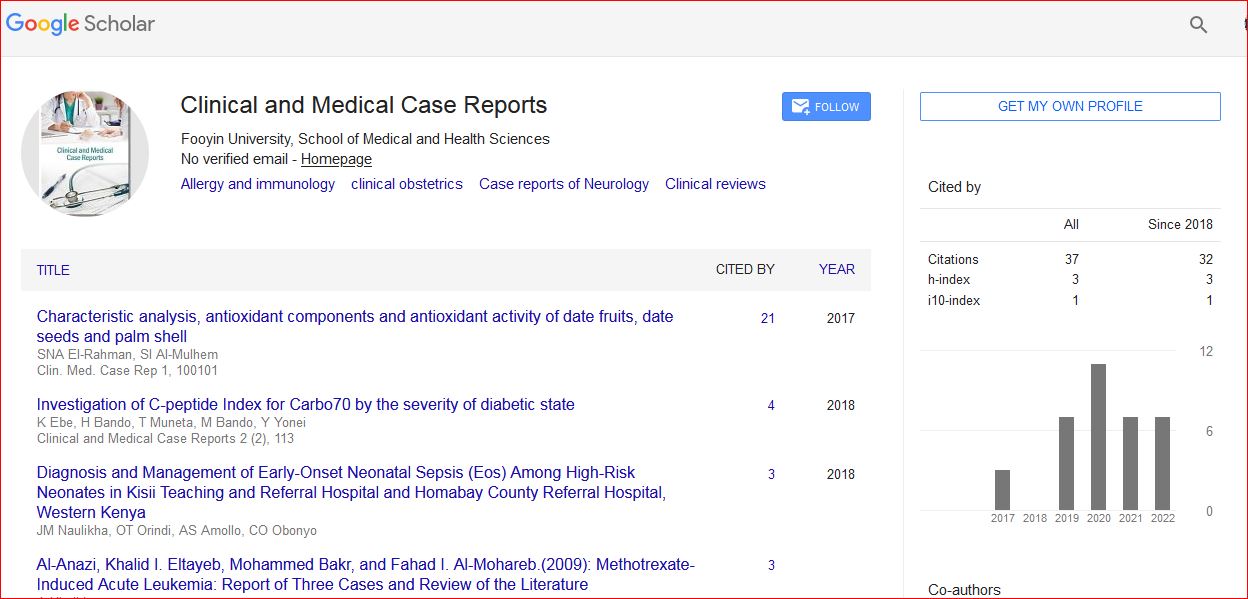
Clinical and Medical Case Reports received 53 citations as per Google Scholar report