Commentary - (2025) Volume 9, Issue 5
Received: 01-Oct-2025, Manuscript No. cmcr-25-178078;
Editor assigned: 03-Oct-2025, Pre QC No. P-178078;
Reviewed: 17-Oct-2025, QC No. Q-178078;
Revised: 22-Oct-2025, Manuscript No. R-178078;
Published:
29-Oct-2025
, DOI: 10.37421/2684-4915.2025.9.394
Citation: O’Neill, Patrick. ”Comprehensive Complication Management for Patient Safety.” Clin Med Case Rep 09 (2025):394.
Copyright: © 2025 O’Neill P. This is an open-access article distributed under the terms of the Creative Commons Attribution License, which permits unrestricted use, distribution and reproduction in any medium, provided the original author and source are credited.
Comprehensive guidelines are available for the perioperative management of patients with diabetes mellitus undergoing bariatric surgery. These emphasize optimized glycemic control, medication adjustments, and a multidisciplinary approach to prevent metabolic and surgical complications, ensuring better patient outcomes in a high-risk population [1].
A systematic review and meta-analysis synthesizes clinical practice guidelines for managing immune checkpoint inhibitor-related adverse events. It offers evidence-based recommendations for diagnosing and treating toxicities across various organ systems, which is crucial for optimizing patient safety and continuing effective cancer immunotherapy [2].
A narrative review focuses on strategies for complication management in adult patients undergoing extracorporeal membrane oxygenation (ECMO). This highlights common complications such as bleeding, thrombosis, infection, and neurological events, offering insights into their prevention, early detection, and effective therapeutic interventions to improve outcomes for critically ill patients on ECMO [3].
A practical approach is offered for the prevention and management of complications associated with transcatheter aortic valve implantation (TAVI). This discusses various procedural and post-procedural complications, including vascular injuries, stroke, paravalvular leak, and conduction abnormalities, providing guidance for clinical teams to mitigate risks and improve patient safety [4].
The management of complications arising from central venous catheters (CVCs) in critically ill patients is reviewed. This covers mechanical, infectious, and thrombotic complications, outlining best practices for CVC insertion, maintenance, and strategies for recognizing and treating adverse events to minimize patient morbidity and mortality in intensive care settings [5].
Neurovascular complications in Neuromyelitis Optica Spectrum Disorder (NMOSD) and Myelin Oligodendrocyte Glycoprotein Antibody-Associated Disease (MOGAD) are explored. This sheds light on diverse vascular events like stroke or venous thrombosis that can occur, highlighting the importance of early recognition and specific management strategies given the distinct pathophysiologies of these autoimmune conditions [6].
An updated overview is provided on the complications associated with living donor liver transplantation (LDLT). It details surgical, immunological, and infectious complications affecting both the donor and recipient, emphasizing the need for meticulous surgical technique, careful recipient selection, and comprehensive postoperative care to improve safety and outcomes in this complex procedure [7].
Diabetic retinopathy management in the current era of new therapies is examined in a comprehensive review. This discusses advancements in treatment, including anti-VEGF agents and surgical interventions, and how these impact the management of a leading cause of blindness in diabetic patients, emphasizing individualized treatment approaches and ongoing monitoring [8].
Perioperative complications and their management in total hip arthroplasty (THA) are addressed in an extensive review. It covers a wide spectrum of potential issues, from infection and dislocation to neurovascular injuries and periprosthetic fractures, providing insights into preventative measures and effective treatment strategies essential for successful outcomes in hip replacement surgery [9].
Complications associated with endoscopic submucosal dissection (ESD) and their effective management are discussed. This describes common complications like perforation, bleeding, and stricture, outlining strategies for prevention, early detection, and various endoscopic or surgical interventions to handle these adverse events, crucial for safe and successful complex endoscopic procedures [10].
Effective management of complications is a cornerstone of patient care across numerous medical disciplines. Recent literature highlights the development of comprehensive guidelines and systematic reviews designed to standardize approaches and improve safety. For example, consensus statements guide perioperative care for patients with diabetes undergoing bariatric surgery, focusing on glycemic control and multidisciplinary team efforts to mitigate metabolic and surgical risks [1]. Similarly, systematic reviews provide evidence-based recommendations for managing adverse events related to immune checkpoint inhibitors, crucial for sustaining cancer immunotherapy while ensuring patient well-being [2]. These foundational documents emphasize preventative measures and early detection, which are vital for optimizing outcomes in complex medical scenarios.
Critically ill patients frequently face a unique set of challenges regarding complications, often exacerbated by advanced life support devices. The management of complications in adult patients undergoing extracorporeal membrane oxygenation (ECMO) involves careful strategies for preventing, detecting, and treating issues like bleeding, thrombosis, infection, and neurological events [3]. In a similar vein, the use of central venous catheters (CVCs) in intensive care requires a meticulous approach to prevent mechanical, infectious, and thrombotic complications through best practices in insertion and maintenance, alongside clear protocols for treating adverse events to reduce morbidity and mortality [5]. Recognizing these device-related risks and implementing proactive management strategies are paramount for improving outcomes in high-acuity environments.
Advanced interventional and surgical procedures, while life-saving, inherently carry risks of significant complications. Transcatheter aortic valve implantation (TAVI) presents potential procedural and post-procedural complications such as vascular injuries, stroke, paravalvular leak, and conduction abnormalities. Clinical teams need practical strategies to prevent and manage these to enhance patient safety [4]. In abdominal surgery, complications associated with endoscopic submucosal dissection (ESD) include perforation, bleeding, and stricture, demanding precise prevention, early detection, and appropriate endoscopic or surgical interventions for successful outcomes [10]. These cases underline the need for specialized expertise in minimizing adverse events during complex procedures.
Transplantation and reconstructive surgeries are major interventions with complex complication profiles affecting both donors and recipients. Living donor liver transplantation (LDLT), for instance, can lead to surgical, immunological, and infectious complications. Improving safety and outcomes in LDLT relies on meticulous surgical technique, careful recipient selection, and comprehensive postoperative care [7]. In orthopedic surgery, total hip arthroplasty (THA) carries risks of perioperative complications like infection, dislocation, neurovascular injuries, and periprosthetic fractures. Effective management strategies for these issues are crucial for long-term success in hip replacement surgery [9].
Beyond procedural complications, certain diseases are associated with specific and challenging adverse events. Diabetic retinopathy, a leading cause of blindness in diabetic patients, requires ongoing management that has evolved with new therapies, including anti-VEGF agents and surgical interventions, highlighting the importance of individualized treatment and monitoring [8]. Moreover, autoimmune conditions can lead to intricate neurological complications. Neurovascular events such as stroke or venous thrombosis are seen in Neuromyelitis Optica Spectrum Disorder (NMOSD) and Myelin Oligodendrocyte Glycoprotein Antibody-Associated Disease (MOGAD), necessitating early recognition and specific management due to their distinct pathophysiologies [6]. Addressing these disease-specific complications is integral to comprehensive patient care and improved quality of life.
This collection of articles offers a broad overview of complication management across diverse medical procedures and conditions. It emphasizes the critical need for robust strategies in prevention, early detection, and effective therapeutic interventions to enhance patient safety and outcomes. Topics range from perioperative management in bariatric surgery, focusing on glycemic control and multidisciplinary approaches, to handling immune checkpoint inhibitor-related adverse events with evidence-based guidelines. The data also covers specific interventions like extracorporeal membrane oxygenation (ECMO) in critically ill adults, detailing issues such as bleeding, thrombosis, and infection, alongside complication management in transcatheter aortic valve implantation (TAVI), addressing vascular injuries, stroke, and conduction abnormalities. Further insights include managing complications of central venous catheters (CVCs) in intensive care, covering mechanical, infectious, and thrombotic risks. Neurological contexts are explored through neurovascular complications in Neuromyelitis Optica Spectrum Disorder (NMOSD) and Myelin Oligodendrocyte Glycoprotein Antibody-Associated Disease (MOGAD), highlighting condition-specific management. Surgical specialties feature prominently with discussions on complications in living donor liver transplantation, total hip arthroplasty covering infection and neurovascular injuries, and endoscopic submucosal dissection for issues like perforation and bleeding. The importance of evolving treatment landscapes is seen in diabetic retinopathy management, integrating new therapies like anti-VEGF agents. Collectively, these articles underscore the continuous effort in medicine to improve patient safety by systematically addressing potential complications with updated guidelines, reviews, and practical approaches.
None
None
Indexed at, Google Scholar, Crossref
Indexed at, Google Scholar, Crossref
Indexed at, Google Scholar, Crossref
Indexed at, Google Scholar, Crossref
Indexed at, Google Scholar, Crossref
Indexed at, Google Scholar, Crossref
Indexed at, Google Scholar, Crossref
Indexed at, Google Scholar, Crossref
Indexed at, Google Scholar, Crossref
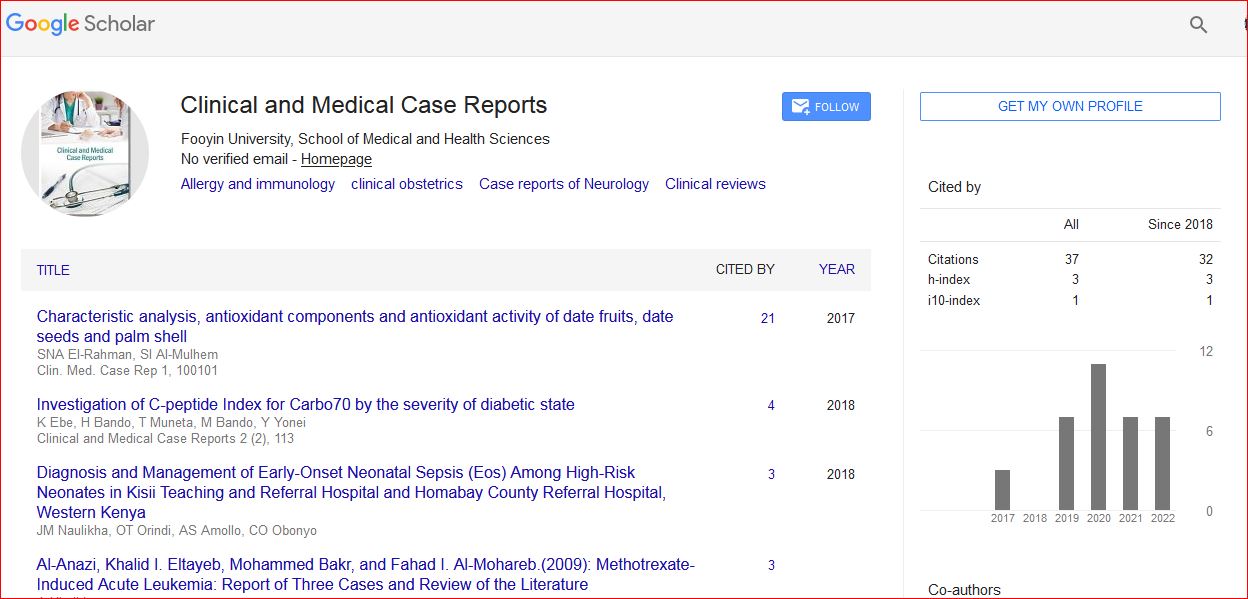
Clinical and Medical Case Reports received 53 citations as per Google Scholar report