Brief Report - (2025) Volume 14, Issue 3
Received: 02-May-2025, Manuscript No. aim-25-177349;
Editor assigned: 05-May-2025, Pre QC No. P-177349;
Reviewed: 19-May-2025, QC No. Q-177349;
Revised: 23-May-2025, Manuscript No. R-177349;
Published:
30-May-2025
, DOI: 10.37421/2427-5162.2025.14.570
Citation: Green, Michael. ”Complementary and Alternative Therapies for Chronic Pain.” Alt Integr Med 14 (2025):570.
Copyright: © 2025 Green M. This is an open-access article distributed under the terms of the Creative Commons Attribution License, which permits unrestricted use, distribution and reproduction in any medium, provided the original author and source are credited.
A comprehensive review delved into the clinical pharmacology and therapeutic potential of curcumin in pain management, covering inflammatory, neuropathic, and postoperative pain. The study elucidated curcumin's anti-inflammatory and antioxidant mechanisms, suggesting its role as a natural analgesic. It also addressed the critical challenges related to its bioavailability and explored various formulation strategies aimed at enhancing its overall efficacy [1].
An overview of systematic reviews consolidated evidence regarding acupuncture for chronic pain. This research confirmed acupuncture's efficacy across common chronic pain conditions, such as musculoskeletal pain, headaches, and osteoarthritis. It noted that acupuncture's benefits were often comparable to non-acupuncture control groups, alongside a favorable safety profile, thereby endorsing its integration into broader pain management frameworks [2].
A systematic review and meta-analysis assessed the role of mindfulness-based interventions in chronic pain management. The analysis concluded that these interventions significantly reduced pain intensity, improved pain acceptance, and mitigated psychological distress associated with chronic pain. These findings strongly advocate for the inclusion of mindfulness practices within comprehensive, multidisciplinary pain treatment programs [3].
An evidence-based review critically evaluated cannabinoids for chronic pain management, differentiating between various types like THC and CBD and their respective mechanisms of action. The review found moderate evidence for analgesic effects in specific chronic pain conditions, particularly neuropathic pain, while also highlighting potential side effects and emphasizing the need for more rigorous clinical trials to solidify these findings [4].
The efficacy of omega-3 fatty acids in pain management was explored in a systematic review and meta-analysis. The research indicated that omega-3 supplementation could offer modest benefits for reducing pain intensity and enhancing physical function across various chronic pain conditions. These effects are primarily attributed to their anti-inflammatory properties, although the study calls for further high-quality research [5].
A systematic review and meta-analysis investigated the impact of yoga on chronic pain. The findings suggested that yoga can significantly reduce pain intensity and improve functional disability, as well as enhance the quality of life for individuals suffering from diverse chronic pain conditions, including back pain, osteoarthritis, and fibromyalgia. This evidence supports yoga as a beneficial complementary therapy in pain care [6].
The effectiveness of aromatherapy for pain relief was evaluated through a systematic review and meta-analysis. Results demonstrated that aromatherapy, whether administered via inhalation or topical application, could significantly alleviate pain levels in various clinical contexts. This positions aromatherapy as a useful adjunctive, non-pharmacological method for pain management, offering an alternative approach to conventional treatments [7].
A systematic review and meta-analysis assessed the clinical efficacy of ginger in patients with chronic pain. The review concluded that ginger supplementation effectively reduced pain intensity and inflammation markers, especially in conditions such as osteoarthritis and dysmenorrhea. This supports ginger's potential as a natural, safe adjunctive therapy in chronic pain management, aligning with a holistic approach to patient care [8].
A Cochrane systematic review examined the effectiveness and safety of topical capsaicin for neuropathic pain. The review confirmed that high-concentration capsaicin patches provided moderate to substantial pain relief for a significant proportion of patients experiencing peripheral neuropathic pain. This highlights capsaicin's utility as a targeted therapy with a generally manageable side effect profile, making it a valuable option in specialized pain treatment regimens [9].
The role of magnesium in chronic pain management was investigated through a systematic review and meta-analysis of randomized controlled trials. The findings suggested that magnesium supplementation could effectively reduce pain intensity and opioid consumption in certain chronic pain conditions, possibly by modulating N-methyl-D-aspartate NMDA receptors. This positions magnesium as a promising potential adjunctive treatment, contributing to a multimodal strategy for pain relief [10].
Curcumin, a natural compound, has been extensively reviewed for its clinical pharmacology and therapeutic applications in various pain states, including inflammatory, neuropathic, and postoperative pain. Its efficacy is largely attributed to potent anti-inflammatory and antioxidant mechanisms, qualifying it as a natural analgesic. However, its therapeutic use is complicated by poor bioavailability, necessitating advanced formulation strategies to maximize its potential benefits in clinical settings [1]. Systematic reviews have provided a comprehensive overview of acupuncture's role in chronic pain management. The evidence consistently supports its effectiveness for common chronic conditions such as musculoskeletal pain, headache, and osteoarthritis, often demonstrating outcomes comparable to non-acupuncture interventions. Furthermore, its favorable safety profile reinforces its suitability as a valuable component within integrated pain management approaches, broadening the spectrum of available therapeutic options [2]. Mindfulness-based interventions are increasingly recognized for their efficacy in managing chronic pain. A systematic review and meta-analysis confirmed their significant impact on reducing pain intensity, fostering greater pain acceptance, and alleviating the psychological distress frequently associated with persistent pain. These compelling results advocate for the strategic integration of mindfulness practices into comprehensive, multidisciplinary treatment programs, enhancing holistic patient care [3]. The application of cannabinoids for chronic pain management has undergone critical evidence-based review. This analysis meticulously distinguished between the effects of THC and CBD, examining their distinct mechanisms of action. Moderate evidence was found for their analgesic effects, particularly beneficial in neuropathic pain conditions. However, the review also underscored the importance of considering potential side effects and the ongoing need for more rigorous clinical trials to fully establish their role and guidelines for use [4]. Omega-3 fatty acids have been investigated for their potential in pain management through a systematic review and meta-analysis. The findings suggested that supplementation with omega-3s could confer modest benefits in mitigating pain intensity and improving physical function across various chronic pain conditions. This benefit is largely attributed to their known anti-inflammatory properties. Nonetheless, the review highlighted the necessity for additional high-quality research to definitively confirm and quantify these therapeutic effects [5]. Yoga has emerged as a promising complementary therapy for chronic pain. A systematic review and meta-analysis demonstrated its significant capacity to reduce pain intensity, improve functional disability, and enhance the overall quality of life for individuals afflicted with diverse chronic pain conditions, including back pain, osteoarthritis, and fibromyalgia. This robust evidence supports the integration of yoga into holistic pain management strategies, offering a non-pharmacological pathway to relief [6]. Aromatherapy's effectiveness in pain relief has been systematically reviewed and analyzed. The aggregated findings indicated that this therapeutic approach, whether applied through inhalation or topically, can significantly reduce pain levels across various clinical settings. This evidence suggests that aromatherapy serves as a valuable adjunctive, non-pharmacological method within pain management protocols, providing a gentle yet effective alternative or complement to conventional treatments [7]. The clinical efficacy of ginger for patients experiencing chronic pain has been substantiated by a systematic review and meta-analysis. The study's conclusions affirmed that ginger supplementation could effectively decrease pain intensity and lower inflammation markers, particularly in conditions like osteoarthritis and dysmenorrhea. These results underscore ginger's potential as a natural, safe adjunctive therapy, supporting its incorporation into comprehensive chronic pain management strategies for a more holistic approach [8]. Topical capsaicin has been thoroughly evaluated for its effectiveness and safety in treating neuropathic pain through a Cochrane systematic review. The review decisively confirmed that high-concentration capsaicin patches offer moderate to substantial pain relief for a notable proportion of patients suffering from peripheral neuropathic pain. Its role as a targeted therapy with a manageable side effect profile positions it as an important option in specialized pain treatment, particularly for localized neuropathic conditions [9]. The utility of magnesium in managing chronic pain has been systematically reviewed and meta-analyzed, focusing on randomized controlled trials. The research indicated that magnesium supplementation can be effective in reducing pain intensity and, notably, opioid consumption in certain chronic pain conditions. This effect is potentially mediated by its modulation of N-methyl-D-aspartate NMDA receptors, thereby identifying magnesium as a significant potential adjunctive treatment in multimodal pain therapy regimens [10].
This collection of reviews examines various complementary and alternative therapies for chronic pain management. Curcumin demonstrates potential as a natural analgesic through anti-inflammatory and antioxidant mechanisms, though bioavailability remains a challenge. Acupuncture is affirmed as effective for common chronic pain conditions, offering comparable results to controls with a favorable safety profile. Mindfulness-based interventions significantly reduce pain intensity, improve acceptance, and alleviate psychological distress. Cannabinoids show moderate analgesic effects, especially for neuropathic pain, but warrant further rigorous trials due to potential side effects. Omega-3 fatty acids provide modest pain reduction and improved physical function via anti-inflammatory properties. Yoga is a beneficial complementary therapy, reducing pain, functional disability, and improving quality of life across various chronic pain conditions. Aromatherapy offers significant pain relief in clinical settings as an adjunctive, non-pharmacological approach. Ginger supplementation reduces pain and inflammation markers, particularly in osteoarthritis and dysmenorrhea. Topical capsaicin provides targeted relief for peripheral neuropathic pain with a manageable side effect profile. Finally, magnesium supplementation can reduce pain intensity and opioid consumption, suggesting its role as a potential adjunctive treatment.
None
None
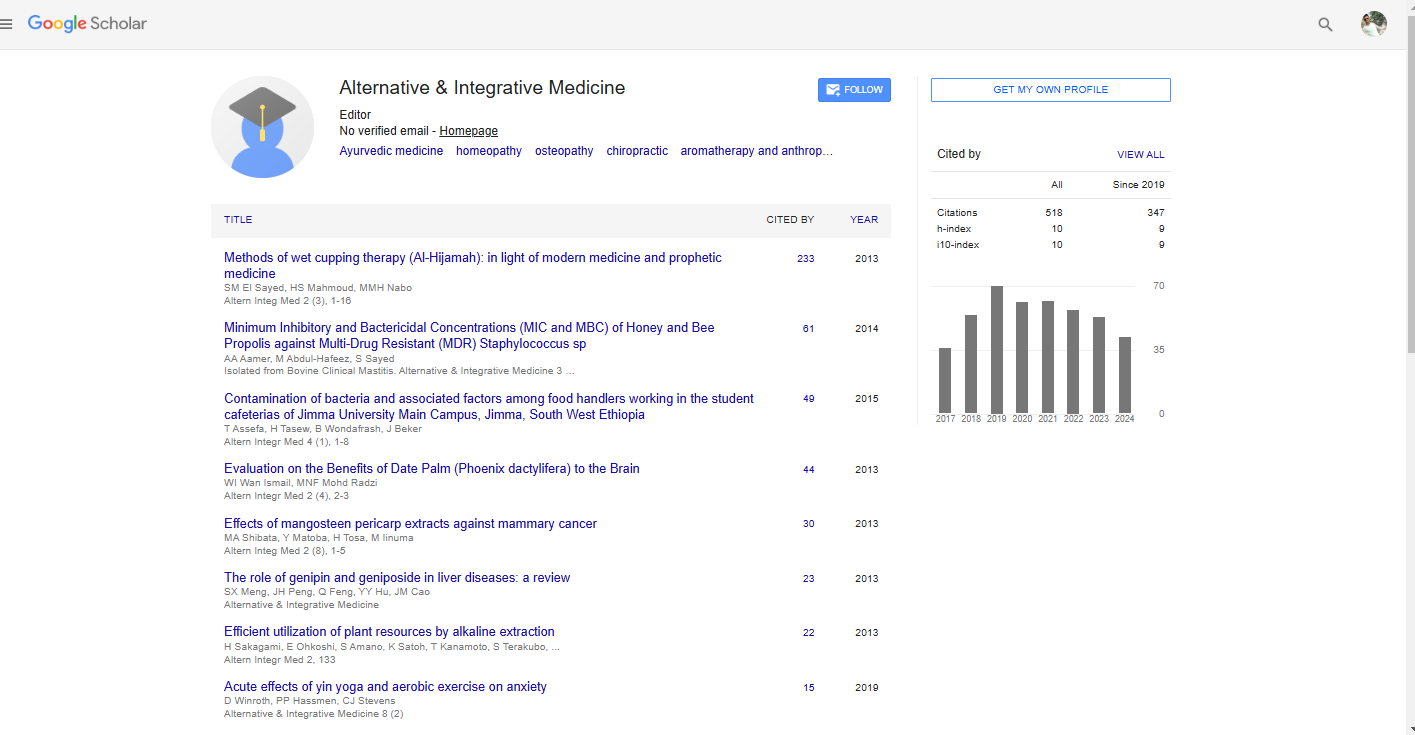
Alternative & Integrative Medicine received 476 citations as per Google Scholar report