Opinion - (2025) Volume 13, Issue 1
Received: 03-Feb-2025, Manuscript No. jpgeb-25-157465;
Editor assigned: 05-Feb-2025, Pre QC No. P-157465;
Reviewed: 19-Feb-2025, QC No. Q-157465;
Revised: 24-Feb-2025, Manuscript No. R-157465;
Published:
28-Feb-2025
, DOI: 10.37421/2329-9002.2025.13.355
Citation: Kumar, Amit. ”Comparative Genomics: Powerful Insights Across Biology.” J Phylogenetics Evol Biol 13 (2025):355.
Copyright: © 2025 Kumar A. This is an open-access article distributed under the terms of the Creative Commons Attribution License, which permits unrestricted use, distribution
and reproduction in any medium, provided the original author and source are credited.
Let's break it down: comparative genomics, a powerful analytical approach, is revolutionizing our understanding across numerous biological disciplines. This method allows researchers to compare the entire genetic makeup of different organisms, revealing similarities and differences that provide critical insights into evolution, adaptation, disease, and fundamental biological processes. The utility of comparative genomics spans from macroscopic life forms to the microscopic world, unraveling complex genetic mechanisms that drive biological diversity and function. This paper offers a deep dive into how polyploidy, the duplication of whole genomes, has shaped plant evolution. What they found is that by comparing the genomes of polyploid and diploid plants, we can better understand the genetic mechanisms driving adaptation and diversification. It's essentially a roadmap for exploring how plants have become so diverse over millions of years[1].
This study uses comparative genomics to really pinpoint genes that help Staphylococcus aureus adapt to its host and cause disease. Here's the thing: by comparing different strains, they identified specific genetic variations linked to virulence, giving us better targets for new treatments or diagnostics. Itâ??s all about understanding what makes these bacteria so tricky[2].
What this really means is that comparing genomes of many different cancers can show us both what's universal and unique in their mutational profiles. They found shared genomic signatures across seemingly different tumor types, which could lead to broader therapeutic strategies, while also highlighting unique pathways that demand targeted approaches. Itâ??s a pretty comprehensive look at cancer's genetic landscape[3].
This article discusses how comparative genomics is a powerful tool for predicting gene function and, crucially, for drug discovery. By comparing genomes across species, researchers can infer functions of unknown genes and identify potential drug targets, accelerating early stages of pharmaceutical development. It's about using evolutionary relationships to find new medicines[4].
This research explored the microbial world, using comparative genomics to uncover common strategies employed by complex microbial communities. They discovered that despite varied environments, these communities often share similar genetic blueprints for how they function and interact. This suggests there are fundamental rules governing microbial ecosystems, which is a pretty cool insight[5].
Here's the thing: comparative genomics isn't just about differences, it's also about similarities. This paper shows how comparing genomes across a wide range of species can reveal instances of convergent evolution and specific adaptations to diverse environments. It helps us understand how unrelated organisms arrive at similar solutions to environmental challenges through parallel genetic changes[6].
This study highlights how comparative genomics is key to finding those elusive human-specific regulatory elements in our genome. By comparing our DNA with that of other primates, researchers identified unique non-coding regions that likely contribute to distinctly human traits and diseases. Itâ??s a big step in understanding what makes us, well, us, at a genetic level[7].
Let's break it down: this research used comparative genomics to figure out how bacteria develop resistance to antimicrobial drugs. By analyzing genomes of drug-resistant clinical isolates, they pinpointed the specific genetic changes responsible for this resistance, giving us critical insights into combating superbugs. It's about finding the enemy's weaknesses at the genetic level[8].
This paper shines a light on how comparative genomics helps us understand gene regulation, particularly through conserved non-coding elements. They identified regions of DNA that don't code for proteins but are remarkably similar across species, suggesting they play crucial, conserved roles in controlling gene expression. It's a testament to the hidden complexity of our genomes[9].
This work explores how bringing together comparative genomics and metagenomics helps us truly grasp how microbial ecosystems function. By comparing individual microbial genomes within the context of entire communities, researchers gain insights into metabolic pathways and interactions that drive ecosystem processes. It's like zooming in and out on a complex microbial city to see how everything connects[10].
Comparative genomics offers profound insights into evolutionary processes across different life forms. For example, it provides a deep dive into how polyploidy, the duplication of whole genomes, has significantly shaped plant evolution. By meticulously comparing the genomes of polyploid and diploid plants, researchers can better understand the genetic mechanisms that drive adaptation and diversification, essentially serving as a roadmap for exploring how plants achieved such immense diversity over millions of years[1]. Furthermore, this powerful analytical tool isn't solely about identifying differences; it also illuminates striking similarities. Comparative genomics, here's the thing, reveals instances of convergent evolution and specific adaptations across diverse species. This helps us understand how unrelated organisms can arrive at similar solutions to environmental challenges through parallel genetic changes, showcasing the elegant efficiency of evolution in action[6].
What this really means is that comparative genomics plays a critical role in tackling significant health challenges, from infectious diseases to cancer, and in accelerating drug development. This study, for instance, uses comparative genomics to really pinpoint the genes that help Staphylococcus aureus adapt to its host and cause disease. By comparing different strains, scientists identified specific genetic variations linked to virulence, providing better targets for new treatments or diagnostics, which is all about understanding what makes these bacteria so tricky[2]. In a similar vein, this research used comparative genomics to figure out how bacteria develop resistance to antimicrobial drugs. By analyzing the genomes of drug-resistant clinical isolates, they pinpointed the specific genetic changes responsible for this resistance, giving us critical insights into combating superbugs. It's about finding the enemy's weaknesses at the genetic level[8]. Beyond infectious agents, comparing the genomes of many different cancers can show us both what's universal and what's unique in their mutational profiles. Researchers found shared genomic signatures across seemingly different tumor types, which could lead to broader therapeutic strategies, while also highlighting unique pathways that demand targeted approaches. Itâ??s a pretty comprehensive look at cancer's genetic landscape[3]. This understanding extends to practical applications, as comparative genomics is a powerful tool for predicting gene function and, crucially, for drug discovery. By comparing genomes across species, researchers can infer functions of unknown genes and identify potential drug targets, accelerating the early stages of pharmaceutical development. It's about using evolutionary relationships to find new medicines[4].
Let's break it down: comparative genomics provides invaluable insights into the complex world of microbial communities and their ecological functions. This research explored the microbial world, using comparative genomics to uncover common strategies employed by complex microbial communities. They discovered that despite varied environments, these communities often share similar genetic blueprints for how they function and interact. This suggests there are fundamental rules governing microbial ecosystems, which is a pretty cool insight[5]. To truly grasp how these microbial ecosystems function, this work explores how bringing together comparative genomics and metagenomics becomes essential. By comparing individual microbial genomes within the context of entire communities, researchers gain insights into metabolic pathways and interactions that drive ecosystem processes. It's like zooming in and out on a complex microbial city to see how everything connects and thrives[10].
Finally, comparative genomics is shedding light on the intricacies of human biology and the fundamental mechanisms of gene regulation. This study highlights how comparative genomics is key to finding those elusive human-specific regulatory elements in our genome. By comparing our DNA with that of other primates, researchers identified unique non-coding regions that likely contribute to distinctly human traits and diseases. Itâ??s a big step in understanding what makes us, well, us, at a genetic level[7]. Furthermore, this paper shines a light on how comparative genomics helps us understand gene regulation, particularly through conserved non-coding elements. They identified regions of DNA that don't code for proteins but are remarkably similar across species, suggesting they play crucial, conserved roles in controlling gene expression. It's a testament to the hidden complexity of our genomes and the subtle controls that orchestrate life[9].
Comparative genomics serves as a powerful tool across diverse biological fields. What this really means is that by comparing genomes, researchers gain deep insights into evolution, adaptation, and disease mechanisms. For example, it helps clarify how polyploidy shaped plant evolution, revealing genetic drivers of diversification. Here's the thing: in microbiology, it identifies genes crucial for Staphylococcus aureus virulence and host adaptation, pinpointing targets for new treatments. It also uncovers shared ecological strategies among complex microbial communities and aids in understanding the intricate functions of microbial ecosystems when integrated with metagenomics. Beyond microbes, comparative genomics illuminates the genetic landscape of diverse cancers, highlighting both universal and unique mutational signatures for broader therapeutic strategies. It's also pivotal in identifying human-specific regulatory elements by comparing primate genomes, deepening our understanding of unique human traits. Moreover, this approach reveals mechanisms of antimicrobial drug resistance in clinical isolates, informing strategies against superbugs. It also predicts gene function, which is a crucial step in drug discovery by leveraging evolutionary relationships. Finally, it provides insights into convergent evolution across species and illuminates conserved non-coding elements critical for gene regulation, underscoring the hidden complexity of our genomes and how unrelated organisms can arrive at similar solutions to environmental challenges through parallel genetic changes.
None
None
1. J. CP, Lachezar AGN, Douglas ES. "The comparative genomics of polyploidy in plants".Front Plant Sci 15 (2024):1378888.
Indexed at, Google Scholar, Crossref
2. Benjamin CJ, Emily LF, David MS. "Comparative genomics of Staphylococcus aureus reveals genes involved in host adaptation and virulence".Microb Genom 9 (2023):001072.
Indexed at, Google Scholar, Crossref
3. Anna GW, Jonathan RK, Emily PD. "Comparative genomics of diverse cancers highlights shared and unique mutational landscapes".Cancer Cell 40 (2022):669-685.e5.
Indexed at, Google Scholar, Crossref
4. Yuh-Chung C, Wei-Wen L, Yen-Ling C. "Comparative genomics for gene function prediction and drug discovery".Expert Opin Drug Discov 16 (2021):141-154.
Indexed at, Google Scholar, Crossref
5. Laura AH, Thomas JK, Sarah RJ. "Comparative genomics of complex microbial communities reveals shared ecological strategies".Nat Microbiol 7 (2022):395-408.
Indexed at, Google Scholar, Crossref
6. David RS, Jennifer LG, Andrew TW. "Comparative genomics provides insights into convergent evolution and adaptation across diverse species".Genome Biol Evol 15 (2023):evad007.
Indexed at, Google Scholar, Crossref
7. Sarah LB, Michael RD, Jessica AW. "Comparative genomics uncovers novel human-specific regulatory elements".Nat Genet 53 (2021):1339-1349.
Indexed at, Google Scholar, Crossref
8. Emily RA, Liam CT, Sarah KJ. "Comparative genomics analysis reveals mechanisms of antimicrobial drug resistance in clinical isolates".J Antimicrob Chemother 75 (2020):2758-2767.
Indexed at, Google Scholar, Crossref
9. Chloe MD, Alexander JR, Victoria PS. "Comparative genomics illuminates conserved non-coding elements in gene regulation".Genome Res 32 (2022):1195-1207.
Indexed at, Google Scholar, Crossref
10. Oliver PG, Sophie AW, Harry KB. "Integrating comparative genomics and metagenomics for understanding microbial ecosystem function".ISME J 17 (2023):441-454.
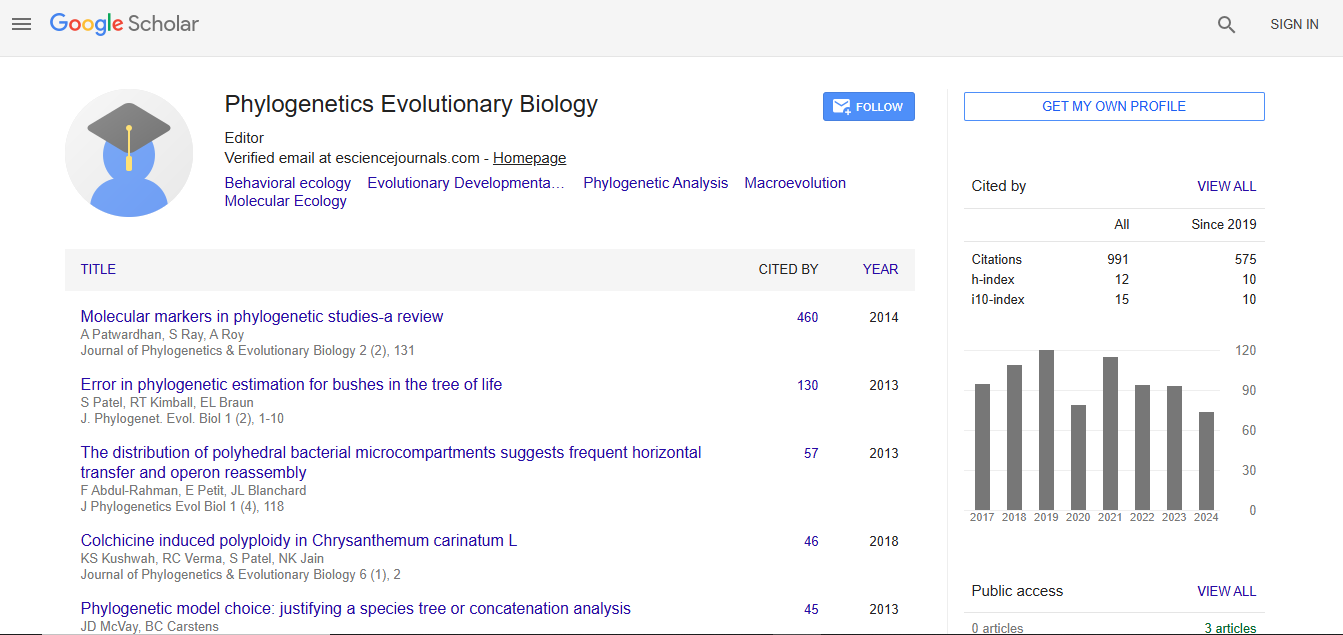
Journal of Phylogenetics & Evolutionary Biology received 911 citations as per Google Scholar report