Brief Report - (2025) Volume 14, Issue 4
Received: 01-Aug-2025, Manuscript No. jhoa-26-187834;
Editor assigned: 04-Aug-2025, Pre QC No. P-187834;
Reviewed: 18-Aug-2025, QC No. Q-187834;
Revised: 22-Aug-2025, Manuscript No. R-187834;
Published:
29-Aug-2025
, DOI: 10.37421/2167-1095.2025.14.536
Citation: Laurent, Sophie. ”Community Health Programs: Detecting and Managing Hypertension.” J Hypertens 14 (2025):536.
Copyright: © 2025 Laurent S. This is an open-access article distributed under the terms of the Creative Commons Attribution License, which permits unrestricted use, distribution and reproduction in any medium, provided the original author and source are credited.
Screening for hypertension within community health programs is recognized as a vital strategy for the early detection and effective management of this widespread condition, thereby contributing to a significant reduction in the overall burden of cardiovascular disease [1].
These community-based initiatives possess a unique capacity to effectively reach underserved populations, enabling the tailoring of specific interventions to meet diverse needs and ultimately improving blood pressure control rates among individuals at risk [1].
Key insights gleaned from various studies underscore the critical importance of ensuring accessible screening locations, adopting culturally sensitive approaches in outreach and education, and establishing robust follow-up care mechanisms to guarantee sustained health benefits for participants [1].
Community health workers are indispensable figures in these programs, playing a crucial role in educating patients about their condition and fostering adherence to treatment and lifestyle recommendations [1].
The effectiveness of community-based hypertension screening interventions, however, is demonstrably variable, largely contingent upon the sophistication of program design and the strategic nuances of their implementation [2].
Research indicates that leveraging pre-existing community structures, such as faith-based organizations and local workplaces, can substantially enhance the reach and engagement levels of these vital programs [2].
Furthermore, the integration of hypertension screening services with other essential health services can streamline the care pathway for individuals and markedly improve the overall efficiency of program delivery [2].
The long-term sustainability of such community health programs is frequently determined by the strength of the partnerships forged with local entities and the availability of dedicated, consistent funding streams [2].
Addressing the persistent health disparities in hypertension is a critical and overarching goal for all community health programs aiming to improve cardiovascular health outcomes [3].
Screening efforts within these programs are therefore directed to prioritize populations that exhibit higher prevalence rates of hypertension and concurrently face significant barriers to accessing adequate healthcare services, including racial and ethnic minorities and individuals from lower socioeconomic backgrounds [3].
The development and dissemination of culturally tailored educational materials, coupled with the presence of diverse healthcare providers within these communities, are essential strategies to foster increased trust and engagement among residents [3].
The role of technological advancements in enhancing the scope and efficacy of hypertension screening initiatives within community settings is becoming increasingly significant [4].
The adoption of mobile health applications and the implementation of remote monitoring tools can substantially facilitate ongoing follow-up care for patients, improve medication adherence rates, and enable more efficient and accurate data collection [4].
These technological innovations hold the promise of extending the reach of existing community health programs and offering more personalized and responsive support to individuals who are actively managing their blood pressure [4].
Implementing hypertension screening programs that are truly sustainable necessitates a comprehensive, multi-faceted approach that actively involves policymakers, healthcare providers, and a broad spectrum of community stakeholders [5].
Policy changes that actively support increased funding for community health programs and promote the seamless integration of hypertension screening into routine primary care practices are absolutely crucial for long-term success [5].
The cultivation of robust collaboration among all involved parties is identified as the linchpin for building and maintaining screening initiatives that are both resilient and highly effective in their impact [5].
The critical importance of comprehensive training and ongoing capacity building for community health workers cannot be overstated when considering the successful execution of hypertension screening programs [6].
These frontline health professionals require thorough and detailed training that encompasses proficiency in accurate blood pressure measurement techniques, the provision of effective lifestyle counseling, and a clear understanding of referral pathways for individuals requiring further medical attention [6].
Continuous support and diligent supervision are essential to ensure the delivery of consistently high-quality services and to safeguard patient safety throughout the screening process [6].
Fostering robust patient engagement and providing effective self-management support are recognized as indispensable components of successful community-based hypertension programs [7].
Empowering individuals with comprehensive knowledge about their specific health condition and equipping them with practical tools for self-monitoring and consistent adherence to prescribed treatment plans are directly linked to improved health outcomes [7].
Community health workers are uniquely positioned to cultivate this essential engagement through targeted educational initiatives and the application of motivational interviewing techniques [7].
The substantial economic impact of implementing hypertension screening within community health programs represents a compelling argument for their continued support and expansion [8].
The early detection and prompt management of hypertension can effectively prevent the occurrence of costly and debilitating complications such as stroke, heart attack, and chronic kidney disease, ultimately leading to significant savings in overall healthcare expenditures [8].
Therefore, strategically investing in community-based preventive health measures is demonstrably a sound and prudent economic strategy for public health [8].
Evaluating the long-term outcomes associated with hypertension screening initiatives conducted in community settings is paramount for conclusively demonstrating their overall effectiveness and impact [9].
Studies that meticulously track sustained blood pressure control, document the reduction in the incidence of cardiovascular events, and quantify improvements in the quality of life for participants provide compelling evidence that justifies continued investment and facilitates the ongoing refinement of these programs [9].
The collection and analysis of longitudinal data are therefore absolutely essential for a thorough understanding of the sustained benefits and real-world impact of these vital public health efforts [9].
The strategic integration of hypertension screening efforts into broader, more comprehensive public health campaigns has the potential to significantly amplify their overall impact and reach [10].
Cultivating collaborative partnerships with local health departments and established non-profit organizations can foster a more holistic and coordinated approach to addressing cardiovascular health within the community [10].
Moreover, well-designed public awareness campaigns serve a crucial role in motivating and guiding individuals to actively seek out screening services offered within existing community programs [10].
Screening for hypertension within community health programs is a fundamental strategy for early detection and management, significantly reducing the burden of cardiovascular disease [1].
These programs excel at reaching underserved populations, allowing for tailored interventions and improved blood pressure control [1].
Accessible screening sites, culturally sensitive approaches, and consistent follow-up care are key to ensuring lasting benefits, with community health workers playing a vital role in patient education and adherence [1].
The variability in the effectiveness of community-based hypertension screening interventions is largely influenced by program design and implementation strategies [2].
Utilizing existing community structures like faith-based organizations and workplaces can enhance reach and engagement [2].
Integrating screening with other health services streamlines care and boosts efficiency, while strong partnerships and dedicated funding are crucial for program sustainability [2].
Community health programs are critically focused on addressing health disparities in hypertension, prioritizing screening for populations with higher prevalence and limited access, such as minorities and low-income individuals [3].
Culturally adapted educational materials and diverse healthcare providers are essential for building trust and encouraging participation in these communities [3].
Technology is playing an increasingly important role in augmenting hypertension screening in community settings [4].
Mobile health apps and remote monitoring tools can improve follow-up care, medication adherence, and data collection, thereby extending program reach and offering personalized support for blood pressure management [4].
Sustainable hypertension screening programs require a multifaceted approach involving policymakers, healthcare providers, and community stakeholders [5].
Policy changes that support funding and integrate screening into primary care are vital, and collaboration is key to building robust and effective initiatives [5].
Comprehensive training and capacity building for community health workers are essential for the success of hypertension screening programs [6].
These workers need thorough training in blood pressure measurement, lifestyle counseling, and referral pathways, alongside ongoing support and supervision to ensure quality and safety [6].
Patient engagement and self-management support are critical elements of community-based hypertension programs [7].
Empowering individuals with knowledge and tools for self-monitoring and treatment adherence leads to better outcomes, facilitated by community health workers through education and motivational interviewing [7].
The economic benefits of community-based hypertension screening programs are substantial [8].
Early detection and management prevent costly complications like stroke and heart attack, leading to significant healthcare cost savings and demonstrating that investment in community prevention is economically sound [8].
Evaluating long-term outcomes is crucial for demonstrating the effectiveness of community hypertension screening [9].
Tracking blood pressure control, reduction in cardiovascular events, and quality of life improvements provides evidence for continued investment and program refinement, with longitudinal data being essential for understanding sustained impact [9].
Integrating hypertension screening into broader public health campaigns can amplify its impact [10].
Collaborating with local health departments and non-profits creates a more comprehensive approach to cardiovascular health, and public awareness campaigns can drive individuals to seek screening within community programs [10].
Community health programs play a crucial role in the early detection and management of hypertension, particularly in underserved populations. These initiatives enhance blood pressure control through accessible screening, culturally sensitive approaches, and effective follow-up care, with community health workers serving as key educators and adherence promoters. Program effectiveness is influenced by design, implementation, and the utilization of community structures. Addressing health disparities by prioritizing at-risk groups and using tailored resources is essential. Technology, such as mobile health apps, is increasingly used to improve reach and patient support. Sustainable programs require collaboration among policymakers, providers, and stakeholders, supported by dedicated funding and policy integration. Comprehensive training for community health workers is vital for quality service delivery. Patient engagement and self-management support, facilitated by health workers, lead to better outcomes. Economically, early detection and management prevent costly complications, making these programs a sound investment. Evaluating long-term outcomes provides evidence for continued support and refinement, while integration into broader public health campaigns can amplify impact.
None
None
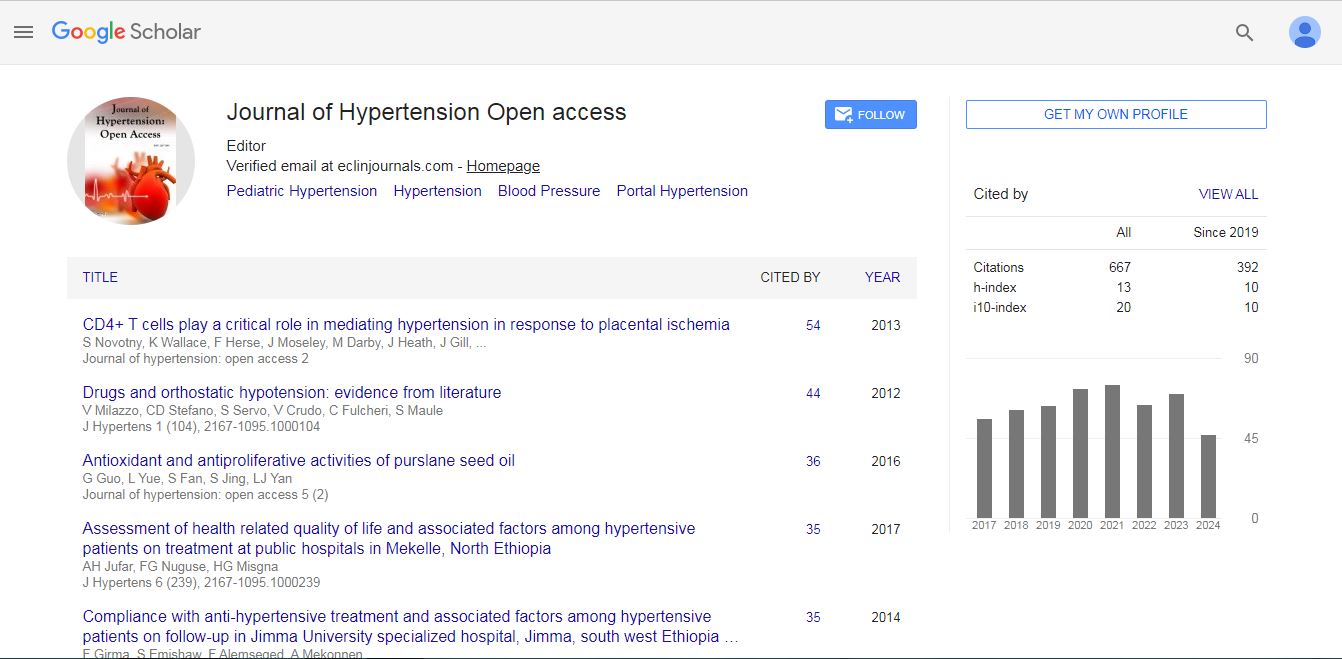
Journal of Hypertension: Open Access received 614 citations as per Google Scholar report