Short Communication - (2025) Volume 14, Issue 2
Received: 01-Mar-2025, Manuscript No. jtsm-26-179516;
Editor assigned: 03-Mar-2025, Pre QC No. P-179516;
Reviewed: 17-Mar-2025, QC No. Q-179516;
Revised: 24-Mar-2025, Manuscript No. R-179516;
Published:
31-Mar-2025
, DOI: 10.37421/2167-0919.2025.14.496
Citation: Al-Zahra, Fatima. ”Cloud Telecom: Innovation, Automation, Security, and 5G.” J Telecommun Syst Manage 14 (2025):496.
Copyright: © 2025 Al-Zahra F. This is an open-access article distributed under the terms of the Creative Commons Attribution License, which permits unrestricted use, distribution and reproduction in any medium, provided the original author and source are credited.
Cloud-based telecommunications systems are fundamentally reshaping how services are managed. These systems offer inherent scalability and flexibility, allowing telecommunication providers to dynamically allocate resources as demand fluctuates. This adaptability is crucial for maintaining service quality and operational efficiency in a rapidly evolving market [1].
The integration of cloud platforms with advanced management tools is not merely an option but a necessity for optimizing network performance and enabling innovative services. Effective management within these cloud environments necessitates sophisticated orchestration and automation capabilities. This involves seamlessly integrating a diverse array of cloud services and ensuring their interoperability for unimpeded service delivery. Such strategies are vital for adapting to changing customer demands and for retaining a competitive edge in the dynamic telecom sector [2].
Security and reliability stand as paramount considerations in the deployment of cloud-based telecommunication solutions. Robust security measures and a commitment to high availability are critical for safeguarding sensitive data and ensuring the uninterrupted provision of services. Research in this area focuses on developing advanced security protocols and resilient architectures tailored for cloud telecom infrastructure [3].
The ongoing evolution towards 5G and subsequent mobile network generations is heavily dependent on the adoption of cloud-native architectures and edge computing. Service management in this context demands intelligent automation, real-time monitoring, and efficient resource orchestration across distributed cloud and edge nodes, highlighting a shift towards decentralized intelligence [4].
Artificial intelligence and machine learning are increasingly integral to intelligent service management within cloud telecommunications. Predictive analytics, anomaly detection, and automated fault resolution are key applications that enhance network resilience and optimize overall service performance, paving the way for proactive management [5].
Multi-access edge computing (MEC) represents a significant distributed cloud paradigm, particularly important for enabling low-latency telecommunication services. Effective service management in MEC environments hinges on efficient resource allocation, strategic service deployment, and localized data processing at the network edge, bringing computation closer to the user [6].
The transition to cloud-native network functions (CNFs) marks a pivotal trend in telecommunications, promising enhanced agility and scalability. Service management for CNFs is characterized by the dynamic instantiation, scaling, and healing of network functions within the flexible confines of cloud environments, embodying a more modular approach to network operations [7].
Quality of Service (QoS) and Quality of Experience (QoE) are critical metrics that dictate the success of cloud-based telecommunication services. Advanced management systems are essential for continuously monitoring, analyzing, and guaranteeing optimal QoS and QoE across intricate cloud infrastructures and a wide spectrum of service types [8].
DevOps practices play an instrumental role in the efficient management of cloud-based telecommunication services. By facilitating faster deployment cycles, continuous integration, and continuous delivery, this methodology fosters crucial collaboration between development and operations teams for streamlined service lifecycle management [9].
The integration of blockchain technology within cloud-based telecommunications is actively being explored as a means to bolster security, transparency, and data integrity. This integration has the potential to foster the development of more trustworthy and resilient service management architectures, enhancing the overall reliability of the ecosystem [10].
Cloud-based telecommunications systems are fundamentally transforming service management by providing scalable, flexible, and cost-effective solutions. This paradigm shift enables dynamic resource allocation, enhances service agility, and streamlines operational processes. The synergistic integration of cloud platforms with advanced management tools is indispensable for optimizing network performance, ensuring unwavering service quality, and facilitating the introduction of innovative telecommunication services [1].
The management of telecommunication services within cloud environments inherently requires sophisticated orchestration and automation capabilities. This involves the intricate integration of diverse cloud services and the assurance of interoperability to achieve seamless service delivery. Effectively implemented management strategies are vital for adapting to evolving customer demands and for maintaining a competitive advantage in the rapidly shifting telecommunications landscape [2].
Security and reliability are non-negotiable attributes in the context of cloud-based telecommunications. The implementation of robust security protocols and the assurance of high service availability are critical for protecting sensitive data and for maintaining uninterrupted service operations. Significant focus is placed on developing and deploying advanced security measures and resilient architectures specifically designed for cloud telecom infrastructure [3].
The ongoing evolution towards 5G and future mobile network generations is critically dependent on the adoption of cloud-native architectures and the principles of edge computing. Service management in this advanced context necessitates intelligent automation, real-time monitoring, and efficient resource orchestration across a distributed network of cloud and edge nodes, underscoring the importance of distributed processing [4].
Artificial intelligence (AI) and machine learning (ML) are increasingly being leveraged for intelligent service management within cloud telecommunications. The application of predictive analytics, sophisticated anomaly detection techniques, and automated fault resolution mechanisms significantly enhances network resilience and optimizes overall service performance, leading to more robust operations [5].
Multi-access edge computing (MEC) offers a compelling distributed cloud paradigm that is particularly crucial for the delivery of low-latency telecommunication services. Effective service management within MEC frameworks involves efficient resource allocation strategies, streamlined service deployment processes, and intelligent data processing capabilities directly at the network edge, thereby reducing latency and improving responsiveness [6].
The transition towards cloud-native network functions (CNFs) represents a significant and transformative trend within the telecommunications sector, promising enhanced agility and scalability. Service management for these CNFs is characterized by the dynamic instantiation, flexible scaling, and automated healing of network functions executed within the versatile environment of cloud platforms, embodying a more agile and responsive network architecture [7].
Quality of Service (QoS) and Quality of Experience (QoE) are indispensable metrics for evaluating the effectiveness of cloud-based telecommunication services. Advanced management systems are critically required to monitor, analyze, and guarantee optimal QoS and QoE levels across complex cloud infrastructures and a diverse range of service types, ensuring a high-quality user experience [8].
DevOps practices are instrumental in effectively managing cloud-based telecommunication services, fostering accelerated deployment cycles, continuous integration, and continuous delivery pipelines. This collaborative approach significantly enhances efficiency in service lifecycle management by promoting close cooperation between development and operations teams [9].
The integration of blockchain technology into cloud-based telecommunications is actively being explored as a means to enhance security, transparency, and the integrity of data. Such integration holds the potential to foster the development of more trustworthy and resilient service management architectures, ultimately improving the overall robustness and trustworthiness of telecommunication services [10].
Cloud-based telecommunications systems offer scalable, flexible, and cost-effective solutions for service management, transforming operational processes and enabling innovation. Effective management in these environments requires sophisticated orchestration, automation, and interoperability to adapt to evolving demands. Security and reliability are paramount, necessitating robust measures and high availability to protect data and ensure uninterrupted service. The evolution towards 5G and future networks relies on cloud-native architectures and edge computing, demanding intelligent automation and real-time monitoring. AI and machine learning are increasingly employed for proactive management, enhancing network resilience and performance. Multi-access edge computing (MEC) is crucial for low-latency services, requiring efficient resource allocation and edge data processing. Cloud-native network functions (CNFs) offer greater agility and scalability, with management focused on dynamic instantiation and healing. Quality of Service (QoS) and Quality of Experience (QoE) are key metrics, necessitating advanced monitoring and analysis systems. DevOps practices are vital for faster deployment and efficient lifecycle management through collaboration. Blockchain integration is being explored to enhance security, transparency, and data integrity in service management.
None
None
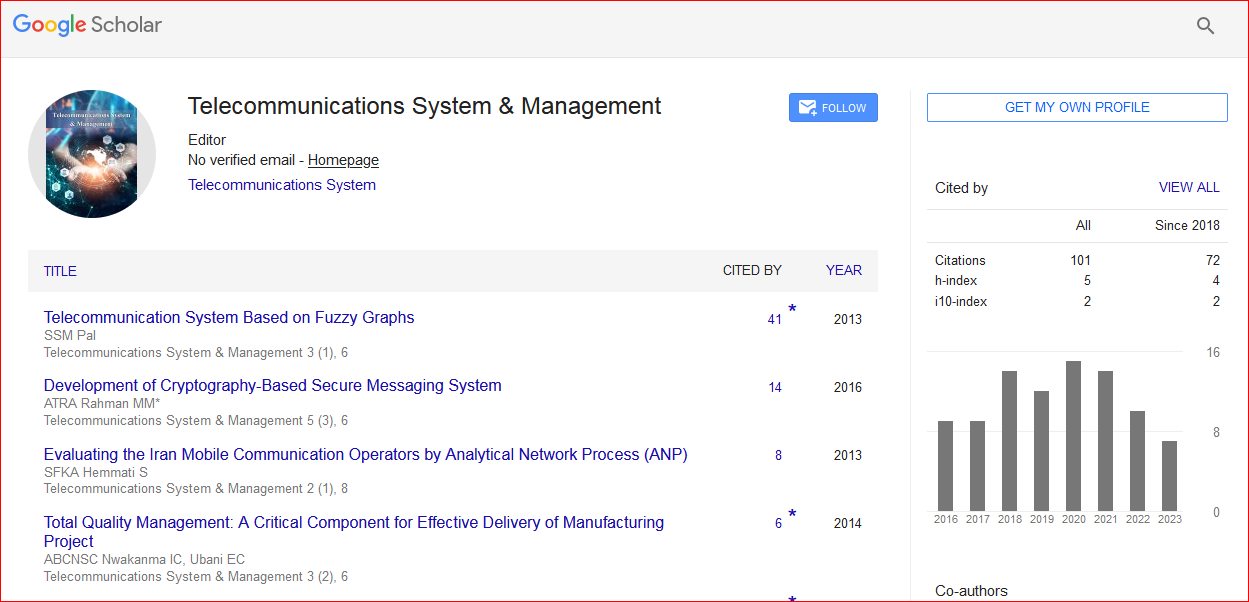
Telecommunications System & Management received 109 citations as per Google Scholar report