Opinion - (2025) Volume 16, Issue 6
Received: 01-Nov-2025, Manuscript No. jhmi-26-178893;
Editor assigned: 03-Nov-2025, Pre QC No. P-178893;
Reviewed: 17-Nov-2025, QC No. Q-178893;
Revised: 24-Nov-2025, Manuscript No. R-178893;
Published:
29-Nov-2025
, DOI: 10.37421/2157-7420.2025.16.621
Citation: Khumalo, Nompumelelo Z.. ”Clinical Informatics: Enhancing Quality, Safety and Efficiency.” J Health Med Informat 16 (2025):621.
Copyright: © 2025 Khumalo Z. Nompumelelo This is an open-access article distributed under the terms of the Creative Commons Attribution License, which permits unrestricted use, distribution and reproduction in any medium, provided the original author and source are credited.
Clinical informatics serves as a critical discipline for advancing healthcare quality and patient safety. It fundamentally enhances healthcare quality and patient safety by enabling improved data management, offering robust decision support, and fostering better communication among healthcare providers. Its application spans various vital areas within the healthcare ecosystem, including electronic health records (EHRs), clinical decision support systems (CDSS), and telehealth platforms, all contributing to a reduction in medical errors, an enhancement in diagnostic accuracy, and a streamlining of care delivery processes. The integration of informatics principles is paramount for cultivating a culture of continuous improvement within healthcare organizations, ensuring that systems and processes are consistently refined to meet evolving patient needs and safety standards. By leveraging data analytics, healthcare professionals can identify emerging trends, personalize treatment regimens, and optimize operational workflows, leading to more efficient and effective patient care pathways. Electronic Health Records (EHRs) represent a cornerstone of clinical informatics, playing a foundational role in the pursuit of quality improvement initiatives. The effective implementation and diligent use of EHRs can lead to substantial reductions in medication errors, promote better adherence to established clinical guidelines, and significantly facilitate seamless care coordination among multidisciplinary teams. Despite these benefits, persistent challenges remain concerning the assurance of interoperability between different systems, encouraging user adoption across all levels of healthcare staff, and efficiently extracting meaningful data for subsequent analysis. Therefore, optimizing the design of EHR systems and providing comprehensive training are key strategies for unlocking their full potential in enhancing both patient safety and overall care quality. Clinical decision support systems (CDSS) are an integral component of clinical informatics, designed to provide clinicians with evidence-based prompts and timely alerts precisely at the point of care. This direct support mechanism is instrumental in preventing adverse patient events, improving the accuracy of diagnoses, and ensuring consistent adherence to best practices and clinical protocols. The intelligence embedded within CDSS is capable of flagging potential drug interactions, identifying patients who may be at increased risk for certain conditions, and recommending appropriate interventions, thereby directly contributing to enhanced patient safety and superior quality of care. Telehealth and remote patient monitoring technologies, significantly enabled by advances in clinical informatics, are actively transforming the landscape of healthcare delivery. These innovations are particularly impactful for the management of chronic diseases and for providing comprehensive post-discharge care. These technologies facilitate continuous patient oversight, enable timely interventions when deviations from baseline health are detected, and improve access to necessary medical care, especially for populations residing in underserved or remote areas. The data generated from remote monitoring efforts can be seamlessly integrated into EHRs, providing a holistic and comprehensive view of the patient's health status and informing ongoing quality improvement efforts. Data analytics and artificial intelligence (AI) are rapidly emerging as indispensable tools within the field of clinical informatics, driving proactive improvements in healthcare quality and safety. By performing sophisticated analyses on large and complex datasets, these technologies possess the capability to predict patient deterioration, accurately identify populations at high risk for specific health concerns, and optimize the allocation of critical resources. The profound insights derived from advanced analytics empower healthcare providers to transition from a reactive approach to patient care towards a more proactive and preventative model, thereby significantly enhancing both the quality of care provided and the overall patient safety outcomes. Interoperability among health information systems stands as a fundamental cornerstone for the effective practice of clinical informatics, ensuring the seamless and secure exchange of patient data between diverse providers and disparate systems. This fluidity of information is absolutely critical for preventing unnecessary and redundant medical tests, avoiding potentially dangerous medical errors that can arise from incomplete patient data, and guaranteeing the continuity of patient care across different settings, all of which are essential components for improving healthcare quality and patient safety. The human-computer interaction (HCI) aspect of clinical informatics holds paramount importance in ensuring the usability of clinical systems and effectively reducing the cognitive load placed upon healthcare professionals. The development of well-designed interfaces and intuitive workflows within clinical informatics tools directly translates into a reduction in the incidence of medical errors and more efficient delivery of patient care, ultimately enhancing both patient safety and the quality of healthcare services. The application of user-centered design principles is therefore crucial in the development of these vital informatics tools. Patient engagement, facilitated by modern informatics tools such as patient portals and mobile health applications, empowers individuals to take a more active and informed role in their own healthcare journey. This enhanced engagement can lead to improved adherence to prescribed treatment plans, a greater understanding of health literacy, and ultimately, to demonstrably better health outcomes and a safer overall healthcare experience for patients. These tools foster a collaborative relationship between patients and their care providers. The security and privacy of sensitive patient data are of critical concern within the domain of clinical informatics. The rigorous implementation of robust security measures and strict adherence to all relevant privacy regulations are absolutely essential for maintaining patient trust and preventing data breaches that could potentially compromise patient safety and well-being. Informatics strategies must therefore meticulously prioritize data protection alongside the ongoing pursuit of quality improvement initiatives. Workflow optimization, achieved through the strategic application of clinical informatics tools, can lead to significant reductions in operational inefficiencies and the elimination of potential sources of error within healthcare settings. By thoughtfully redesigning existing processes and implementing intelligent technologies, it becomes possible to streamline tasks, improve inter-team communication, and ensure that patient care is delivered more safely and effectively, ultimately resulting in tangible and measurable improvements in key quality metrics.
Clinical informatics plays a pivotal role in enhancing healthcare quality and patient safety through improved data management, decision support, and communication. Its application in areas like electronic health records (EHRs), clinical decision support systems (CDSS), and telehealth can reduce medical errors, improve diagnostic accuracy, and streamline care delivery. This involves leveraging data analytics to identify trends, personalize treatment, and optimize workflows, fostering a culture of continuous improvement within healthcare organizations [1].
Electronic Health Records (EHRs) are foundational to clinical informatics for quality improvement. Their effective implementation and use can significantly reduce medication errors, improve adherence to clinical guidelines, and facilitate care coordination. However, challenges remain in ensuring interoperability, user adoption, and the efficient extraction of meaningful data for analysis. Optimizing EHR design and training are key to unlocking their full potential in enhancing safety and quality [2].
Clinical decision support systems (CDSS) are integral to clinical informatics, providing clinicians with evidence-based prompts and alerts at the point of care. This direct support helps in preventing adverse events, improving diagnostic accuracy, and ensuring adherence to best practices. The intelligence embedded in CDSS can flag potential drug interactions, identify patients at risk, and recommend appropriate interventions, thereby directly contributing to enhanced patient safety and care quality [3].
Telehealth and remote patient monitoring, facilitated by clinical informatics, are transforming healthcare delivery, especially for chronic disease management and post-discharge care. These technologies allow for continuous patient oversight, timely interventions, and improved access to care, particularly in underserved areas. The data generated from remote monitoring can be integrated into EHRs, providing a comprehensive view of the patient's health status and informing quality improvement efforts [4].
Data analytics and artificial intelligence (AI) are becoming indispensable tools within clinical informatics for proactive quality and safety improvements. By analyzing large datasets, these technologies can predict patient deterioration, identify high-risk populations, and optimize resource allocation. The insights derived from advanced analytics enable healthcare providers to move from reactive to proactive care, thereby significantly enhancing both quality of care and patient safety outcomes [5].
Interoperability of health information systems is a cornerstone of effective clinical informatics, enabling the seamless exchange of patient data between different providers and systems. This fluidity of information is critical for preventing redundant tests, avoiding medical errors due to incomplete data, and ensuring continuity of care, all of which are essential for improving healthcare quality and safety [6].
The human-computer interaction (HCI) aspect of clinical informatics is paramount for ensuring usability and reducing cognitive load on healthcare professionals. Well-designed interfaces and intuitive workflows in clinical systems directly translate to fewer errors and more efficient patient care, thereby enhancing safety and quality. User-centered design principles are crucial in the development of these informatics tools [7].
Patient engagement through informatics tools, such as patient portals and mobile health applications, empowers individuals to actively participate in their own care. This increased engagement can lead to better adherence to treatment plans, improved health literacy, and ultimately, enhanced health outcomes and a safer healthcare experience for patients [8].
The security and privacy of patient data are critical concerns within clinical informatics. Implementing robust security measures and adhering to privacy regulations are essential for maintaining patient trust and preventing breaches that could compromise patient safety. Informatics strategies must prioritize data protection alongside quality improvement initiatives [9].
Workflow optimization through clinical informatics tools can significantly reduce inefficiencies and potential sources of error in healthcare settings. By redesigning processes and implementing smart technologies, it's possible to streamline tasks, improve communication, and ensure that care is delivered more safely and effectively, leading to tangible improvements in quality metrics [10].
Clinical informatics is essential for improving healthcare quality and patient safety. Key components include Electronic Health Records (EHRs) for error reduction and care coordination, and Clinical Decision Support Systems (CDSS) for evidence-based guidance at the point of care. Telehealth and remote monitoring expand access and facilitate continuous patient oversight. Advanced tools like data analytics and AI enable proactive care by predicting risks and optimizing resources. Interoperability of systems is crucial for seamless data exchange, while human-computer interaction focuses on usability to reduce errors. Patient engagement through digital tools enhances self-care and adherence. Robust data security and privacy are paramount, alongside workflow optimization strategies to improve efficiency and reduce potential errors. These informatics applications collectively contribute to safer, more effective healthcare delivery.
None
None
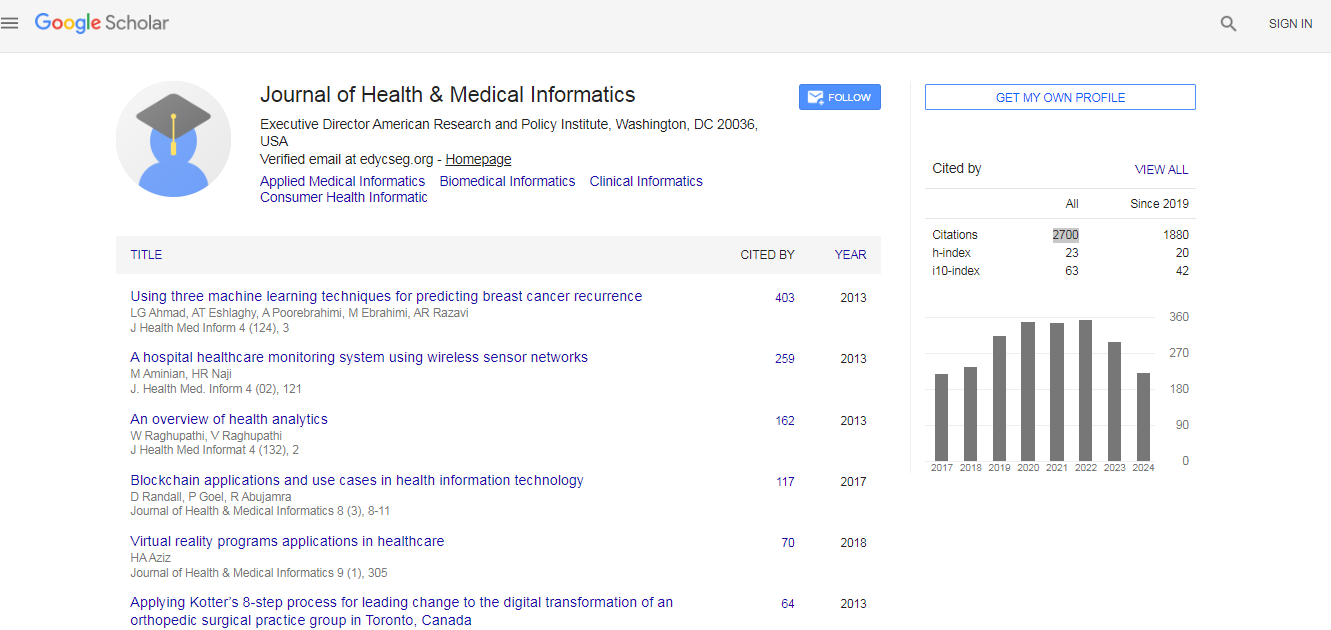
Journal of Health & Medical Informatics received 2700 citations as per Google Scholar report