Perspective - (2025) Volume 13, Issue 4
Received: 01-Aug-2025, Manuscript No. JCMG-26-185549;
Editor assigned: 03-Aug-2025, Pre QC No. P-185549;
Reviewed: 18-Aug-2025, QC No. Q-185549;
Revised: 23-Aug-2025, Manuscript No. R-185549;
Published:
29-Aug-2025
, DOI: 10.37421/2472-128X.2025.13.352
Citation: Al-Farouq, Noor. ”Clinical Genomics: Impact, Workflow, and Future Directions.” J Clin Med Genomics 13 (2025):352.
Copyright: © 2025 Al-Farouq N. This is an open-access article distributed under the terms of the Creative Commons Attribution License, which permits unrestricted use, distribution and reproduction in any medium, provided the original author and source are credited.
The field of clinical genomics is rapidly evolving, transforming the landscape of patient care and enabling unprecedented levels of personalized medicine. This journey begins with the fundamental step of sample collection, which lays the groundwork for all subsequent analyses. The intricacies involved in ensuring sample integrity and quality are paramount to the success of downstream genomic investigations. This initial phase is critical for obtaining reliable data that can ultimately inform therapeutic decisions [1].
The analytical validation of genomic assays is a cornerstone of their successful integration into clinical practice. This rigorous process ensures that diagnostic tests are not only accurate and reliable but also reproducible across different settings and platforms. Establishing key performance characteristics such as sensitivity, specificity, and precision is essential for building confidence in the results generated by these assays. Standardization in genomic testing further contributes to maintaining quality and comparability of results, which is vital for therapeutic interventions [2].
In oncology, genomic profiling of tumors has emerged as a powerful tool for guiding precision cancer medicine. Next-generation sequencing (NGS) data allows for the identification of actionable mutations, which in turn can predict treatment response and inform the selection of targeted therapies. Addressing the challenges associated with data interpretation and reporting, including the need for robust bioinformatics pipelines and expert review, is crucial for maximizing the impact of genomics in oncology [3].
For patients with rare diseases, whole-genome sequencing (WGS) has proven to be an invaluable diagnostic tool. In many cases, WGS has identified pathogenic variants that were previously missed by other diagnostic methods, leading to definitive diagnoses and appropriate patient management. The growing utility of WGS in clinical settings, driven by technological advancements and decreasing costs, is making it an increasingly accessible option for diagnosing complex genetic conditions [4].
Pharmacogenomics offers a significant opportunity to optimize drug therapy by considering an individual's genetic makeup. This field explores how genetic variations influence drug metabolism and efficacy, enabling the selection of optimal drug dosages and the prevention of adverse drug reactions. The development of clinical decision support tools and the education of clinicians are key to facilitating the widespread implementation of pharmacogenomic testing and realizing its potential in personalized medicine [5].
Liquid biopsies represent a paradigm shift in cancer management, offering non-invasive methods for early detection, treatment response monitoring, and the identification of minimal residual disease. The detection of circulating tumor DNA (ctDNA) and other biomarkers in bodily fluids holds immense promise for revolutionizing cancer diagnostics and personalizing therapy. These advancements have the potential to complement or even supplant traditional tissue biopsies in certain clinical scenarios [6].
The ethical, legal, and social implications (ELSI) of clinical genomics are profound and require careful consideration. Issues such as data privacy, genetic discrimination, informed consent, and equitable access to genomic technologies necessitate the development of robust policies and guidelines. Responsible implementation of clinical genomics is paramount to fostering public trust and ensuring that its benefits are accessible to all individuals [7].
Bioinformatics pipelines play a critical role in managing and interpreting the vast amounts of data generated by clinical genomics. Addressing the computational challenges, standardizing workflows, and developing robust analytical tools are essential for translating sequencing data into clinically relevant information. Effective variant calling, annotation, and pathogenicity assessment are key components of these pipelines, enabling diagnostic and therapeutic insights [8].
In the realm of pediatric oncology, genomic sequencing has significantly improved diagnostic accuracy and guided treatment decisions, particularly for children with challenging or refractory cancers. The integration of genomic data into multidisciplinary tumor boards and the importance of rapid turnaround times are critical for clinical actionability. Genomics holds substantial potential to enhance outcomes for young cancer patients [9].
Quality assurance and regulatory oversight are fundamental to ensuring the reliability and validity of clinical genomic testing. Adherence to established standards and guidelines, along with robust regulatory frameworks and accreditation processes, is crucial for maintaining confidence in genomic diagnostics. Continuous quality improvement and a commitment to the integrity of testing processes are vital for the widespread adoption of clinical genomics [10].
The progression of clinical genomics is characterized by a series of interconnected stages, beginning with the critical initial step of sample collection. Ensuring the integrity and quality of biological samples is foundational for the accuracy of subsequent genomic analyses, and this process is meticulously detailed in the context of advancing clinical genomics workflows for precision medicine [1].
Following sample collection, the analytical validation of genomic assays is a crucial phase before their widespread clinical implementation. This rigorous validation ensures that diagnostic tests meet high standards of accuracy, reliability, and reproducibility. Defining critical performance characteristics such as sensitivity, specificity, and precision is paramount, and standardization across laboratories and platforms is emphasized to maintain confidence in the genomic results that guide therapeutic interventions [2].
Within the domain of cancer treatment, the application of genomic profiling has become indispensable for implementing precision cancer medicine. Next-generation sequencing (NGS) technology enables the identification of specific genetic alterations in tumors, facilitating the selection of targeted therapies and predicting patient responses. The integration of bioinformatics pipelines and expert review is highlighted as essential for effectively interpreting and reporting this complex genomic data [3].
For individuals diagnosed with rare diseases, whole-genome sequencing (WGS) has emerged as a powerful diagnostic modality. WGS has demonstrated its capacity to uncover genetic variations that eluded detection by other diagnostic methods, thereby providing definitive diagnoses and enabling appropriate patient management. The increasing accessibility and utility of WGS in clinical practice underscore its growing importance for challenging diagnostic cases [4].
The integration of pharmacogenomics into clinical practice offers a pathway to personalized drug therapy. By understanding how an individual's genetic variations influence drug metabolism and response, clinicians can optimize drug selection and dosage, thereby minimizing adverse drug reactions. The development of decision support tools and clinician education are key facilitators for the successful implementation of pharmacogenomics [5].
Liquid biopsies represent a significant advancement in cancer management, providing a less invasive approach to diagnosis and monitoring. The analysis of circulating tumor DNA (ctDNA) and other biomarkers in bodily fluids facilitates early cancer detection, assessment of treatment response, and the identification of minimal residual disease. These technologies are poised to revolutionize non-invasive cancer diagnostics and personalize therapeutic strategies [6].
As clinical genomics becomes more integrated into healthcare, addressing the ethical, legal, and social implications (ELSI) is imperative. Critical issues such as data privacy, genetic discrimination, and equitable access require the establishment of comprehensive policies and guidelines. Navigating these complex challenges responsibly is essential for building public trust and ensuring the equitable distribution of benefits from genomic medicine [7].
Efficient processing and interpretation of large-scale genomic data are dependent on well-designed bioinformatics pipelines. These pipelines address significant computational challenges, emphasize the need for standardized workflows, and leverage robust analytical tools. Accurate variant calling, annotation, and pathogenicity assessment are fundamental steps in generating clinically actionable information from sequencing data [8].
In pediatric oncology, the application of genomic sequencing has led to improved diagnostic accuracy and more targeted treatment strategies, especially for children with complex or resistant cancers. The timely incorporation of genomic findings into clinical decision-making, often through multidisciplinary tumor boards, is crucial for optimizing patient outcomes [9].
Ensuring the quality and regulatory compliance of clinical genomic testing is vital for its widespread adoption and the trust it inspires. Adherence to established standards, guidelines, and regulatory frameworks is essential for guaranteeing the reliability and validity of genomic diagnostics. A commitment to continuous quality improvement is fundamental to the integrity of clinical genomic testing processes [10].
This collection of research highlights the transformative impact of genomics across various clinical applications. It details the workflow of clinical genomics from sample collection to treatment, emphasizing analytical validation for diagnostic accuracy and the profiling of tumors for precision cancer medicine. The diagnostic utility of whole-genome sequencing for rare diseases and the implementation of pharmacogenomics for personalized drug therapy are explored. Furthermore, the role of liquid biopsies in cancer management, the ethical and social implications of genomic medicine, and the essential bioinformatics pipelines for data interpretation are discussed. The application of genomic sequencing in pediatric oncology and the crucial aspects of quality assurance and regulatory oversight for clinical genomic testing are also presented.
None
None
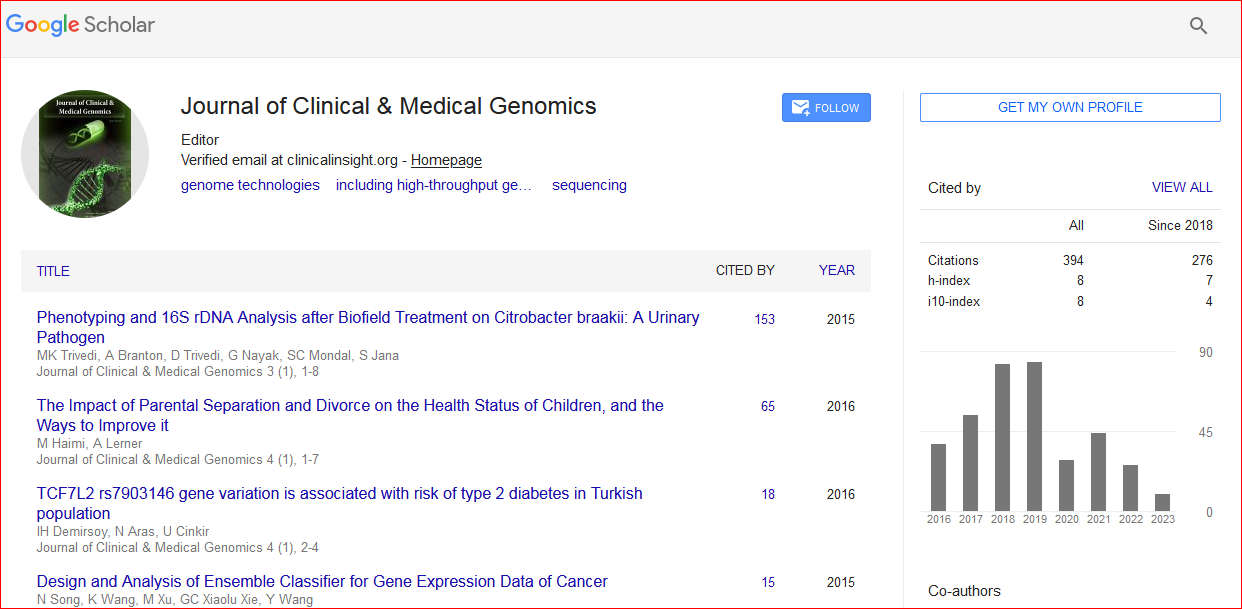
Journal of Clinical & Medical Genomics received 391 citations as per Google Scholar report