Short Communication - (2025) Volume 14, Issue 6
Received: 03-Nov-2025, Manuscript No. mcce-26-190200;
Editor assigned: 05-Nov-2025, Pre QC No. P-190200;
Reviewed: 19-Nov-2025, QC No. Q-190200;
Revised: 24-Nov-2025, Manuscript No. R-190200;
Published:
29-Nov-2025
, DOI: 10.37421/2470-6965.2025.14.434
Citation: Johansson, Peter. ”Climate Change Alters Malaria Vector Ecology and Risk.” Malar Contr Elimination 14 (2025):434.
Copyright: © 2025 Johansson P. This is an open-access article distributed under the terms of the Creative Commons Attribution License, which permits unrestricted use, distribution and reproduction in any medium, provided the original author and source are credited.
Rising global temperatures and altered precipitation patterns are significantly reshaping the ecological landscape for malaria vectors. This shift impacts their geographical distribution, breeding site availability, and the extrinsic incubation period of the parasite, ultimately influencing malaria transmission dynamics and the effectiveness of current control strategies. Understanding these vector ecology changes is crucial for adapting and strengthening malaria elimination efforts [1].
Changes in rainfall, temperature, and humidity are creating new breeding habitats for Anopheles mosquitoes in previously unsuitable regions, while also affecting larval development and survival in established endemic areas. These alterations in vector abundance and distribution are directly linked to varying patterns of malaria transmission, posing new challenges for public health interventions [2].
The extrinsic incubation period (EIP) of the malaria parasite, Plasmodium falciparum, is highly temperature-dependent. Warmer temperatures can shorten the EIP, leading to a more rapid development of infectious sporozoites within the mosquito. This acceleration can increase the vectorial capacity of mosquitoes and thus the potential for malaria transmission, particularly in regions experiencing warming trends [3].
Extreme weather events, such as floods and droughts, also play a significant role in altering mosquito populations and malaria transmission. Floods can create new breeding sites, while droughts can concentrate mosquitoes and their hosts around remaining water sources, potentially increasing contact rates and disease transmission [4].
The expansion of Anopheles mosquito species into higher altitudes and latitudes, driven by warming climates, is a concerning trend. This geographical expansion introduces malaria to populations that may have little to no prior immunity, increasing the risk of severe outbreaks and complicating elimination efforts in these new areas [5].
Understanding the complex interplay between environmental change, vector behavior, and parasite development is essential for predicting future malaria risk. Advanced modeling techniques are being employed to forecast potential shifts in transmission hotspots and to guide adaptive vector control strategies [6].
The timing and duration of rainy seasons, crucial for mosquito breeding, are being altered by climate change. Shorter, more intense rainy periods or prolonged dry spells can disrupt the typical Anopheles life cycle and consequently affect malaria transmission patterns, making traditional seasonal predictions unreliable [7].
Changes in land use, such as deforestation and urbanization, often interact with climate change to influence malaria vector ecology. For instance, deforestation can alter local microclimates and create new breeding grounds, while urbanization can lead to increased human-mosquito contact in certain settings [8].
The genetic makeup of mosquito populations can also be influenced by environmental pressures, potentially affecting their vectorial capacity and response to control interventions. Adaptation to changing climatic conditions could lead to the selection of mosquito genotypes that are more efficient at transmitting malaria or more resistant to insecticides [9].
Sustained efforts in malaria surveillance are critical for detecting and responding to shifts in vector ecology. Integrated monitoring systems that combine entomological, parasitological, and climatic data are essential for identifying emerging threats and adapting control strategies in real-time [10].
The ecological landscape for malaria vectors is undergoing significant reshaping due to rising global temperatures and altered precipitation patterns. These climatic shifts directly impact the geographical distribution of vectors, the availability of breeding sites, and the extrinsic incubation period of the malaria parasite. Consequently, these changes influence malaria transmission dynamics and the efficacy of existing control strategies, necessitating a deeper understanding for effective malaria elimination efforts [1].
Altered rainfall, temperature, and humidity are leading to the emergence of new breeding habitats for Anopheles mosquitoes in regions previously considered unsuitable. Concurrently, these environmental changes affect larval development and survival rates in established malaria-endemic areas. The resulting modifications in vector abundance and distribution are intrinsically linked to variable patterns of malaria transmission, presenting novel challenges for public health interventions [2].
The extrinsic incubation period (EIP) of Plasmodium falciparum, the malaria parasite, is demonstrably temperature-dependent. Elevated temperatures accelerate the development of infectious sporozoites within the mosquito, shortening the EIP. This accelerated development enhances the vectorial capacity of mosquitoes, thereby increasing the potential for malaria transmission, particularly in areas experiencing warming trends [3].
Extreme weather phenomena, including floods and droughts, exert a considerable influence on mosquito populations and the subsequent transmission of malaria. Floods can generate novel breeding grounds, while droughts tend to concentrate mosquitoes and their hosts around scarce water sources, potentially escalating contact rates and disease transmission [4].
A notable and concerning trend is the geographical expansion of Anopheles mosquito species into higher altitudes and latitudes, a phenomenon largely attributed to warming climates. This expansion introduces malaria to naive populations with limited or no prior immunity, heightening the risk of severe outbreaks and complicating elimination strategies in these newly affected areas [5].
A comprehensive understanding of the intricate interactions between environmental changes, vector behavior, and parasite development is paramount for accurate prediction of future malaria risk. Sophisticated modeling techniques are increasingly being utilized to forecast potential shifts in malaria transmission hotspots and to inform the development of adaptive vector control strategies [6].
The temporal dynamics and duration of rainy seasons, which are critical for mosquito proliferation, are being significantly altered by climate change. The occurrence of shorter, more intense rainy periods or prolonged dry spells can disrupt the typical Anopheles life cycle, consequently affecting malaria transmission patterns and rendering traditional seasonal predictions less reliable [7].
Modifications in land use, such as deforestation and increasing urbanization, frequently interact with climate change to influence the ecology of malaria vectors. For example, deforestation can alter local microclimates and create new breeding environments, while urbanization can lead to increased human-mosquito contact in specific urban settings [8].
The genetic composition of mosquito populations is also susceptible to environmental pressures, which can impact their vectorial capacity and their responsiveness to control measures. The process of adaptation to changing climatic conditions may favor the selection of mosquito genotypes that exhibit enhanced efficiency in malaria transmission or a greater resistance to insecticides [9].
Robust and continuous malaria surveillance systems are indispensable for the early detection and timely response to alterations in vector ecology. The implementation of integrated monitoring systems, which combine entomological, parasitological, and climatic data, is vital for identifying emerging threats and for adapting control strategies effectively in real-time [10].
Climate change is significantly altering the ecology of malaria vectors, impacting their distribution, breeding sites, and the parasite's incubation period. Warmer temperatures accelerate parasite development, increasing mosquito vectorial capacity. Extreme weather events like floods and droughts create new breeding grounds or concentrate vectors. Mosquitoes are expanding into higher altitudes and latitudes, exposing naive populations. Land-use changes interact with climate change to influence vector habitats. Changes in rainfall patterns disrupt mosquito life cycles. Genetic adaptation in mosquito populations may lead to increased transmission efficiency or insecticide resistance. Advanced modeling is crucial for predicting future risk and guiding adaptive control. Effective malaria control requires integrated surveillance systems combining entomological, parasitological, and climatic data.
None
None
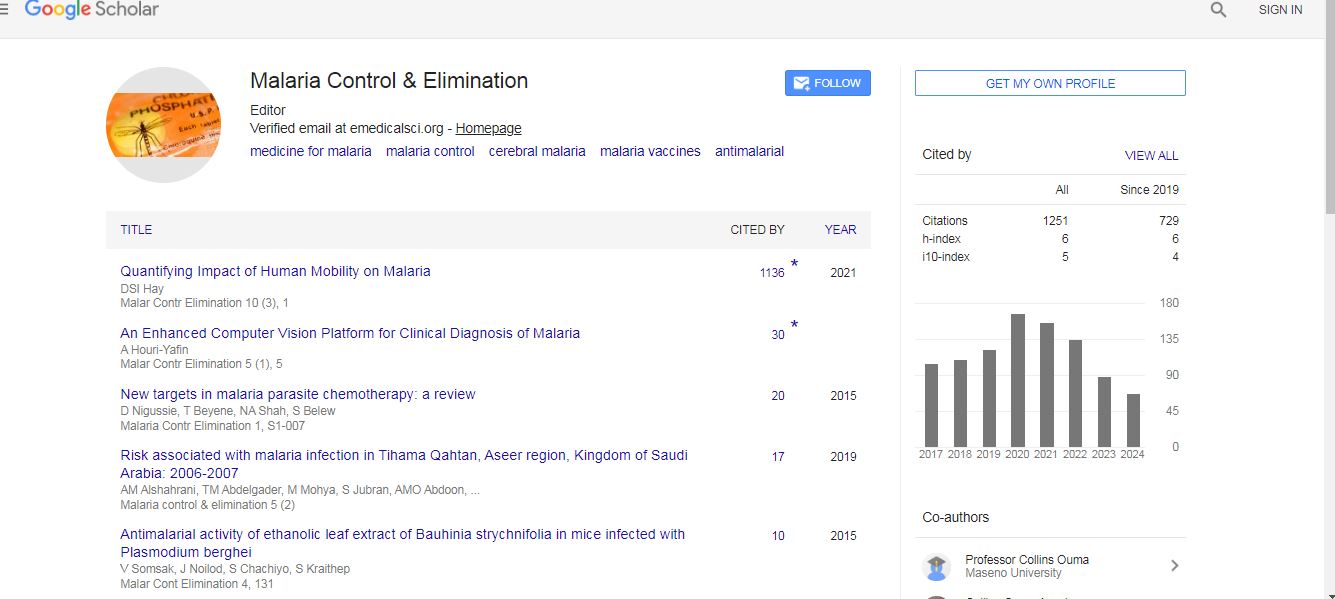
Malaria Control & Elimination received 1187 citations as per Google Scholar report