Brief Report - (2025) Volume 12, Issue 4
Received: 01-Aug-2025, Manuscript No. jreac-26-185851;
Editor assigned: 04-Aug-2025, Pre QC No. P-185851;
Reviewed: 18-Aug-2025, QC No. Q-185851;
Revised: 22-Aug-2025, Manuscript No. R-185851;
Published:
29-Aug-2025
, DOI: 10.37421/2380-2391.2025.12.437
Citation: Rahman, Noor. ”Chemometrics: Analyzing Complex Environmental Data for Pollution.” J Environ Anal Chem 12 (2025):437.
Copyright: © 2025 Rahman N. This is an open-access article distributed under the terms of the Creative Commons Attribution License, which permits unrestricted use, distribution and reproduction in any medium, provided the original author and source are credited.
Chemometric tools are fundamental for extracting meaningful insights from the complex datasets generated in environmental monitoring. These advanced statistical and mathematical methods enable researchers to identify pollution sources, track contaminant trends, and assess overall environmental quality, leading to more informed decision-making for pollution control and remediation strategies [1].
The power of multivariate statistical methods, particularly Principal Component Analysis (PCA) and Partial Least Squares Discriminant Analysis (PLS-DA), is evident in deciphering complex environmental datasets related to water quality. These techniques reveal hidden patterns, distinguish between different pollution sources, and build predictive models for water quality parameters, offering a systematic approach to manage and interpret large volumes of data for effective water resource management [2].
Advanced chemometric techniques, including Self-Organizing Maps (SOMs) and Hierarchical Cluster Analysis (HCA), are explored for their application in identifying and differentiating sources of air pollution in urban environments. By analyzing comprehensive datasets of atmospheric pollutants, these methods effectively group samples based on emission profiles, pinpointing the likely origin of various pollution events and underscoring their utility in source apportionment studies [3].
The use of chemometric modeling, specifically Partial Least Squares Regression (PLSR), is investigated for predicting heavy metal concentrations in soil based on spectral data. The developed models demonstrate good accuracy and robustness, offering a rapid and cost-effective alternative to traditional laboratory analysis for soil contamination assessment and highlighting the potential of chemometrics in developing efficient environmental monitoring tools [4].
Chemometric techniques, including PCA and SIMCA (Soft Independent Modeling of Class Analogy), are applied to assess the spatio-temporal variations in groundwater quality. This research effectively categorizes different groundwater types and identifies major factors influencing water quality degradation, demonstrating the capability of chemometrics to provide a holistic understanding of complex environmental systems like groundwater resources [5].
Chemometric methods, specifically PCA and PLS-DA, are utilized for the classification and identification of pollution sources in coastal marine environments. By analyzing the chemical composition of sediments and water samples, researchers can distinguish between different pollution inputs, such as agricultural runoff and industrial discharge, highlighting the importance of chemometrics in marine environmental management [6].
The application of multivariate calibration techniques, including PLS, is a focus for the analysis of trace organic pollutants in environmental matrices. These chemometric tools enable the development of accurate predictive models for pollutant concentrations from instrumental signals, showcasing the efficiency of chemometrics in quantitative analysis for environmental monitoring [7].
Chemometric methods, particularly PCA, are applied to analyze the spatial distribution and source identification of polycyclic aromatic hydrocarbons (PAHs) in river sediments. The results reveal distinct patterns related to different emission sources and transport pathways, demonstrating the value of chemometrics in understanding the complex behavior of organic contaminants in aquatic ecosystems [8].
The exploration of chemometric tools, including Principal Component Regression (PCR) and PLS, is crucial for the analysis of dissolved organic matter (DOM) in surface waters. These methods extract meaningful information about DOM composition and variability from spectral data, aiding in the understanding of aquatic biogeochemical processes and water quality [9].
Research investigates the application of chemometrics, specifically PLS-DA and PCA, for the identification and classification of different industrial wastewater types. By analyzing the chemical profiles of various wastewater streams, models are developed that can accurately discriminate between different sources, which is crucial for effective wastewater treatment and pollution control strategies [10].
Chemometric tools serve as indispensable instruments for extracting meaningful insights from the complex datasets generated within the field of environmental monitoring. Techniques such as Principal Component Analysis (PCA), Partial Least Squares (PLS), and Hierarchical Cluster Analysis (HCA) are highlighted for their effectiveness in identifying pollution sources, tracking contaminant trends, and assessing the overall environmental quality. The application of these methods facilitates more efficient and reliable interpretation of environmental data, ultimately leading to better-informed decision-making for pollution control and remediation strategies [1].
This review specifically emphasizes the power of multivariate statistical methods, notably PCA and PLS-DA, in deciphering intricate environmental datasets pertaining to water quality. The authors demonstrate how these techniques can effectively uncover hidden patterns, differentiate between various pollution sources like industrial, agricultural, and domestic effluents, and construct predictive models for water quality parameters. This analytical approach provides a systematic pathway for managing and interpreting large volumes of environmental data, thereby enhancing the effectiveness of water resource management [2].
The study delves into the application of advanced chemometric techniques, including Self-Organizing Maps (SOMs) and Hierarchical Cluster Analysis (HCA), for the purpose of identifying and differentiating sources of air pollution within an urban context. Through the analysis of a comprehensive dataset comprising atmospheric pollutants, the researchers successfully grouped samples based on their emission profiles, thereby effectively pinpointing the probable origins of diverse pollution events. This work underscores the significant utility of chemometrics in conducting source apportionment studies [3].
This paper investigates the efficacy of chemometric modeling, with a specific focus on Partial Least Squares Regression (PLSR), for the prediction of heavy metal concentrations within soil samples, utilizing spectral data as the input. The resultant model exhibits a high degree of accuracy and robustness, offering a rapid and cost-effective alternative to conventional laboratory analysis methods for the assessment of soil contamination. This finding underscores the considerable potential of chemometrics in the development of efficient tools for environmental monitoring [4].
The research presented applies chemometric techniques, encompassing PCA and SIMCA (Soft Independent Modeling of Class Analogy), to rigorously assess the spatio-temporal variations observed in groundwater quality. The study adeptly categorizes different groundwater types and identifies the principal factors contributing to water quality degradation. This work effectively demonstrates the capacity of chemometrics to furnish a comprehensive understanding of complex environmental systems, such as those related to groundwater resources [5].
This study leverages chemometric methods, with a particular emphasis on PCA and PLS-DA, to facilitate the classification and identification of pollution sources within coastal marine environments. By meticulously analyzing the chemical composition of both sediment and water samples, the researchers were able to effectively distinguish between various pollution inputs, including agricultural runoff and industrial discharge. The findings derived from this research highlight the critical importance of chemometrics in the effective management of marine environments [6].
The research concentrates on the application of multivariate calibration techniques, notably PLS, for the precise analysis of trace organic pollutants present in diverse environmental matrices. The authors successfully demonstrate the capability of these chemometric tools in developing accurate predictive models that correlate instrumental signals with pollutant concentrations. This effort showcases the remarkable efficiency of chemometrics in quantitative analysis, a crucial aspect of comprehensive environmental monitoring [7].
This study employs chemometric methods, predominantly PCA, to conduct a detailed analysis of the spatial distribution patterns and source identification of polycyclic aromatic hydrocarbons (PAHs) within river sediments. The outcomes of this analysis reveal distinct patterns that are closely associated with different emission sources and transport pathways. This clearly demonstrates the significant value of chemometrics in comprehending the complex behaviors of organic contaminants within aquatic ecosystems [8].
The paper explores the utilization of chemometric tools, specifically Principal Component Regression (PCR) and PLS, for the analytical examination of dissolved organic matter (DOM) in surface waters. The study effectively illustrates how these methodologies can extract valuable and meaningful information regarding DOM composition and variability directly from spectral data. This contributes significantly to a deeper understanding of aquatic biogeochemical processes and overall water quality [9].
This research investigates the practical application of chemometric approaches, with a specific focus on PLS-DA and PCA, for the accurate identification and classification of various types of industrial wastewater. By analyzing the distinct chemical profiles characteristic of different wastewater streams, the study successfully developed models capable of reliably discriminating between these diverse sources. This capability is of paramount importance for the implementation of effective wastewater treatment and robust pollution control strategies [10].
This collection of research highlights the pivotal role of chemometric techniques in analyzing complex environmental data. Studies demonstrate the application of methods like PCA, PLS, HCA, SOMs, and SIMCA for source identification of pollutants in air, water, and soil, as well as for assessing spatio-temporal variations and predicting contaminant concentrations. These chemometric approaches offer efficient and reliable ways to interpret environmental data, leading to better informed decision-making for pollution control and resource management.
None
None
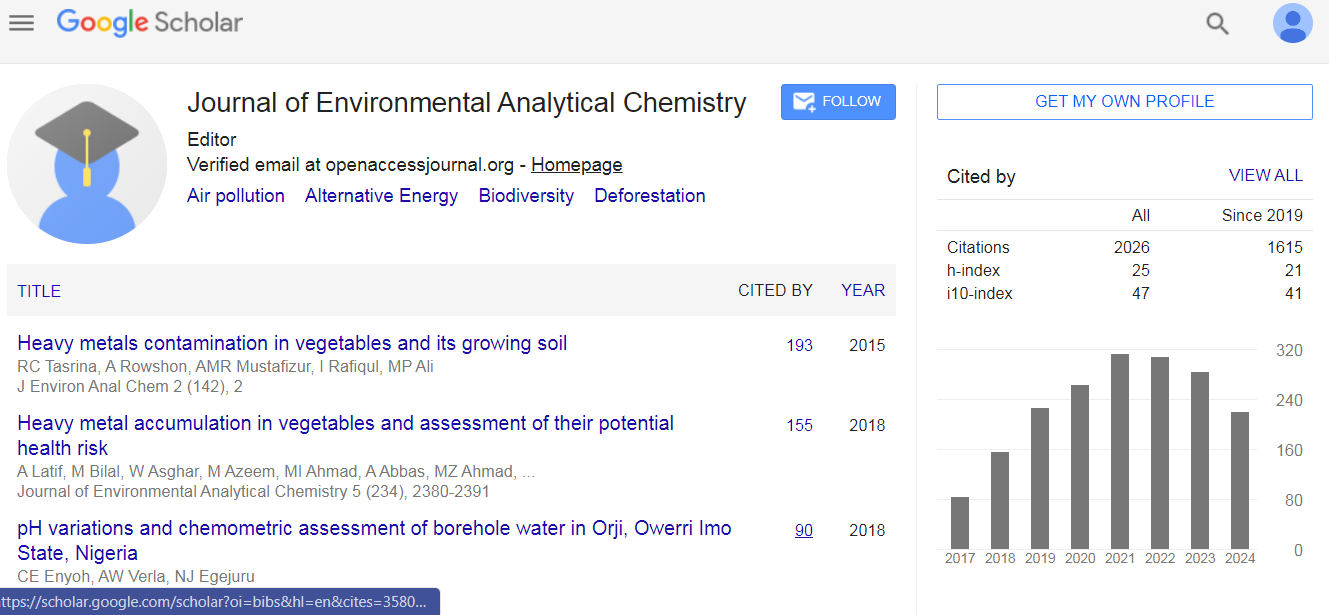
Journal of Environmental Analytical Chemistry received 1781 citations as per Google Scholar report