Opinion - (2025) Volume 14, Issue 2
Received: 01-Apr-2025, Manuscript No. jsp-26-182233;
Editor assigned: 03-Apr-2025, Pre QC No. P-182233;
Reviewed: 17-Apr-2025, QC No. Q-182233;
Revised: 22-Apr-2025, Manuscript No. R-182233;
Published:
29-Apr-2025
, DOI: 10.37421/2165-7939.2025.14.712
Citation: Patel, Vikram S.. ”Cervical Spondylosis: Degeneration, Compression, And Management.” J Spine 14 (2025):712.
Copyright: © 2025 Patel S. Vikram This is an open-access article distributed under the terms of the Creative Commons Attribution License, which permits unrestricted use, distribution and reproduction in any medium, provided the original author and source are credited.
Cervical spondylosis is a prevalent degenerative condition affecting the cervical spine, characterized by age-related wear and tear on intervertebral discs and facet joints. This process involves disc dehydration, the formation of bone spurs known as osteophytes, and thickening of ligaments, collectively leading to narrowing of the spinal canal and compression of nerve roots. The clinical manifestations can vary significantly, ranging from localized neck pain and stiffness to more severe neurological deficits such as radiculopathy and myelopathy. Management strategies are diverse, incorporating conservative approaches like physical therapy, pain management modalities, and lifestyle adjustments. For more advanced or progressive cases, surgical interventions become necessary to decompress neural elements and provide spinal stability. The efficacy of surgical treatments is influenced by factors such as the extent of disease progression and the specific surgical techniques employed [1].
Biomechanically, degenerative changes in the cervical spine lead to significant alterations, with disc height loss and facet joint degeneration playing key roles in segmental instability and the redistribution of loads across the spine. This cascade of events can result in osteophyte formation and ossification of ligaments, ultimately contributing to spinal canal stenosis. Emerging therapeutic paradigms, including minimally invasive decompression and dynamic stabilization, are being explored for their potential to restore spinal function and address neurological deficits. These advanced techniques aim to provide effective treatment while minimizing invasiveness [2].
The inflammatory processes underpinning cervical spondylosis are critical to understanding and developing targeted therapies. Research highlights the involvement of cytokines and growth factors in accelerating disc degeneration and osteophyte formation. Consequently, pharmacologic interventions, such as anti-inflammatory drugs and chondroprotective agents, are being investigated for their ability to slow disease progression and manage symptoms. A personalized treatment approach, considering individual patient characteristics, is emphasized as essential for optimal outcomes [3].
Accurate diagnosis of cervical spondylosis relies on various imaging modalities, each with its own strengths and limitations. Conventional X-rays, Magnetic Resonance Imaging (MRI), and CT myelography are commonly used to visualize degenerative changes, assess neural compression, and evaluate spinal alignment. MRI, in particular, offers superior visualization of soft tissues and neurological structures, playing a crucial role in surgical decision-making. A stepwise imaging strategy, guided by the patient's clinical presentation, is often recommended to ensure comprehensive diagnostic evaluation [4].
Physical therapy plays a vital role in the conservative management of cervical spondylosis, aiming to alleviate pain, improve range of motion, and enhance overall function. Therapeutic interventions include tailored exercise programs, manual therapy techniques, and the use of modalities like heat and ultrasound. Patient education and active participation in rehabilitation are considered paramount for achieving sustained functional improvements and long-term success in managing this condition [5].
Surgical management of cervical myelopathy, a severe complication of spondylosis, involves a critical evaluation of different surgical strategies. Anterior versus posterior decompression approaches are compared based on their indications, associated risks, and outcomes regarding neurological recovery and complication rates. The integration of spinal fusion with decompression is also examined, with a focus on achieving solid fusion and mitigating the risk of adjacent segment disease, a common long-term complication [6].
Minimally invasive surgical techniques are increasingly being adopted for the treatment of cervical spondylosis, offering potential advantages over traditional open procedures. These benefits include reduced blood loss, shorter hospital stays, and faster patient recovery. Specific techniques such as posterior cervical foraminotomy and anterior cervical discectomy and fusion (ACDF) performed with smaller incisions are being detailed and refined, representing a significant evolution in surgical care [7].
The pathophysiology of cervical radiculopathy, often caused by spondylotic changes, involves nerve root compression stemming from disc herniation, osteophytes, and narrowing of the neural foramen. Clinical presentation, diagnostic assessment, and conservative management, including cervical epidural steroid injections, are discussed. The article also outlines the criteria for surgical decompression of the affected nerve root when conservative measures prove insufficient [8].
Cervical disc arthroplasty is being compared with anterior cervical discectomy and fusion (ACDF) for symptomatic cervical disc degeneration. Studies evaluate long-term outcomes such as patient satisfaction, functional recovery, and the incidence of adjacent segment pathology. Preliminary findings suggest that disc arthroplasty may offer benefits in preserving spinal motion and potentially reducing the risk of adjacent segment degeneration, though further research is ongoing [9].
The etiology of cervical spondylosis is multifactorial, influenced by a complex interplay of genetic predisposition and environmental factors. Lifestyle choices, occupational exposures, and the natural aging process all contribute to the development and progression of this degenerative condition. Identifying these contributing factors is crucial for risk stratification and the development of effective preventive strategies aimed at mitigating the impact of cervical spondylosis [10].
Cervical spondylosis, a degenerative condition of the cervical spine, arises from age-related wear and tear on the intervertebral discs and facet joints. This pathophysiology involves disc dehydration, osteophyte formation, and ligamentous hypertrophy, leading to spinal canal stenosis and nerve root compression. Symptoms range from neck pain and stiffness to radiculopathy and myelopathy. Treatment strategies are multifaceted, encompassing conservative measures like physical therapy, pain management, and lifestyle modifications, alongside surgical interventions for severe or progressive cases. Surgical options aim to decompress neural elements and stabilize the spine, with outcomes influenced by the extent of disease and surgical technique [1].
This study delves into the biomechanical alterations in the cervical spine due to degenerative changes, focusing on how disc height loss and facet joint degeneration contribute to segmental instability and altered load distribution. The research highlights the cascade of events leading to osteophyte formation and ligamentous ossification, ultimately narrowing the spinal canal. Emerging treatment paradigms, including minimally invasive decompression techniques and dynamic stabilization methods, are discussed in relation to their efficacy in restoring spinal function and alleviating neurological deficits [2].
Understanding the inflammatory pathways involved in cervical spondylosis is crucial for developing targeted therapies. This article explores the role of cytokines and growth factors in promoting disc degeneration and osteophyte formation. It also examines the effectiveness of pharmacologic interventions, such as anti-inflammatory agents and chondroprotective drugs, in slowing disease progression and managing symptoms. The authors emphasize the importance of a personalized approach to treatment, considering individual patient factors [3].
The diagnostic accuracy of various imaging modalities for cervical spondylosis is reviewed, including X-ray, MRI, and CT myelography. The article highlights the strengths and limitations of each technique in visualizing degenerative changes, neural compression, and spinal alignment. A particular focus is placed on MRI's superior ability to assess soft tissues and neurological structures, guiding surgical decision-making. The authors recommend a stepwise approach to imaging based on clinical presentation [4].
This review synthesizes evidence on the efficacy of physical therapy interventions for managing cervical spondylosis. It examines the benefits of exercise, manual therapy, and modalities like heat and ultrasound in reducing pain, improving range of motion, and enhancing functional outcomes. The authors emphasize the importance of patient education and active participation in rehabilitation programs for long-term success [5].
The surgical management of cervical myelopathy secondary to spondylosis is critically evaluated. This article compares anterior versus posterior decompression approaches, discussing their indications, risks, and outcomes in terms of neurological recovery and complication rates. The role of spinal fusion in conjunction with decompression is also explored, with an emphasis on achieving solid fusion and preventing adjacent segment disease [6].
This research focuses on the evolving role of minimally invasive surgical techniques in treating cervical spondylosis. It examines the advantages of these approaches, such as reduced blood loss, shorter hospital stays, and faster recovery times, compared to traditional open procedures. Specific techniques like posterior cervical foraminotomy and anterior cervical discectomy and fusion (ACDF) using smaller incisions are discussed in detail [7].
The pathophysiology of cervical radiculopathy due to spondylosis is explored, emphasizing the mechanisms of nerve root compression from disc herniation, osteophytes, and foraminal stenosis. This article discusses the clinical presentation, diagnostic workup, and conservative management options, including cervical epidural steroid injections. The indications for surgical decompression of the affected nerve root are also outlined [8].
This study investigates the long-term outcomes of cervical disc arthroplasty compared to anterior cervical discectomy and fusion (ACDF) for the treatment of symptomatic cervical disc degeneration. The authors report on patient satisfaction, functional recovery, and the incidence of adjacent segment pathology. The findings suggest that disc arthroplasty may offer advantages in preserving motion and potentially reducing the risk of adjacent segment degeneration [9].
The genetic and environmental factors influencing the development of cervical spondylosis are explored. This article discusses the interplay of genetic predisposition, lifestyle choices, occupational exposures, and aging processes in the manifestation of this degenerative condition. Understanding these contributing factors can aid in identifying individuals at higher risk and developing preventive strategies [10].
Cervical spondylosis is a common degenerative spinal condition characterized by wear and tear of discs and facet joints, leading to stenosis and nerve compression. Symptoms include neck pain, stiffness, radiculopathy, and myelopathy. Treatment involves conservative methods like physical therapy and pain management, as well as surgical interventions for severe cases. Biomechanical studies highlight the impact of disc height loss and facet degeneration on spinal instability. Inflammatory pathways are also implicated, with research exploring cytokine roles and potential pharmacologic targets. Diagnostic accuracy relies on imaging modalities like MRI, which excels at visualizing soft tissues. Physical therapy focuses on exercises and manual techniques to improve function. Surgical management strategies for cervical myelopathy compare anterior and posterior decompression, with a focus on fusion and preventing adjacent segment disease. Minimally invasive techniques are gaining traction due to reduced invasiveness and faster recovery. Cervical radiculopathy management involves understanding nerve root compression mechanisms and conservative treatments like epidural injections. Comparative studies of cervical disc arthroplasty versus ACDF are ongoing, evaluating long-term outcomes and motion preservation. The etiology of cervical spondylosis is multifactorial, influenced by genetics, lifestyle, and environmental exposures.
None
None
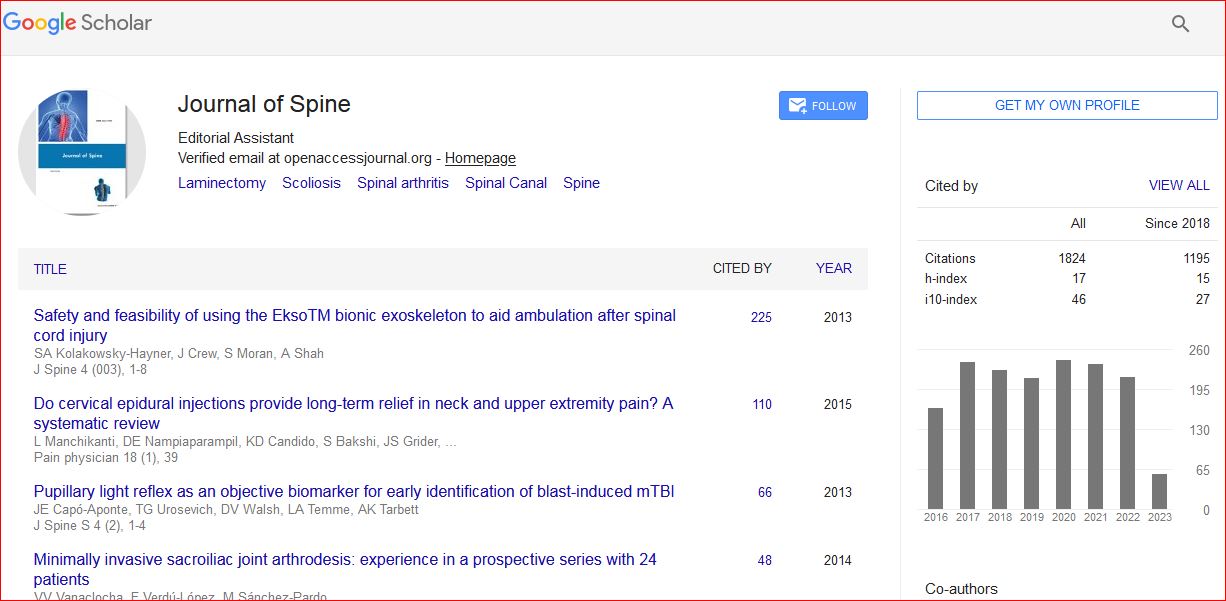
Journal of Spine received 2022 citations as per Google Scholar report