Brief Report - (2025) Volume 14, Issue 4
Received: 03-Aug-2025, Manuscript No. jsp-26-182262;
Editor assigned: 05-Aug-2025, Pre QC No. P-182262;
Reviewed: 19-Aug-2025, QC No. Q-182262;
Revised: 23-Aug-2025, Manuscript No. R-182262;
Published:
30-Aug-2025
, DOI: 10.37421/2165-7939.2025.14.731
Citation: Mokoena, Thabo N.. ”Cervical Spine Trauma: Diagnosis, Management, and Outcomes.” J Spine 14 (2025):731.
Copyright: © 2025 Mokoena N. Thabo This is an open-access article distributed under the terms of the Creative Commons Attribution License, which permits unrestricted use, distribution and reproduction in any medium, provided the original author and source are credited.
Cervical spine injuries in trauma patients represent a critical management challenge, demanding rapid and accurate diagnosis to prevent devastating neurological deficits. Early identification, appropriate immobilization, and timely surgical intervention are paramount. Imaging modalities like CT and MRI play a crucial role, while surgical approaches are tailored to the specific injury pattern and patient stability. The role of conservative management versus surgical decompression and fusion continues to be refined based on evolving evidence and patient factors. Emerging technologies and improved resuscitation strategies are also influencing outcomes [1].
The accuracy of plain radiography in detecting cervical spine injuries has limitations, particularly in the presence of occult fractures or subtle instability. Advanced imaging, especially multiplanar CT, is the cornerstone of initial assessment for suspected cervical spine trauma. MRI is invaluable for evaluating ligamentous and spinal cord injuries, guiding treatment decisions for patients with neurological deficits [2].
Surgical management of unstable cervical spine fractures aims to restore alignment, decompress neural elements, and achieve stable fusion. Posterior instrumentation techniques, such as pedicle screws and rods, are frequently employed for posterior element fixation and stabilization. The choice of surgical approach and construct depends on the fracture pattern, level of injury, and patient's overall condition [3].
Anterior cervical decompression and fusion (ACDF) remains a cornerstone for treating certain types of cervical spine injuries, particularly those involving anterior column instability or significant neural compression. Advances in instrumentation and bone grafting materials have improved fusion rates and reduced complications, though challenges persist in managing multi-level disease and associated comorbidities [4].
Cervical spine injuries in pediatric trauma patients present unique challenges due to the developing anatomy and potential for ligamentous injuries without obvious bony displacement. Careful imaging protocols and a high index of suspicion are crucial. Non-operative management with immobilization is often favored when possible, but surgical interventions may be necessary for instability or neurological compromise [5].
Spinal cord injury (SCI) following trauma requires prompt management to mitigate secondary injury mechanisms. Beyond initial stabilization, strategies focus on neuroprotection, preventing complications, and facilitating rehabilitation. Multidisciplinary care involving neurosurgeons, orthopedic spine surgeons, neurologists, and rehabilitation specialists is essential for optimizing patient outcomes [6].
Occult cervical spine injuries are a significant concern in multiply-injured patients, where higher-priority injuries may distract from or obscure subtle cervical abnormalities. Vigilance, thorough clinical examination, and judicious use of imaging are critical. In conscious and cooperative patients, the absence of pain, tenderness, and neurological deficits after a low-energy mechanism can sometimes allow for safe discontinuation of cervical immobilization, but this decision requires careful consideration [7].
The role of dynamic imaging in assessing cervical spine instability in trauma patients is evolving. While static imaging is standard, stress radiographs or flexion-extension views, performed cautiously and when indicated, can sometimes reveal subtle instability not apparent on conventional imaging. This is particularly relevant in cases of suspected ligamentous injury [8].
Complications following cervical spine trauma and surgery can be significant, including infection, nonunion, hardware failure, and neurological deterioration. Prophylactic measures, meticulous surgical technique, and diligent postoperative care are essential to minimize these risks. Early recognition and management of complications are critical for optimal outcomes [9].
The management of polytraumatized patients with concurrent cervical spine injuries requires a coordinated and multidisciplinary approach. Resuscitation priorities, imaging strategies, and surgical decision-making must be integrated with the management of other life-threatening injuries. Early stabilization of the cervical spine is often a critical step to prevent further neurological damage [10].
The management of cervical spine injuries in trauma patients is a complex endeavor, necessitating rapid and precise diagnosis to avert severe neurological impairments. Prompt identification, adequate immobilization, and timely surgical interventions are of utmost importance. Advanced imaging techniques such as CT and MRI are indispensable, with surgical strategies being customized to the specific injury characteristics and the patient's overall stability. Ongoing research continues to refine the balance between conservative management and surgical decompression and fusion, influenced by emerging evidence and individual patient factors. Advances in technology and resuscitation protocols are also contributing to improved patient outcomes [1].
Conventional plain radiography demonstrates inherent limitations in detecting all cervical spine injuries, particularly occult fractures or subtle instability. Consequently, multiplanar CT scans are now considered the primary imaging modality for the initial evaluation of suspected cervical spine trauma. MRI proves invaluable for assessing ligamentous damage and spinal cord injuries, playing a critical role in guiding treatment decisions, especially in patients presenting with neurological deficits [2].
Surgical intervention for unstable cervical spine fractures focuses on restoring anatomical alignment, relieving pressure on neural elements, and achieving stable bony fusion. Posterior instrumentation techniques, including the use of pedicle screws and rods, are commonly employed for stabilizing the posterior elements of the cervical spine. The selection of the surgical approach and the specific instrumentation construct is determined by the fracture pattern, the level of the injury, and the patient's general health status [3].
Anterior cervical decompression and fusion (ACDF) continues to be a foundational surgical procedure for managing specific types of cervical spine injuries, particularly those characterized by anterior column instability or significant compression of neural structures. Progress in instrumentation and bone grafting materials has led to enhanced fusion rates and a reduction in operative complications, although challenges remain in addressing multi-level pathologies and coexisting medical conditions [4].
Cervical spine injuries in the pediatric population present distinct clinical challenges due to their developing skeletal anatomy and the propensity for ligamentous injuries that may not be accompanied by obvious bony displacement. Rigorous imaging protocols and a heightened clinical suspicion are essential. While non-operative management with immobilization is often preferred when feasible, surgical intervention may become necessary in instances of instability or neurological compromise [5].
Effective management of spinal cord injury (SCI) following trauma is crucial for limiting secondary injury processes. Beyond immediate stabilization, therapeutic strategies encompass neuroprotection, the prevention of secondary complications, and the facilitation of comprehensive rehabilitation. Optimal patient outcomes are best achieved through coordinated, multidisciplinary care involving specialists in neurosurgery, orthopedic spine surgery, neurology, and rehabilitation medicine [6].
Occult cervical spine injuries pose a significant diagnostic hurdle, especially in multiply-injured patients where attention may be diverted by more life-threatening conditions. Maintaining vigilance, conducting thorough clinical examinations, and employing judicious imaging are paramount. In alert and cooperative patients, the absence of pain, tenderness, and neurological deficits following a low-energy mechanism may, under careful assessment, permit the safe removal of cervical immobilization, though this decision warrants cautious consideration [7].
The utility of dynamic imaging in the assessment of cervical spine instability in trauma patients is an area of ongoing development. While static imaging remains the standard, carefully performed stress radiographs or flexion-extension views, when clinically indicated, can sometimes delineate subtle instability that is not apparent on conventional imaging. This is particularly relevant in suspected cases of ligamentous injury [8].
Complications associated with cervical spine trauma and its surgical management can be substantial, encompassing infections, failure of bony fusion (nonunion), hardware complications, and neurological deterioration. Proactive preventative measures, meticulous surgical execution, and diligent postoperative care are vital for mitigating these risks. Prompt recognition and management of any developing complications are critical for achieving the best possible functional outcomes [9].
The treatment of polytraumatized patients sustaining concurrent cervical spine injuries necessitates a highly coordinated and multidisciplinary strategy. Priorities in resuscitation, the selection of imaging modalities, and surgical decision-making must be seamlessly integrated with the management of other severe injuries. Early stabilization of the cervical spine is frequently a pivotal step in preventing further neurological damage [10].
Cervical spine injuries in trauma patients demand rapid diagnosis and intervention to prevent neurological deficits. Imaging plays a crucial role, with CT and MRI being essential. Management strategies include conservative approaches and surgical interventions like anterior cervical decompression and fusion (ACDF) or posterior instrumentation, tailored to the specific injury. Pediatric patients present unique challenges, and occult injuries require vigilance. Spinal cord injury management focuses on neuroprotection and rehabilitation. Dynamic imaging may aid in assessing instability. Complications can arise, necessitating preventative measures and diligent care. Polytraumatized patients require a multidisciplinary approach for coordinated care. Continuous advancements in technology and understanding are refining treatment protocols.
None
None
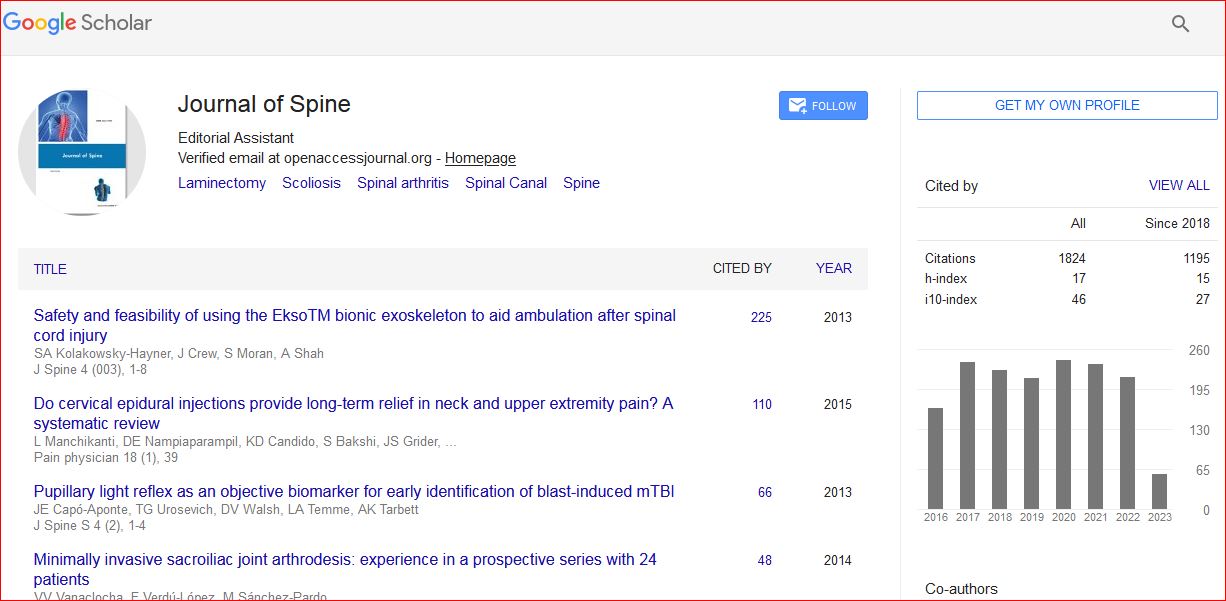
Journal of Spine received 2022 citations as per Google Scholar report