Perspective - (2025) Volume 13, Issue 2
Received: 01-Apr-2025, Manuscript No. jcdd-25-175438;
Editor assigned: 03-Apr-2025, Pre QC No. P-175438;
Reviewed: 17-Apr-2025, QC No. Q-175438;
Revised: 22-Apr-2025, Manuscript No. R-175438;
Published:
29-Apr-2025
, DOI: 10.37421/2329-9517.2025.13.660
Citation: Satoshi Tanaka. ”Cardiomyopathies: Diverse, Personalized
Advances in Care.” J Cardiovasc Dis Diagn 13 (2025):660.
Copyright: © 2025 T. Satoshi This is an open-access article distributed under the terms of the Creative Commons Attribution License, which permits unrestricted use,
distribution and reproduction in any medium, provided the original author and source are credited.
Cardiomyopathies represent a complex group of heart muscle diseases characterized by structural and functional abnormalities of the myocardium. Recent advancements in medical science have significantly deepened our understanding of these conditions, spanning from genetic etiologies to sophisticated diagnostic modalities and innovative therapeutic interventions. A key area of focus involves Hypertrophic Cardiomyopathy (HCM), where recent progress has refined diagnostic tools, improved risk stratification, and introduced emerging pharmacological and interventional therapies. Personalized approaches are proving instrumental in enhancing outcomes for patients living with HCM [1].
Further insights into HCM highlight its genetic basis, with ongoing research exploring various gene mutations responsible for the disease. Genetic testing has become paramount for accurate diagnosis, effective risk stratification, and comprehensive family screening, ultimately paving the way for genotype-specific therapies [9].
Dilated Cardiomyopathy (DCM) is another significant area of research, with new developments in understanding, diagnosis, and management. Genetic insights, coupled with advanced imaging techniques, are leading to novel therapeutic strategies aimed at improving cardiac function and overall patient prognosis in DCM [2].
Beyond this, nonischemic dilated cardiomyopathy (NIDCM) is a distinct entity, differentiated from ischemic forms by its diverse etiologies, which include genetic, inflammatory, and toxic causes. Current diagnostic pathways and evidence-based therapeutic interventions are being refined to effectively manage heart failure symptoms and improve long-term outcomes for individuals with NIDCM [7].
Arrhythmogenic Cardiomyopathy (ACM) also continues to be a subject of intense study. Updated reviews provide comprehensive overviews of its genetic basis, diverse clinical presentations, and critical diagnostic criteria. Current management strategies are keenly focused on preventing sudden cardiac death and effectively managing arrhythmias in affected individuals, enhancing patient safety and quality of life [3].
The spectrum of cardiomyopathies extends to unique and specialized forms, such as Takotsubo syndrome, commonly known as stress-induced cardiomyopathy. Comprehensive reviews of this condition delve into its pathophysiology, clinical characteristics, and diagnostic challenges, while also discussing its prognosis and potential treatment approaches for this often reversible condition [4].
Another distinct form is diabetic cardiomyopathy, a heart muscle disease frequently observed in diabetic patients. Research explores its underlying molecular mechanisms, identifies key risk factors, and outlines its clinical presentation, underscoring the vital need for early detection and targeted interventions to prevent the progression to heart failure [5].
Peripartum cardiomyopathy (PPCM) presents a life-threatening challenge specifically affecting pregnant or recently delivered women. New insights are emerging regarding its causes, critical risk factors, diagnostic approaches, and evolving treatment strategies, including advancements in drug therapy and mechanical circulatory support, which promise improved maternal and fetal outcomes [6].
Infiltrative cardiomyopathies, encompassing conditions like amyloidosis and sarcoidosis, are characterized by the accumulation of abnormal substances within the heart muscle. Advances in early diagnosis, facilitated by sophisticated imaging and novel biomarkers, are critical. Crucially, the emergence of targeted therapies specifically addressing the underlying infiltrative process offers new hope for affected patients [8].
Finally, understanding cardiomyopathies in pediatric populations presents its own unique set of considerations. This includes navigating genetic heterogeneity, recognizing the diverse clinical presentations specific to children, and addressing the distinct diagnostic and management hurdles. Efforts are concentrated on enhancing outcomes through early detection and the provision of highly specialized pediatric care [10].
Together, these varied areas of research underscore a concerted effort to unravel the complexities of cardiomyopathies, leading to more precise diagnostics and increasingly personalized and effective treatments across different patient demographics.
Cardiomyopathies encompass a broad spectrum of myocardial diseases, each with distinct pathophysiological mechanisms, clinical presentations, and management challenges. Hypertrophic Cardiomyopathy (HCM), a prominent genetic heart condition, involves an abnormal thickening of the heart muscle. Recent advances have markedly improved the management of HCM, focusing on refined diagnostic tools, precise risk stratification, and the implementation of novel pharmacological and interventional therapies. The emphasis now includes personalized approaches, which are demonstrably enhancing patient outcomes [1]. The genetic architecture of HCM is particularly important, as various gene mutations are implicated in its development. Understanding these genetic underpinnings facilitates crucial genetic testing for accurate diagnosis, effective risk stratification, and comprehensive family screening, which in turn informs the development of genotype-specific therapies [9].
Dilated Cardiomyopathy (DCM), characterized by the enlargement and weakening of the heart's pumping chambers, has also seen significant progress in its diagnosis and treatment. This progress is largely driven by deeper genetic insights and the application of advanced cardiac imaging techniques. These developments are integral to designing novel therapeutic strategies aimed at improving compromised cardiac function and ultimately enhancing the long-term prognosis for patients with DCM [2]. Complementing this, nonischemic dilated cardiomyopathy (NIDCM) is being understood with greater clarity. Its etiologies are diverse, spanning genetic predispositions, inflammatory processes, and exposure to toxic substances. Defining these causes is critical for establishing effective diagnostic pathways and implementing evidence-based therapeutic interventions that alleviate heart failure symptoms and improve overall patient survival [7].
Arrhythmogenic Cardiomyopathy (ACM) is another complex condition, often presenting with life-threatening arrhythmias. Contemporary reviews offer an updated perspective on its genetic basis, the varied ways it can manifest clinically, and the evolving diagnostic criteria essential for early and accurate identification. A central goal in managing ACM is the prevention of sudden cardiac death, alongside proactive strategies for managing recurrent arrhythmias in affected individuals [3]. The category of infiltrative cardiomyopathies, including amyloidosis and sarcoidosis, involves the undesirable accumulation of abnormal proteins or inflammatory cells within the heart muscle. Significant strides have been made in their early diagnosis through advanced imaging techniques and the use of specific biomarkers. Crucially, targeted therapies are now emerging that directly address the underlying infiltrative process, offering more precise and effective treatment options [8].
Beyond these more common forms, several unique cardiomyopathies require specialized attention. Takotsubo syndrome, often referred to as stress-induced cardiomyopathy, presents as an acute heart failure syndrome triggered by severe emotional or physical stress. Comprehensive reviews highlight its distinct pathophysiology, clinical hallmarks, and the diagnostic complexities involved. Discussions also cover its prognosis and outline potential treatment approaches for this often transient and reversible condition [4]. Diabetic cardiomyopathy, a distinct form of heart muscle disease, frequently affects individuals with diabetes. Research delves into the intricate molecular mechanisms driving its development, identifies critical risk factors, and details its clinical presentation. This understanding underscores the urgent need for early detection and targeted interventions to avert the progression to full-blown heart failure in diabetic patients [5].
Finally, peripartum cardiomyopathy (PPCM) is a severe condition impacting women during late pregnancy or shortly after childbirth. Recent research has shed light on its underlying causes, identified key risk factors, improved diagnostic approaches, and refined evolving treatment strategies, including both pharmaceutical interventions and mechanical circulatory support, aiming to improve outcomes for both mother and child [6]. The understanding and management of cardiomyopathies in pediatric populations also presents unique challenges. These include navigating genetic heterogeneity, recognizing the diverse clinical presentations specific to children, and addressing the distinct diagnostic and management hurdles. Efforts are concentrated on enhancing outcomes through early detection and the provision of highly specialized pediatric care [10]. This comprehensive body of research collectively indicates a promising trajectory towards more individualized and effective management strategies for the wide array of cardiomyopathies.
Cardiomyopathies encompass a diverse group of heart muscle diseases, with recent research highlighting significant advances in understanding their varied etiologies, diagnostic approaches, and therapeutic strategies. Hypertrophic Cardiomyopathy (HCM), for instance, has seen progress in diagnostic tools, risk stratification, and the development of personalized pharmacological and interventional therapies, with its genetic underpinnings being crucial for diagnosis and genotype-specific treatments. Dilated Cardiomyopathy (DCM) research has advanced through genetic insights and sophisticated imaging, leading to novel strategies for improving cardiac function. Relatedly, nonischemic dilated cardiomyopathy (NIDCM) is being better understood through the exploration of its diverse genetic, inflammatory, and toxic causes, informing diagnostic pathways and therapeutic interventions. Arrhythmogenic Cardiomyopathy (ACM) benefits from an updated overview of its genetic basis, clinical features, and management strategies to prevent sudden cardiac death. Infiltrative cardiomyopathies, like amyloidosis and sarcoidosis, are seeing improved early diagnosis via imaging and biomarkers, along with the emergence of targeted therapies to address the underlying accumulation of abnormal substances. Unique forms of cardiomyopathy are also under scrutiny; Takotsubo syndrome, or stress-induced cardiomyopathy, is better characterized in terms of its pathophysiology and treatment, while diabetic cardiomyopathy is increasingly recognized for its distinct molecular mechanisms and the need for early, targeted interventions. Peripartum cardiomyopathy (PPCM), a condition affecting pregnant or recently delivered women, has garnered new insights into its causes, risk factors, and evolving treatment. Finally, the specific challenges of cardiomyopathies in pediatric populations are being addressed, focusing on genetic heterogeneity, varied presentations, and the need for specialized care for better outcomes. These collective advancements underscore a shift towards more precise, personalized approaches in managing these complex heart conditions.
Indexed at, Google Scholar, Crossref
Indexed at, Google Scholar, Crossref
Indexed at, Google Scholar, Crossref
Indexed at, Google Scholar, Crossref
Indexed at, Google Scholar, Crossref
Indexed at, Google Scholar, Crossref
Indexed at, Google Scholar, Crossref
Indexed at, Google Scholar, Crossref
Indexed at, Google Scholar, Crossref
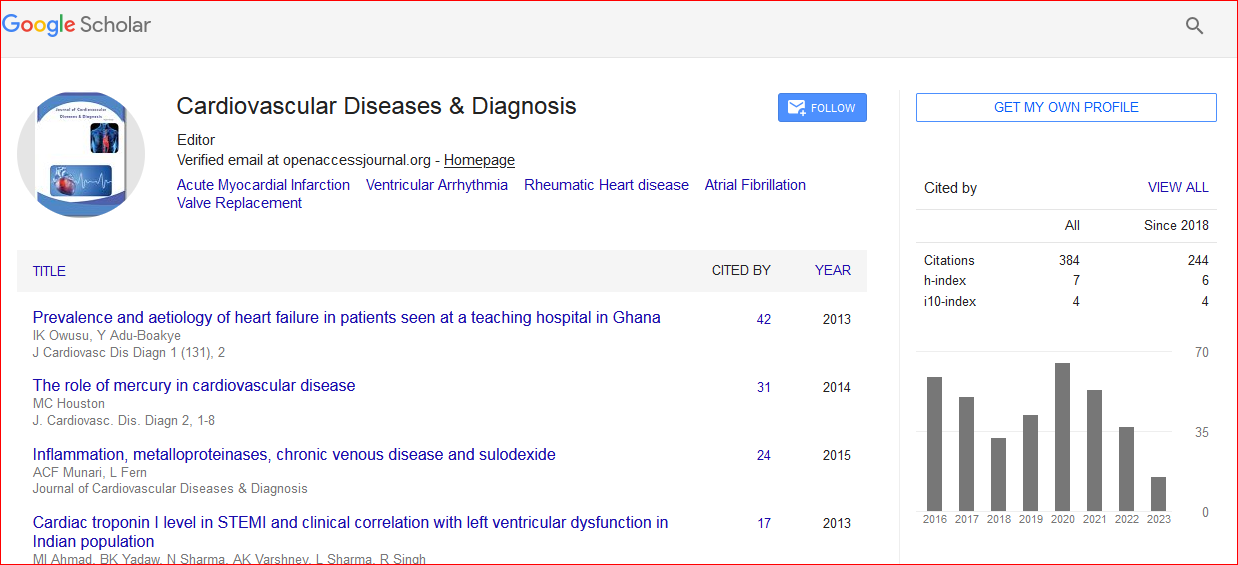
Cardiovascular Diseases & Diagnosis received 427 citations as per Google Scholar report