Short Communication - (2025) Volume 13, Issue 6
Received: 01-Dec-2025, Manuscript No. JCMG-26-185566;
Editor assigned: 03-Dec-2025, Pre QC No. P-185566;
Reviewed: 17-Dec-2025, QC No. Q-185566;
Revised: 22-Dec-2025, Manuscript No. R-185566;
Published:
29-Dec-2025
, DOI: 10.37421/2472-128X.2025.13.376
Citation: Silva, Ricardo. ”Cardiogenomics: Personalized Prevention and Treatment of Heart Disease.” J Clin Med Genomics 13 (2025):376.
Copyright: © 2025 Silva R. This is an open-access article distributed under the terms of the Creative Commons Attribution License, which permits unrestricted use, distribution and reproduction in any medium, provided the original author and source are credited.
Cardiogenomics represents a significant advancement in the field of cardiovascular medicine, offering a personalized approach to understanding and managing heart disease. By delving into an individual's genetic makeup, this discipline moves beyond traditional risk factors to identify susceptibility to various cardiovascular conditions, including coronary artery disease, arrhythmias, and cardiomyopathies. This enables the development of tailored prevention strategies and early interventions, aiming to reduce the global burden of heart disease [1].
Investigating the genetic architecture of common cardiovascular diseases highlights the intricate interplay between multiple genes and environmental influences. Genome-wide association studies (GWAS) have been pivotal in identifying genetic loci associated with conditions such as myocardial infarction and hypertension. This genetic insight is crucial for risk stratification and the discovery of novel therapeutic targets, fundamentally transforming cardiovascular health management [2].
Pharmacogenomics, a vital sub-discipline within cardiogenomics, is indispensable for optimizing drug therapies for cardiovascular patients. Understanding how genetic variations impact drug response allows for the fine-tuning of treatment efficacy, the minimization of adverse drug reactions, and the overall improvement of patient outcomes. This personalized pharmacotherapy is essential for the effective management of chronic heart conditions [3].
The integration of multi-omics data, encompassing genomics, transcriptomics, and proteomics, provides a more holistic comprehension of cardiovascular disease pathogenesis. By converging these diverse data streams, researchers can elucidate complex molecular pathways and identify novel biomarkers for early detection and risk assessment, thereby paving the way for more precise diagnostic and therapeutic strategies [4].
Rare genetic variants can play a substantial role in the risk of developing specific inherited cardiovascular diseases. The advent of advanced sequencing technologies facilitates the identification of these variants, leading to earlier diagnoses for individuals and families at high risk. This targeted genetic analysis is critical for preventing sudden cardiac events and guiding family screening protocols [5].
Despite its promise, the clinical implementation of cardiogenomics encounters several challenges. These include the complexities of data interpretation, ethical considerations surrounding genetic information, and the seamless integration into existing healthcare systems. Developing robust guidelines and comprehensive educational programs for both clinicians and patients is paramount to ensure the responsible and effective utilization of genetic insights in cardiovascular care [6].
Polygenic risk scores (PRS) are emerging as a powerful tool within cardiogenomics, capable of aggregating the effects of numerous common genetic variants to estimate an individual's predisposition to complex heart diseases. PRS have the potential to enhance risk prediction beyond conventional clinical factors, aiding in the identification of individuals who could benefit most from intensified preventive measures or genetic counseling [7].
The field of cardiovascular gene discovery is in a state of continuous evolution, driven by advancements in sequencing technology and sophisticated bioinformatics. Identifying genes linked to diverse cardiac phenotypes, ranging from arrhythmias to structural heart disease, is fundamental to understanding disease mechanisms and developing targeted therapeutic interventions. This ongoing research is central to the progress of cardiogenomics [8].
Familial hypercholesterolemia (FH) serves as a compelling example of a monogenic disorder where genetic testing offers transformative clinical benefits. Cardiogenomics enables precise diagnosis of FH, facilitating early intervention to avert premature cardiovascular events in affected individuals and their relatives. This demonstrates the direct clinical impact of genetic discoveries in cardiology [9].
Ethical, legal, and social implications (ELSI) are integral to the advancement and application of cardiogenomics. Ensuring data privacy, promoting equitable access to genetic testing, and providing appropriate genetic counseling are critical steps in fostering trust and maximizing the benefits of this transformative technology in the realm of cardiovascular health [10].
Cardiogenomics offers a powerful pathway for predicting heart disease risk by analyzing an individual's genetic makeup. This approach extends beyond traditional risk factors to identify predispositions to various cardiovascular conditions, including coronary artery disease, arrhythmias, and cardiomyopathies. By comprehending the genetic foundations, personalized prevention strategies and early interventions can be devised, with the ultimate goal of alleviating the global burden of heart disease [1].
The investigation into the genetic architecture of common cardiovascular diseases reveals complex interactions involving multiple genes and environmental factors. Genome-wide association studies (GWAS) have been instrumental in pinpointing genetic loci associated with conditions such as myocardial infarction and hypertension, laying the groundwork for risk stratification and the identification of novel therapeutic targets. This genetic insight is revolutionizing the approach to cardiovascular health [2].
Pharmacogenomics, a crucial component of cardiogenomics, plays a vital role in personalizing drug therapies for cardiovascular patients. Understanding how genetic variations influence drug response can optimize treatment efficacy, minimize adverse drug reactions, and enhance patient outcomes. This personalized approach to pharmacotherapy is indispensable for effectively managing chronic heart conditions [3].
The integration of multi-omics data, including genomics, transcriptomics, and proteomics, yields a more comprehensive understanding of cardiovascular disease pathogenesis. By combining these data streams, researchers can uncover intricate molecular pathways and identify novel biomarkers for early detection and risk assessment, thereby paving the way for more precise diagnostic and therapeutic strategies [4].
Rare genetic variants can significantly contribute to the risk of developing specific forms of inherited cardiovascular diseases. Advanced sequencing technologies enable the identification of these variants, leading to earlier diagnoses for individuals and families at high genetic risk. This targeted genetic analysis is essential for preventing sudden cardiac events and guiding family screening efforts [5].
The clinical adoption of cardiogenomics faces hurdles related to data interpretation, ethical considerations, and integration within healthcare systems. The development of robust guidelines and educational programs for clinicians and patients is crucial to ensure the responsible and effective use of genetic information in cardiovascular care. Overcoming these challenges is key to unlocking the full potential of this field [6].
Polygenic risk scores (PRS) are emerging as a valuable tool in cardiogenomics, aggregating the effects of numerous common genetic variants to estimate an individual's susceptibility to complex heart diseases. PRS can improve risk prediction beyond traditional clinical factors, assisting in identifying individuals who may benefit from intensified preventive measures or genetic counseling [7].
The landscape of cardiovascular gene discovery is constantly evolving with progress in sequencing technology and bioinformatics. Identifying genes linked to diverse cardiac phenotypes, from arrhythmias to structural heart disease, is essential for understanding disease mechanisms and developing targeted therapies. This continuous research is fundamental to the advancement of cardiogenomics [8].
Familial hypercholesterolemia (FH) serves as a prime example of a monogenic disorder where genetic testing is transformative. Cardiogenomics allows for precise diagnosis of FH, enabling early intervention to prevent premature cardiovascular events in affected individuals and their relatives. This underscores the direct clinical impact of genetic insights in cardiology [9].
Ethical, legal, and social implications (ELSI) are central to the progress and application of cardiogenomics. Ensuring data privacy, equitable access to genetic testing, and appropriate genetic counseling are critical for building trust and maximizing the benefits of this powerful technology in cardiovascular health [10].
Cardiogenomics leverages an individual's genetic makeup to predict and manage heart disease risk, moving beyond traditional factors. This approach aids in identifying susceptibility to conditions like coronary artery disease and arrhythmias, enabling personalized prevention and early intervention. Genome-wide association studies have identified key genetic loci associated with conditions such as myocardial infarction and hypertension, informing risk stratification and therapeutic target discovery. Pharmacogenomics tailors drug therapies by understanding genetic influences on drug response, optimizing efficacy and minimizing adverse effects. Multi-omics data integration offers a comprehensive view of disease pathogenesis, uncovering molecular pathways and biomarkers for precise diagnostics. Rare genetic variants are identified through advanced sequencing, leading to earlier diagnosis and targeted interventions for inherited cardiovascular diseases. Despite its promise, clinical implementation faces challenges in data interpretation, ethics, and healthcare integration. Polygenic risk scores (PRS) enhance risk prediction by aggregating numerous genetic variants, identifying individuals for intensified prevention. Continuous advancements in gene discovery are crucial for understanding disease mechanisms and developing targeted therapies. Familial hypercholesterolemia exemplifies the clinical utility of genetic testing for early intervention. Ethical, legal, and social considerations, including data privacy and equitable access, are paramount for the responsible application of cardiogenomics.
None
None
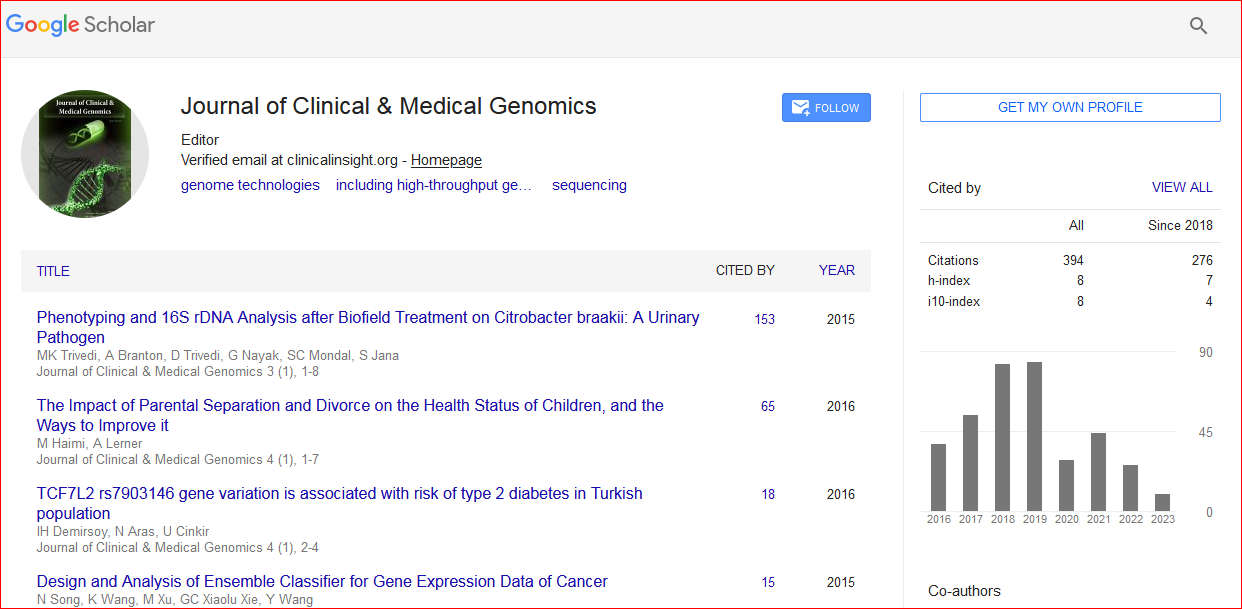
Journal of Clinical & Medical Genomics received 391 citations as per Google Scholar report