Commentary - (2025) Volume 13, Issue 3
Received: 02-Jun-2025, Manuscript No. jcdd-25-176787;
Editor assigned: 04-Jun-2025, Pre QC No. P-176787;
Reviewed: 18-Jun-2025, QC No. Q-176787;
Revised: 23-Jun-2025, Manuscript No. R-176787;
Published:
30-Jun-2025
, DOI: 10.37421/2329-9517.2025.13.672
Citation: Kowalska, Anna. ”Cardiac CT: Evolving Role, AI, Safety,
Outcomes.” J Cardiovasc Dis Diagn 13 (2025):672.
Copyright: © 2025 Kowalska A. This is an open-access article distributed under the terms of the Creative Commons Attribution License, which permits unrestricted use,
distribution and reproduction in any medium, provided the original author and source are credited.
The landscape of cardiovascular imaging is continuously evolving, with Coronary Computed Tomography Angiography (CCTA) emerging as a cornerstone for assessing coronary artery disease. Establishing updated appropriate use criteria for CCTA is crucial, as it provides clear guidelines for clinicians. These criteria ensure the effective application of CCTA in evaluating both suspected and known coronary artery disease, thereby optimizing patient care and resource utilization. This structured approach helps practitioners make informed decisions about when and how to deploy this powerful diagnostic tool. [1].
Expanding on its diagnostic prowess, CCTA's accuracy in identifying functional myocardial ischemia has been rigorously assessed through systematic reviews and meta-analyses. Here's the thing, these studies consistently demonstrate CCTA's significant potential as a reliable non-invasive method. It plays a pivotal role in guiding revascularization strategies for patients contending with coronary artery disease, providing a clearer path forward for treatment. This ability to not only visualize anatomy but also infer functional significance is a major advantage. [2].
Innovation in CCTA extends to its analysis, where Artificial Intelligence (AI) is making substantial inroads. The evolving role of AI in analyzing CCTA images is particularly exciting for detailed coronary plaque characterization. What this really means is, AI can help identify and quantify different types of plaque, which is vital. This advanced analysis holds immense potential to significantly improve risk stratification and enable more personalized treatment approaches for patients suffering from atherosclerosis, moving beyond simple stenosis assessment. [3].
Beyond immediate diagnosis, the long-term prognostic value of CCTA has been a key area of research. Comparisons between CCTA and stress myocardial perfusion imaging in patients with suspected Coronary Artery Disease (CAD) affirm CCTA's strong ability. It can predict adverse cardiac events and guide subsequent clinical management, offering valuable insights into patient outcomes over time. This predictive power helps clinicians manage patient expectations and plan long-term care more effectively, showcasing its utility beyond just initial screening. [4].
Cardiac CT is not limited to coronary artery assessment; it also plays a critical role in complex interventional procedures. For instance, in pre-procedural planning for Transcatheter Aortic Valve Implantation (TAVI), cardiac CT is indispensable. It meticulously guides prosthesis sizing, access route selection, and complication avoidance. This detailed pre-operative insight significantly improves patient outcomes by minimizing risks and ensuring the optimal fit and placement of the prosthetic valve. [5].
To further enhance the functional assessment of coronary lesions, CT-derived fractional flow reserve (CT-FFR) has emerged as a valuable tool. A meta-analysis evaluating the diagnostic performance of CT-FFR in detecting hemodynamically significant coronary artery disease underscores its importance. This establishes its value as a non-invasive method to functionalize anatomical stenoses observed on CCTA. It bridges the gap between anatomical imaging and physiological significance, offering a more complete picture of coronary artery disease. [6].
The utility of cardiac CT also extends to tissue characterization, specifically in quantifying myocardial fibrosis. This review discusses the fundamental principles and clinical utility of cardiac CT in measuring myocardial fibrosis, which is an important biomarker for various cardiac diseases. Its non-invasive nature presents a considerable advantage over traditional, more invasive methods, making it a preferred option for assessing cardiac health and disease progression. [7].
In the realm of structural heart disease, cardiac CT plays an expanding role, particularly in adult congenital heart disease. The article reviews its use in diagnosis, surgical planning, and long-term follow-up for these patients. It highlights cardiac CT's capabilities for detailed anatomical and functional assessment, which is crucial for managing the complex pathologies associated with adult congenital heart disease. This comprehensive view aids both interventionists and surgeons. [8].
Patient safety remains a paramount concern in diagnostic imaging. Accordingly, significant technological advancements and clinical strategies are continuously being developed to reduce radiation dose in CCTA. The review highlights these efforts, aiming to ensure safer diagnostic procedures for patients without compromising image quality. This ongoing commitment to minimizing exposure while maintaining diagnostic efficacy is a key area of progress. [9].
Looking to the future, Artificial Intelligence continues its profound impact on cardiac CT. This article explores how AI is transforming the field, from automating image analysis and quantification to providing advanced diagnostic support. This evolution is paving the way for more efficient and precise cardiac imaging, promising a new era of diagnostic capability where human expertise is augmented by powerful computational tools. [10].
Cardiac Computed Tomography (CT), particularly Coronary Computed Tomography Angiography (CCTA), serves as a foundational diagnostic tool in modern cardiology, with its utility steadily expanding. The effective application of CCTA in evaluating suspected or known coronary artery disease is guided by updated appropriate use criteria, ensuring optimal patient care and responsible resource utilization [1]. Here's the thing, CCTA demonstrates significant accuracy in pinpointing functional myocardial ischemia, making it a powerful, non-invasive method for guiding revascularization strategies in patients with coronary artery disease [2]. This diagnostic capability extends beyond mere anatomical visualization. For instance, studies comparing CCTA with stress myocardial perfusion imaging affirm CCTA's strong ability to predict adverse cardiac events, providing crucial prognostic value and informing long-term clinical management for individuals suspected of having coronary artery disease [4]. To further refine functional assessment, CT-derived fractional flow reserve (CT-FFR) offers a non-invasive means to evaluate the hemodynamic significance of coronary artery stenoses identified via CCTA, bridging the gap between anatomy and physiology [6].
Beyond its primary role in coronary artery disease, cardiac CT proves indispensable in several other critical areas of cardiovascular care. It plays an essential role in pre-procedural planning for complex interventions like Transcatheter Aortic Valve Implantation (TAVI). Cardiac CT data meticulously guides prosthesis sizing, access route selection, and strategies for complication avoidance, which substantially improves patient outcomes [5]. The technology also contributes to tissue characterization; specifically, a review highlights the principles and clinical utility of cardiac CT in quantifying myocardial fibrosis. What this really means is, myocardial fibrosis is a key biomarker for various cardiac diseases, and CT offers a non-invasive alternative to traditional methods for its assessment [7]. Furthermore, cardiac CTâ??s expanding role in diagnosing, planning surgical interventions, and providing long-term follow-up for adult congenital heart disease patients is notable, offering detailed anatomical and functional insights critical for managing these intricate conditions [8].
Innovation is continuously enhancing the capabilities and safety of cardiac CT. Artificial Intelligence (AI) is transforming the analysis of CCTA images, particularly for detailed coronary plaque characterization. This advanced AI application has the potential to improve risk stratification and lead to more personalized treatment plans for patients with atherosclerosis [3]. More broadly, AI is impacting cardiac CT by automating image analysis and quantification, alongside providing sophisticated diagnostic support, paving the way for more efficient and precise cardiac imaging [10]. This integration of AI represents a significant leap forward in diagnostic precision and workflow optimization.
Patient safety remains a key focus within the field. Significant technological advancements and clinical strategies are being actively pursued to reduce radiation dose in CCTA. These ongoing efforts are crucial for ensuring safer diagnostic procedures without compromising image quality. This commitment helps maintain the integrity of diagnostic information while protecting patients from unnecessary exposure, representing a balanced approach to advanced imaging [9]. The convergence of improved diagnostic criteria, advanced imaging techniques, and cutting-edge analytical tools like AI, alongside a strong emphasis on patient safety, positions cardiac CT as a dynamically evolving and increasingly central component of cardiovascular medicine.
Cardiac Computed Tomography (CT) and specifically Coronary Computed Tomography Angiography (CCTA) are proving essential in modern cardiology, with their applications continually expanding and refining. Updated appropriate use criteria guide clinicians on CCTAâ??s effective application in evaluating suspected or known coronary artery disease, optimizing patient care and resource utilization. CCTA demonstrates significant accuracy in identifying functional myocardial ischemia, serving as a non-invasive tool to guide revascularization strategies. Beyond diagnostic capabilities, CCTA shows robust long-term prognostic value, effectively predicting adverse cardiac events and informing clinical management compared to stress myocardial perfusion imaging. Technological advancements are enhancing its utility and safety. Artificial Intelligence (AI) is transforming cardiac CT by improving image analysis, automated quantification, and advanced diagnostic support, particularly in detailed coronary plaque characterization for better risk stratification and personalized treatment of atherosclerosis. Crucially, efforts are being made to reduce radiation dose in CCTA through significant technological advancements and clinical strategies, ensuring safer diagnostic procedures without compromising image quality. Cardiac CT also plays a vital role in pre-procedural planning for Transcatheter Aortic Valve Implantation (TAVI), assisting in prosthesis sizing and complication avoidance. It extends its utility to quantifying myocardial fibrosis, an important non-invasive biomarker for various cardiac diseases. The expanding role of cardiac CT includes the diagnosis, surgical planning, and long-term follow-up of adult congenital heart disease patients, offering detailed anatomical and functional assessments. Moreover, CT-derived fractional flow reserve (CT-FFR) stands out as a non-invasive tool to assess hemodynamically significant coronary artery disease, functionalizing anatomical stenoses identified by CCTA.
Indexed at, Google Scholar, Crossref
Indexed at, Google Scholar, Crossref
Indexed at, Google Scholar, Crossref
Indexed at, Google Scholar, Crossref
Indexed at, Google Scholar, Crossref
Indexed at, Google Scholar, Crossref
Indexed at, Google Scholar, Crossref
Indexed at, Google Scholar, Crossref
Indexed at, Google Scholar, Crossref
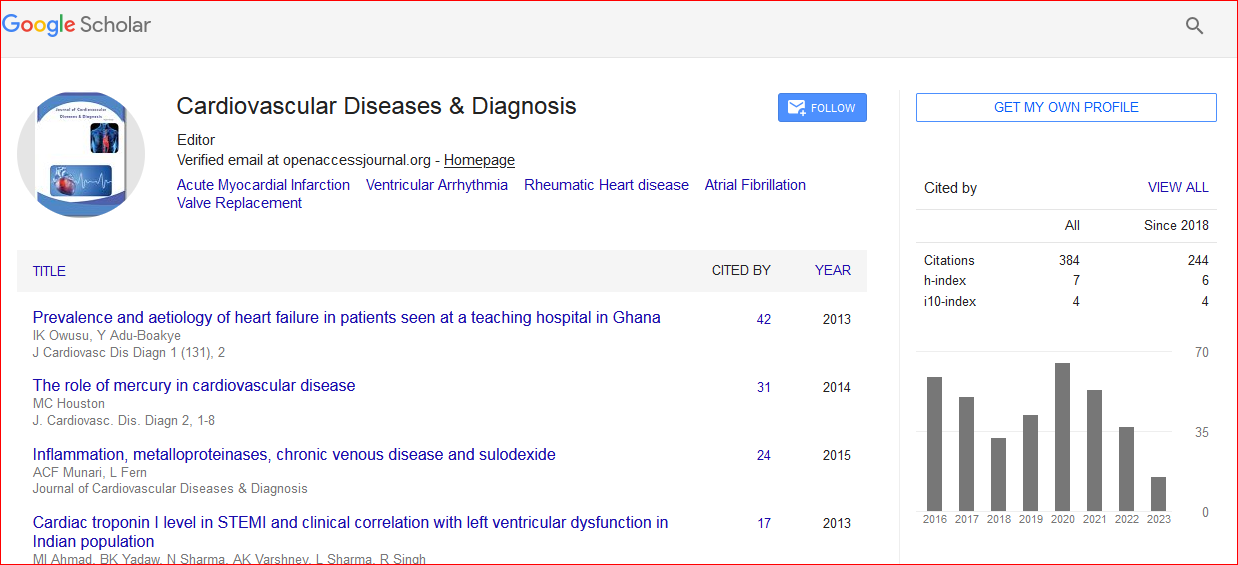
Cardiovascular Diseases & Diagnosis received 427 citations as per Google Scholar report