Perspective - (2025) Volume 17, Issue 6
Received: 03-Nov-2025, Manuscript No. jcst-25-176313;
Editor assigned: 05-Nov-2025, Pre QC No. P-176313;
Reviewed: 19-Nov-2025, QC No. Q-176313;
Revised: 24-Nov-2025, Manuscript No. R-176313;
Published:
01-Dec-2025
, DOI: 10.37421/1948-5956.2025.17.737
Citation: Jacob Anderson. ”Cancer Psychosocial Challenges:
Diverse Interventions & Support.” J Cancer Sci Ther 17 (2025):737.
Copyright: © 2025 A. Jacob This is an open-access article distributed under the terms of the Creative Commons Attribution License, which permits unrestricted use, distribution
and reproduction in any medium, provided the original author and source are credited.
This paper systematically reviews the prevalence and impact of psychological distress on the quality of life among cancer patients. It highlights that distress is a common and significant issue, negatively affecting patient well-being and treatment outcomes, underscoring the necessity of integrated psychosocial support in oncology [1].
This systematic review provides an updated analysis of psychosocial interventions aimed at supporting family caregivers of cancer patients. It evaluates the effectiveness of various programs in alleviating caregiver burden, improving mental health outcomes, and enhancing coping strategies, emphasizing the critical role of caregiver support in comprehensive cancer care [2].
This systematic review explores the distinct psychosocial challenges faced by adolescent and young adult (AYA) cancer patients. It highlights common issues such as identity formation, peer relationships, education, and career development, and the need for age-appropriate psychosocial interventions tailored to their unique developmental stage [3].
This systematic review delves into the complex psychosocial challenges experienced by women living with metastatic breast cancer. It identifies prevalent issues like fear of progression, body image concerns, relationship changes, and financial toxicity, emphasizing the need for targeted psychosocial interventions to improve their quality of life [4].
This systematic review and meta-analysis assesses the effectiveness of various psychosocial interventions on the quality of life in cancer patients. It reveals that such interventions significantly improve emotional well-being, reduce distress, and enhance overall life satisfaction, advocating for their routine integration into cancer care protocols [5].
This systematic review and meta-analysis investigates the efficacy of eHealth interventions in managing psychosocial distress among cancer patients. It demonstrates that digital platforms can be effective in delivering support, reducing anxiety and depression, and improving overall psychological well-being, highlighting the potential of technology in expanding access to psychosocial care [6].
This systematic review provides insight into the psychosocial needs of men with prostate cancer, drawing from qualitative studies. It highlights concerns such as changes in sexual function, body image, masculine identity, and the need for peer support and tailored communication from healthcare providers, advocating for holistic care that addresses these specific male experiences [7].
This review explores the landscape of digital interventions in psycho-oncology, examining the current evidence, inherent challenges, and potential future trajectories. It highlights the growing role of digital tools in delivering accessible and personalized psychosocial support, while also addressing issues of equity, engagement, and integration into clinical pathways [8].
This scoping review investigates the psychosocial needs of patients diagnosed with primary bone and soft tissue sarcoma. It uncovers unique challenges related to physical disfigurement, limb function, intense treatment, and long-term uncertainty, highlighting the critical demand for specialized psychosocial support tailored to this patient population [9].
This systematic review and meta-analysis investigates the prevalence and characteristics of psychological distress among patients with head and neck cancer. It reveals high rates of anxiety and depression, often linked to functional impairments and body image issues, underscoring the urgent need for routine psychosocial screening and tailored interventions in this vulnerable group [10].
This paper systematically reviews the prevalence and impact of psychological distress on the quality of life among cancer patients. It highlights that distress is a common and significant issue, negatively affecting patient well-being and treatment outcomes, underscoring the necessity of integrated psychosocial support in oncology [1]. Such psychosocial interventions significantly improve emotional well-being, reduce distress, and enhance overall life satisfaction, advocating for their routine integration into cancer care protocols [5].
This systematic review provides an updated analysis of psychosocial interventions aimed at supporting family caregivers of cancer patients. It evaluates the effectiveness of various programs in alleviating caregiver burden, improving mental health outcomes, and enhancing coping strategies, emphasizing the critical role of caregiver support in comprehensive cancer care [2]. Digital platforms, specifically eHealth interventions, effectively deliver support, reduce anxiety and depression, and improve psychological well-being among cancer patients [6]. Digital tools in psycho-oncology are increasingly vital, offering accessible and personalized psychosocial support, while navigating challenges like equity and engagement [8].
This systematic review explores the distinct psychosocial challenges faced by adolescent and young adult (AYA) cancer patients. It highlights common issues such as identity formation, peer relationships, education, and career development, and the need for age-appropriate psychosocial interventions tailored to their unique developmental stage [3]. Women with metastatic breast cancer experience complex psychosocial challenges, including fear of progression, body image concerns, relationship changes, and financial toxicity, necessitating targeted interventions [4].
Men with prostate cancer face specific psychosocial needs, such as changes in sexual function, body image, and masculine identity, highlighting the importance of peer support and tailored communication [7]. Patients with primary bone and soft tissue sarcoma have unique psychosocial needs related to physical disfigurement, limb function, intense treatment, and long-term uncertainty, demanding specialized support [9].
This systematic review and meta-analysis investigates the prevalence and characteristics of psychological distress among patients with head and neck cancer. It reveals high rates of anxiety and depression, often linked to functional impairments and body image issues, underscoring the urgent need for routine psychosocial screening and tailored interventions in this vulnerable group [10].
Psychological distress significantly impacts the quality of life among cancer patients, proving to be a common and substantial concern that negatively affects overall well-being and treatment outcomes [1]. To address this, various psychosocial interventions are crucial, and studies show they effectively improve emotional well-being, reduce distress, and enhance life satisfaction, suggesting their routine integration into cancer care [5]. Support for family caregivers of cancer patients is also critical, with interventions aimed at alleviating their burden and improving mental health [2]. Digital platforms and eHealth interventions demonstrate efficacy in managing psychosocial distress, expanding access to support, and reducing anxiety and depression [6, 8]. Specific patient populations encounter distinct challenges. Adolescent and young adult (AYA) cancer patients face issues related to identity, relationships, education, and career development, requiring age-appropriate support [3]. Women with metastatic breast cancer deal with fears of progression, body image issues, and financial toxicity, needing targeted interventions [4]. Men with prostate cancer have psychosocial needs tied to sexual function, body image, and masculine identity [7]. Patients with primary bone and soft tissue sarcoma face challenges like physical disfigurement and long-term uncertainty [9]. Finally, high rates of anxiety and depression are prevalent in head and neck cancer patients, often linked to functional and body image impairments, calling for routine screening and tailored support [10]. This collective body of work underscores the pervasive nature of psychosocial challenges in oncology and the diverse strategies required for comprehensive patient and caregiver support.
Indexed at, Google Scholar, Crossref
Indexed at, Google Scholar, Crossref
Indexed at, Google Scholar, Crossref
Indexed at, Google Scholar, Crossref
Indexed at, Google Scholar, Crossref
Indexed at, Google Scholar, Crossref
Indexed at, Google Scholar, Crossref
Indexed at, Google Scholar, Crossref
Indexed at, Google Scholar, Crossref
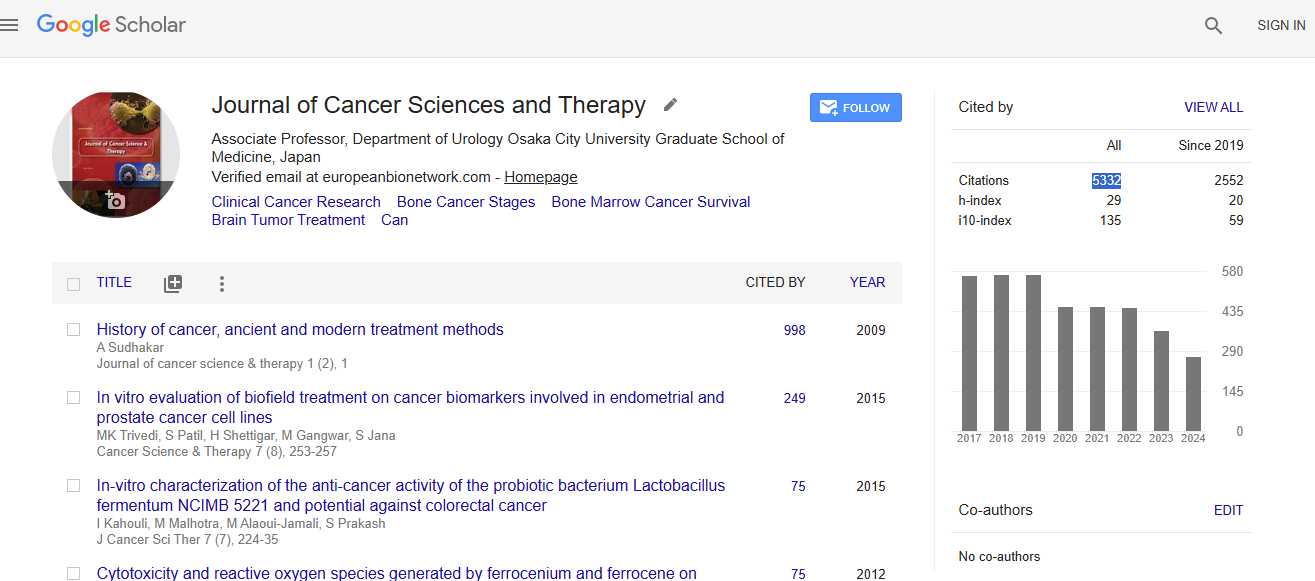
Cancer Science & Therapy received 5332 citations as per Google Scholar report