Commentary - (2025) Volume 17, Issue 3
Received: 01-May-2025, Manuscript No. jcst-25-172454;
Editor assigned: 05-May-2025, Pre QC No. P-172454;
Reviewed: 19-May-2025, QC No. Q-172454;
Revised: 22-May-2025, Manuscript No. R-172454;
Published:
29-May-2025
, DOI: 10.37421/1948-5956.2025.17.703
Citation: Mehta, Rajesh. ”Cancer Mechanisms: Oncogenes,
KRAS, Epigenetics, Therapies.” J Cancer Sci Ther 17 (2025):703.
Copyright: © 2025 Mehta R. This is an open-access article distributed under the terms of the Creative Commons Attribution License, which permits unrestricted use, distribution
and reproduction in any medium, provided the original author and source are credited.
Oncogenic KRAS plays a pivotal role in driving cancer progression through complex cellular signaling pathways. Current research meticulously explores these intricate mechanisms and highlights the latest therapeutic strategies. These include the development of direct inhibitors and innovative combination approaches, all aimed at overcoming resistance and ultimately improving patient outcomes in KRAS-driven malignancies [1].
Understanding cancer development requires distinguishing between oncogenes and tumor suppressor genes. Oncogenes typically drive cancer through gain-of-function mutations, promoting uncontrolled cell growth, while tumor suppressor genes inhibit growth and contribute to cancer when they experience loss-of-function mutations. This fundamental distinction, alongside key examples and their pathways, underscores the profound complexity inherent in cancer genetics [2].
Epigenetic mechanisms are crucial in regulating the expression of both oncogenes and tumor suppressor genes within the context of cancer. Processes like DNA methylation and histone modification represent reversible changes that significantly contribute to tumorigenesis. Delving into these epigenetic alterations offers valuable insights into the development of novel epigenetic therapies for cancer treatment [3].
Lung cancer pathogenesis is critically influenced by specific oncogenes, such as EGFR, KRAS, and ALK, and tumor suppressor genes like TP53 and RB1. Alterations in these genes are fundamental to the initiation and progression of the disease. Importantly, understanding these genetic changes is essential for guiding targeted therapeutic strategies tailored for the diverse subtypes of lung cancer [4].
Oncogene-induced senescence (OIS) presents a complex dual role in liver cancer. Initially, OIS can function as a potent tumor-suppressive mechanism, halting the proliferation of cancerous cells. However, it can also paradoxically contribute to pro-tumorigenic changes within the tumor microenvironment, profoundly impacting therapeutic responses and overall disease progression [5].
Glioma exhibits a highly complex landscape characterized by diverse oncogenic drivers and significant tumor heterogeneity. The presence of varied genetic alterations within a single tumor profoundly complicates the effectiveness of treatment strategies and directly contributes to drug resistance. This challenge strongly emphasizes the critical need for precision medicine approaches to effectively manage glioma [6].
Targeting oncogenes in ovarian cancer faces significant current challenges, yet also offers promising future prospects. A thorough review of key oncogenic drivers and their associated pathways is essential. This includes exploring existing targeted therapies and developing emerging strategies designed to overcome resistance, ultimately improving outcomes for patients afflicted with this aggressive malignancy [7].
Recent updates on oncogene-induced senescence (OIS) continue to shed light on its intricate underlying molecular mechanisms. This phenomenon plays complex roles in both tumor suppression and the aging process. The ongoing research also highlights promising potential therapeutic strategies that could modulate OIS for more effective cancer treatment interventions [8].
Colorectal cancer frequently demonstrates KRAS oncogene addiction, presenting distinct therapeutic challenges due to the prevalence of KRAS mutations. Nevertheless, new opportunities are emerging, including the development of direct KRAS inhibitors and strategies for upstream/downstream signaling pathway blockade, all aimed at effectively overcoming this resistance [9].
The pathogenesis of gastric cancer is significantly influenced by critical oncogenes and tumor suppressor genes. Alterations in these specific genes are known to contribute directly to disease initiation, progression, and metastasis. Consequently, these genetic targets offer valuable avenues for both early diagnosis and targeted therapeutic intervention in gastric cancer patients [10].
Cancer development is fundamentally driven by critical genetic alterations involving both oncogenes and tumor suppressor genes [2]. These gene categories play distinct yet interconnected roles in cellular regulation. Oncogenes, when aberrantly activated through gain-of-function mutations, act as potent accelerators, promoting uncontrolled cell growth, proliferation, and survival pathways that are hallmarks of malignancy. In contrast, tumor suppressor genes normally function as the crucial brakes, regulating cell division, repairing DNA damage, and inducing programmed cell death when necessary. Their inactivation or loss-of-function mutations effectively remove these vital cellular controls, thereby paving the way for tumorigenesis and disease progression [2, 10]. Grasping this delicate balance and the precise mechanisms of dysregulation is central to unraveling the profound complexities of cancer genetics and, importantly, identifying novel and effective therapeutic targets.
Among the specific oncogenic drivers, the KRAS gene family commands significant attention. Extensive research has meticulously detailed its intricate mechanisms in driving the initiation and progression of various cancers, largely through its involvement in critical cellular signaling pathways [1, 9]. This makes KRAS a persistent focal point for therapeutic intervention, motivating the development of highly specific direct inhibitors and innovative combination approaches, all meticulously designed to overcome inherent treatment resistance and improve clinical outcomes [1]. Beyond these direct genetic mutations, epigenetic mechanisms, notably DNA methylation and histone modification, play an equally crucial role. These dynamic and reversible changes regulate the intricate expression patterns of both oncogenes and tumor suppressor genes within the cancerous state. Their dysregulation contributes substantially to tumorigenesis, thereby offering promising avenues for the development of novel epigenetic therapies that can potentially reverse these detrimental changes [3].
The profound impact of these intricate genetic and epigenetic factors manifests uniquely across a diverse spectrum of cancer types. For example, in lung cancer, the roles of specific oncogenes like EGFR, KRAS, and ALK, alongside vital tumor suppressor genes such as TP53 and RB1, are critical determinants of both disease initiation and progression [4]. Understanding these precise genetic alterations is paramount for guiding highly targeted therapeutic strategies that are tailored specifically for the distinct molecular subtypes of lung cancer, thereby maximizing treatment efficacy. Similarly, the pathogenesis of gastric cancer is intricately linked to alterations in key oncogenes and tumor suppressor genes that collectively contribute to disease initiation, progression, and ultimately metastasis, offering crucial targets for both early diagnosis and highly specific therapeutic intervention [10]. Adding to this complexity is the pervasive challenge of tumor heterogeneity, especially pronounced in aggressive cancers like glioma. Here, diverse genetic alterations frequently coexist within a single tumor, which profoundly complicates the efficacy of standard treatment strategies and significantly fosters the development of pervasive drug resistance, unequivocally underscoring the urgent and compelling need for precision medicine approaches [6].
Oncogene-induced senescence (OIS) represents a fascinating and increasingly complex aspect of cancer biology, exploring its nuanced dual role in various malignancies. While OIS can, under certain conditions, initially act as a potent tumor-suppressive mechanism, effectively halting the proliferation of precancerous or cancerous cells, it can also paradoxically contribute to pro-tumorigenic changes within the intricate tumor microenvironment, especially as the disease progresses [5, 8]. This inherent complexity profoundly affects therapeutic responses and presents unique clinical and research challenges. For aggressive malignancies like ovarian cancer, the targeting of oncogenes faces significant hurdles despite ongoing explorations into key oncogenic drivers and their associated pathways. Overcoming therapeutic resistance remains a critical and ongoing goal for existing targeted therapies and for the continuous development of emerging strategies [7]. In the context of cancers such as colorectal cancer, the phenomenon of KRAS oncogene addiction poses particular and persistent therapeutic challenges due to the prevalence of activating KRAS mutations. Nevertheless, new opportunities are vigorously emerging through the development of highly selective direct KRAS inhibitors and comprehensive strategies for upstream or downstream signaling pathway blockade, all aimed at effectively overcoming this resistance [9]. Furthermore, modulating OIS itself is actively being explored as a promising potential therapeutic strategy for enhancing overall cancer treatment outcomes [8].
This comprehensive collection of articles delves into the intricate molecular underpinnings of cancer, primarily focusing on the pivotal roles of oncogenes and tumor suppressor genes. It clearly distinguishes their mechanisms: oncogenes drive cancer through gain-of-function mutations, promoting unchecked proliferation, while tumor suppressor genes, through loss-of-function, relinquish vital cellular controls. A significant emphasis is placed on the oncogenic KRAS, exploring its complex signaling pathways, its specific addiction in colorectal cancer, and the innovative therapeutic strategies being developed, including direct inhibitors and combination approaches, all aimed at combating resistance and improving patient outcomes. The data also illuminates the crucial influence of epigenetic mechanisms, such as DNA methylation and histone modification, in regulating these genes, discussing their contribution to tumorigenesis and their potential as targets for novel epigenetic therapies. Furthermore, the collection examines the multifaceted phenomenon of oncogene-induced senescence (OIS), highlighting its dual role â?? both as an initial tumor-suppressive mechanism and, paradoxically, as a factor contributing to pro-tumorigenic microenvironmental changes, alongside its molecular mechanisms and therapeutic modulation. The articles provide cancer-specific insights into lung, liver, glioma, ovarian, and gastric cancers, detailing their unique genetic landscapes, identifying critical oncogenes, addressing the challenges posed by tumor heterogeneity, and outlining the current challenges and promising prospects of targeted therapies to overcome resistance and enhance patient outcomes through tailored precision medicine approaches.
Indexed at, Google Scholar, Crossref
Indexed at, Google Scholar, Crossref
Indexed at, Google Scholar, Crossref
Indexed at, Google Scholar, Crossref
Indexed at, Google Scholar, Crossref
Indexed at, Google Scholar, Crossref
Indexed at, Google Scholar, Crossref
Indexed at, Google Scholar, Crossref
Indexed at, Google Scholar, Crossref
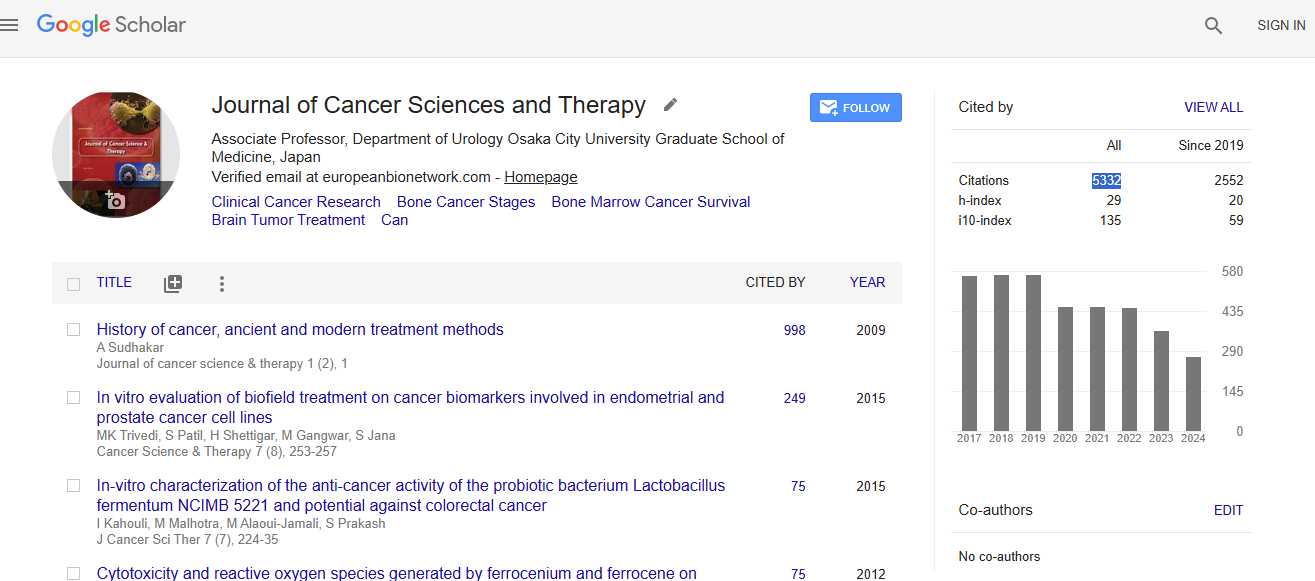
Cancer Science & Therapy received 5332 citations as per Google Scholar report