Opinion - (2025) Volume 14, Issue 3
Received: 01-Jun-2025, Manuscript No. jbfa-25-174146;
Editor assigned: 03-Jun-2025, Pre QC No. P-174146;
Reviewed: 17-Jun-2025, QC No. Q-174146;
Revised: 23-Jun-2025, Manuscript No. R-174146;
Published:
30-Jun-2025
, DOI: 10.37421/2167-0234.2025.14.534
Citation: Pellegrini, Marco. ”Business Sustainability: Strategy, Finance, Governance.” J Bus Fin Aff 14 (2025):534.
Copyright: © 2025 Pellegrini M. This is an open-access article distributed under the terms of the Creative Commons Attribution License, which permits unrestricted use, distribution and reproduction in any medium, provided the original author and source are credited.
This collection of studies reviews the dynamic landscape of business sustainability. It systematically examines how business sustainability has evolved, highlighting key challenges and emerging trends over time. The focus has shifted from mere environmental compliance to a broader integration of social and economic factors [1].
One significant area explores the relationship between corporate social responsibility (CSR) and financial performance. This body of work synthesizes findings, generally indicating a positive correlation, though it also points to moderating factors such as industry, country, and specific CSR dimensions. Understanding these nuances is crucial for businesses aiming to leverage CSR for both societal benefit and financial gain [2].
Further research investigates the impact of Environmental, Social, and Governance (ESG) reporting on corporate financial performance, specifically within European firms. Findings suggest that transparent ESG reporting can positively influence financial outcomes, bolstering investor confidence and potentially lowering capital costs. This underscores the strategic importance of embedding ESG disclosures into business operations for long-term value creation [3].
The transition from linear to circular approaches in business models is another key theme. Systematic reviews detail the strategies, benefits, and inherent challenges in implementing various circular economy business models, offering a comprehensive overview for businesses seeking resource efficiency, waste reduction, and value creation through systemic shifts [4].
The importance of integrating sustainability throughout the supply chain is also highlighted. A meta-analysis delves into the relationship between sustainable supply chain management (SSCM) and firm performance, consolidating evidence that SSCM practices generally lead to improved environmental, social, and economic outcomes. This confirms SSCM as a strategic imperative for competitive advantage and long-term resilience [5].
Effective stakeholder engagement is recognized as critical for advancing business sustainability. Studies identify various approaches to engaging stakeholders, including employees, customers, communities, and investors, and discuss how such engagement fosters trust, innovation, and shared value creation. This area also proposes a research agenda to explore the dynamics and impacts of different engagement strategies [6].
Sustainable innovation is explored by mapping the current landscape and suggesting future research avenues. It examines how businesses can develop and implement new products, processes, and business models that deliver economic value while minimizing environmental impact and promoting social equity. The paper stresses an integrated approach to innovation, considering the entire lifecycle and stakeholder perspectives [7].
The role of green marketing in supporting business sustainability is also reviewed. This involves outlining existing research and identifying future study gaps, discussing various green marketing strategies like eco-labeling, green advertising, and sustainable product development. These strategies impact consumer behavior and firm performance, emphasizing the need for genuine commitment to sustainability to build consumer trust and avoid greenwashing [8].
Robust corporate governance structures are fundamental to embedding sustainability. Recent literature on the interplay between corporate governance and sustainability highlights how board diversity and ethical leadership contribute to integrating sustainability within organizational strategy and operations. Effective governance is essential for overseeing ESG risks and opportunities, thus enhancing long-term business resilience and stakeholder value [9].
Finally, the relationship between ethical leadership and corporate sustainability is investigated. This work provides a roadmap for future research, unpacking how leaders embodying ethical principles can drive organizational commitment to environmental protection, social responsibility, and sound governance. Ethical leadership is presented as a cornerstone for cultivating a culture of sustainability and achieving long-term, responsible business success [10].
Business sustainability is a crucial and evolving area of focus, systematically reviewed to understand its historical trajectory, current challenges, and future trends [1]. The landscape of sustainable practices has notably shifted from merely meeting environmental regulations to a more holistic integration of social and economic dimensions, driven by a global context that demands adaptable strategies. Understanding this evolution is key to navigating the complex demands placed on modern businesses [1]. Stakeholder engagement stands out as a critical element in this journey, with various approaches identified for involving employees, customers, communities, and investors. Effective engagement builds trust, sparks innovation, and creates shared value, underscoring its importance for long-term success [6].
A significant portion of recent research delves into the financial implications of sustainable practices. The relationship between corporate social responsibility (CSR) and financial performance, for instance, shows a generally positive correlation. However, this link is nuanced, with factors such as industry type, geographic location, and specific CSR initiatives moderating the outcomes. Businesses need to grasp these subtleties to effectively leverage CSR for both profit and societal good [2]. Similarly, transparent ESG (Environmental, Social, and Governance) reporting has a tangible impact on corporate financial performance. For European firms, specifically, such reporting enhances investor confidence and can reduce capital costs, reinforcing the strategic necessity of integrating ESG disclosures into core business operations for sustainable value creation [3]. Beyond individual firms, integrating sustainability throughout the entire supply chain, known as Sustainable Supply Chain Management (SSCM), consistently leads to improved environmental, social, and economic outcomes, proving to be a strategic imperative for competitive advantage and organizational resilience [5].
Innovation and operational models are also central to advancing sustainability. The systematic review of circular economy business models highlights the strategies, benefits, and inherent challenges involved in transitioning from linear to circular approaches. These models offer significant opportunities for enhancing resource efficiency, reducing waste, and creating value, though they necessitate systemic shifts within organizations [4]. Furthermore, sustainable innovation encompasses developing new products, processes, and business models that simultaneously deliver economic value, minimize environmental impact, and promote social equity. An integrated approach, considering the entire lifecycle and diverse stakeholder perspectives, is crucial for successful implementation [7]. Complementing these efforts, green marketing strategies, including eco-labeling and green advertising, play a vital role in supporting business sustainability. These strategies influence consumer behavior and firm performance, emphasizing that genuine commitment to sustainability is necessary to avoid greenwashing and build consumer trust effectively [8].
The foundational role of governance and leadership in embedding sustainability cannot be overstated. Robust corporate governance structures, characterized by board diversity and ethical leadership, are instrumental in integrating sustainability into organizational strategy and day-to-day operations. This effective governance is crucial for identifying and managing ESG risks and opportunities, thereby enhancing long-term business resilience and stakeholder value [9]. Ethical leadership, specifically, cultivates a culture of sustainability. Leaders who embody strong ethical principles can drive profound organizational commitment to environmental protection, social responsibility, and sound governance. This leadership style is a cornerstone for achieving long-term, responsible business success [10]. Collectively, these findings paint a comprehensive picture of business sustainability, highlighting its multifaceted nature and the interconnectedness of strategy, operations, finance, governance, and leadership in driving a more sustainable future.
This body of work extensively reviews the critical facets of business sustainability. It tracks the evolution of sustainable practices, underscoring a shift from basic environmental compliance to a comprehensive integration of social and economic factors in dynamic global contexts. The analyses consistently reveal that robust engagement with sustainability directly impacts financial performance. This is evident through findings on Corporate Social Responsibility (CSR) and ESG reporting, both showing positive correlations with financial outcomes, enhancing investor confidence, and potentially reducing capital costs. Operational strategies like the circular economy, sustainable supply chain management (SSCM), and sustainable innovation are presented as vital for resource efficiency, waste reduction, and overall value creation. These require systemic organizational shifts and integrated approaches that consider entire lifecycles and stakeholder perspectives. Moreover, effective stakeholder engagement is highlighted as fundamental for fostering trust, innovation, and shared value. Green marketing strategies are also explored, emphasizing the need for genuine commitment to build consumer trust and avoid greenwashing. The overarching theme points to the indispensable role of strong corporate governance and ethical leadership in embedding sustainability within organizational strategy, managing ESG risks, and cultivating a responsible business culture for long-term resilience and success.
None
None
Indexed at, Google Scholar, Crossref
Indexed at, Google Scholar, Crossref
Indexed at, Google Scholar, Crossref
Indexed at, Google Scholar, Crossref
Indexed at, Google Scholar, Crossref
Indexed at, Google Scholar, Crossref
Indexed at, Google Scholar, Crossref
Indexed at, Google Scholar, Crossref
Indexed at, Google Scholar, Crossref
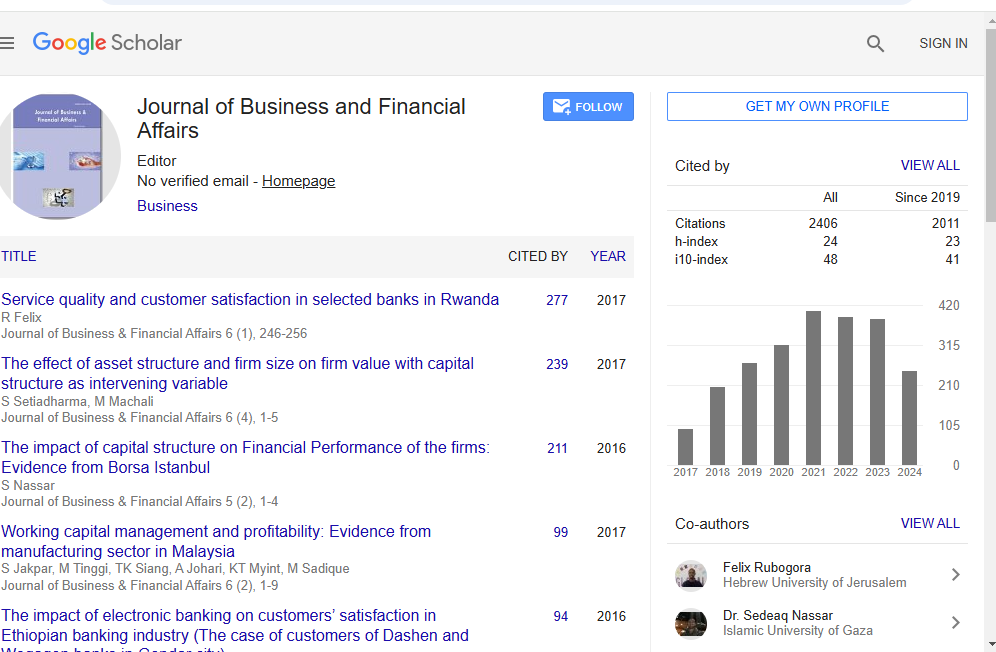
Journal of Business & Financial Affairs received 1726 citations as per Google Scholar report