Perspective - (2025) Volume 18, Issue 3
Received: 30-Apr-2025, Manuscript No. jscb-25-176392;
Editor assigned: 02-May-2025, Pre QC No. P-176392;
Reviewed: 16-May-2025, QC No. Q-176392;
Revised: 23-May-2025, Manuscript No. R-176392;
Published:
30-May-2025
, DOI: 10.37421/0974-7230.2025.18.586
Citation: Al-Hassan, Aisha. ”Business Intelligence \& Analytics: Capabilities, Ethics, Impact.” J Comput Sci Syst Biol 18 (2025):586.
Copyright: © 2025 Al-Hassan A. This is an open-access article distributed under the terms of the Creative Commons Attribution License, which permits unrestricted use, distribution and reproduction in any medium, provided the original author and source are credited.
Business Intelligence and Analytics (BI&A) capabilities are crucial for organizations seeking to gain insights from data. This involves various dimensions, including technological, organizational, and human aspects, all interacting to enable data-driven decision-making. Future research points towards areas such as Artificial Intelligence (AI) integration, ethical considerations, and real-time analytics [1].
The dynamic relationship between Big Data, Business Intelligence, and Analytics continues to evolve, playing a combined role in transforming how organizations make decisions. Integrating these technologies allows businesses to extract valuable insights from vast datasets, leading to more informed and strategic choices. This integration fosters innovation and competitive advantage, despite the increasing complexity [2].
In the healthcare sector, Business Intelligence and Analytics (BI&A) significantly contribute to performance management. These tools empower healthcare organizations to monitor, analyze, and enhance various operational and clinical outcomes. This leads to improved patient care, optimized resource utilization, and streamlined administrative processes, though challenges remain alongside the benefits [3].
Effective implementation of Business Intelligence (BI) systems hinges on identifying critical success factors (CSFs). These factors span technical, organizational, and managerial dimensions, providing a roadmap for organizations to navigate common challenges and maximize their BI investments. A holistic approach, encompassing data quality, executive support, user involvement, and project management, is vital for successful BI adoption and realizing strategic benefits [4].
Understanding Business Intelligence (BI) maturity models is fundamental for organizations aiming to advance their BI capabilities. These models offer frameworks to assess and guide an organization's journey, synthesizing common dimensions and stages. This helps companies progressively enhance their data analytics infrastructure, processes, and culture, which is crucial for strategic planning and achieving greater data-driven competence [5].
The advent of Cloud Business Intelligence (CBI) presents both opportunities and challenges. Migrating BI capabilities to the cloud offers advantages such as scalability, cost-effectiveness, and enhanced accessibility. However, it also introduces hurdles related to data security, integration complexities, and vendor lock-in. CBI holds transformative potential for organizations seeking agility and advanced analytical power [6].
Ethical considerations are paramount in Business Intelligence (BI) and Big Data Analytics. This includes addressing privacy concerns, potential data misuse, algorithmic bias, and accountability issues arising from collecting and analyzing vast amounts of data. Establishing robust ethical frameworks and governance policies is essential to ensure responsible data practices and maintain trust in data-driven decision-making processes [7].
The impact of Business Intelligence and Analytics (BI&A) capabilities on supply chain performance is notable. Empirical evidence shows that organizations effectively leveraging BI&A can achieve significant improvements in operational efficiency, responsiveness, and overall supply chain resilience. Data-driven insights are strategically important for optimizing complex logistics and procurement, leading to enhanced competitive advantage [8].
Small and Medium-Sized Enterprises (SMEs) face unique challenges when implementing Business Intelligence (BI). A tailored BI framework for SMEs addresses these constraints, synthesizing existing literature to identify critical components, success factors, and implementation strategies. The emphasis here is on flexible, scalable, and cost-effective BI solutions that align with the specific needs and capabilities of smaller organizations to gain competitive advantage [9].
User adoption is a critical factor for the success of Business Intelligence (BI) systems, particularly within sectors like banking. Key factors influencing adoption include perceived usefulness, perceived ease of use, adequate training, and strong management support. These insights are valuable for organizations aiming to foster a data-driven culture and maximize the return on BI technology investments through effective user engagement strategies [10].
Business Intelligence and Analytics (BI&A) are fundamental for organizations looking to leverage data for insights. A comprehensive review outlines how these capabilities involve technological, organizational, and human dimensions, all working together for data-driven decision-making. Researchers also suggest future avenues like Artificial Intelligence (AI) integration, ethical considerations, and real-time analytics [1]. Here's the thing, the relationship between Big Data, Business Intelligence, and Analytics continues to evolve, transforming organizational decision processes. Integrating these technologies helps businesses extract valuable insights from vast datasets, leading to more informed and strategic choices. This integration also fuels innovation and competitive advantage [2].
Implementing Business Intelligence (BI) systems effectively relies on understanding critical success factors (CSFs). These factors span technical, organizational, and managerial aspects, guiding organizations to overcome hurdles and maximize their BI investments. A holistic strategy, considering data quality, executive support, user involvement, and project management, is key for successful BI adoption and achieving its strategic benefits [4]. What this really means is that assessing an organization's BI capabilities requires looking at BI maturity models. These existing frameworks provide an overview, synthesizing common dimensions and stages. Using these insights, companies can progressively improve their data analytics infrastructure, processes, and culture. Understanding BI maturity is vital for strategic planning and building stronger data-driven competence [5].
BI&A finds crucial application in specific sectors, demonstrating its versatility. For example, in healthcare performance management, BI&A tools empower organizations to monitor, analyze, and enhance operational and clinical outcomes. This ultimately improves patient care, optimizes resource use, and streamlines administrative tasks within healthcare [3]. Similarly, Business Intelligence and Analytics capabilities significantly impact supply chain performance. Empirical studies show that organizations effectively using BI&A achieve marked improvements in operational efficiency, responsiveness, and overall supply chain resilience. Data-driven insights are strategically important for optimizing complex logistics and procurement processes, which in turn enhances competitive advantage in dynamic markets [8]. For Small and Medium-Sized Enterprises (SMEs), a tailored Business Intelligence (BI) framework is proposed. This framework addresses their unique challenges and resource constraints, identifying critical components, success factors, and implementation strategies. The need is for flexible, scalable, and cost-effective BI solutions that fit the specific needs and capabilities of smaller organizations, helping them gain a competitive edge [9].
The landscape of Cloud Business Intelligence (CBI) is a key area of discussion, with identified trends, challenges, and future research paths. Migrating BI capabilities to the cloud offers benefits like scalability, cost-effectiveness, and improved accessibility. However, significant hurdles exist, including data security, integration complexities, and vendor lock-in. Still, CBI holds transformative potential for organizations seeking agility and advanced analytical power [6]. Parallel to technological advancements, ethical considerations in Business Intelligence (BI) and Big Data Analytics are paramount. Privacy concerns, data misuse, algorithmic bias, and accountability issues arise from collecting and analyzing vast amounts of data. This underscores the necessity for strong ethical frameworks and governance policies to ensure responsible data practices and maintain trust in data-driven decision-making [7].
Finally, successful adoption of Business Intelligence (BI) systems by users is a critical point, particularly in sectors like banking. Key factors that influence this adoption include perceived usefulness, perceived ease of use, adequate training, and strong management support. These insights offer valuable guidance for organizations aiming to foster a data-driven culture and maximize the return on their BI technology investments through effective user engagement strategies [10].
This collection of research explores the multifaceted landscape of Business Intelligence (BI) and Analytics (BI&A), highlighting its pivotal role in data-driven decision-making across various organizational contexts. The papers collectively emphasize how BI&A capabilities are essential for organizations to extract valuable insights from data, driving strategic choices and fostering competitive advantage. Specifically, the research covers a comprehensive review of BI&A capabilities, examining technological, organizational, and human dimensions, and also proposes future research areas like Artificial Intelligence (AI) integration and ethical considerations. There's a significant focus on the evolving relationship between Big Data, Business Intelligence, and Analytics, showing how their integration transforms decision-making and innovation. The application of BI&A is explored in specific sectors, such as healthcare performance management, where it aids in improving operational and clinical outcomes. Key elements for successful BI implementation are identified through a systematic review of critical success factors, spanning technical, organizational, and managerial aspects. The literature also delves into BI maturity models, providing frameworks for organizations to assess and enhance their data analytics infrastructure, and the growing area of Cloud Business Intelligence, discussing its benefits and challenges. Furthermore, the ethical implications of BI and Big Data Analytics are addressed, underscoring privacy, bias, and accountability concerns, and the necessity for robust ethical frameworks. The impact of BI&A on supply chain performance is empirically studied, demonstrating improvements in efficiency and resilience. Special attention is given to a BI framework for Small and Medium-Sized Enterprises (SMEs), tailored to their unique resource constraints. Finally, factors influencing user adoption of BI systems, particularly in the banking sector, are investigated, emphasizing perceived usefulness, ease of use, and management support.
None
None
Mariam J, Abdul-Fattah M, Mohannad A. "Business Intelligence and Analytics Capabilities: A Review and Future Research Agenda".Int J Adv Comput Sci Appl 14 (2023):110-120.
Indexed at, Google Scholar, Crossref
Andrea S, Antonio DG, Roberto M. "Big Data, Business Intelligence and Analytics: The Evolution of Knowledge for Decision-Making".J Intell Manuf 33 (2022):1153-1166.
Indexed at, Google Scholar, Crossref
Muhammad I, Muhammad N, Muhammad A. "Business Intelligence and Analytics for Performance Management in Healthcare: A Systematic Review".J Healthc Eng 2021 (2021):9942630.
Indexed at, Google Scholar, Crossref
F. N, T. TTN, E. TSK. "Critical Success Factors for Business Intelligence Implementation: A Systematic Literature Review".Int J Adv Comput Sci Appl 11 (2020):663-677.
Indexed at, Google Scholar, Crossref
Mohannad A, Abdul-Fattah M, Mariam J. "Business Intelligence Maturity Models: A Systematic Literature Review".Int J Adv Comput Sci Appl 10 (2019):112-120.
Indexed at, Google Scholar, Crossref
Mohamad AA, Abdullah A, Mohammad A. "Cloud Business Intelligence: A Literature Review and Future Research Directions".IJECE 13 (2023):4426-4434.
Indexed at, Google Scholar, Crossref
Maryam Z, Marjan G, Fereshteh A. "Ethical Considerations in Business Intelligence and Big Data Analytics: A Systematic Review".J Info Sci Eng 37 (2021):799-816.
Indexed at, Google Scholar, Crossref
Wafa A, Nabeel AA, Sultan A. "Business intelligence and analytics capabilities for supply chain performance: an empirical study".Int J Logist Manag 33 (2022):497-521.
Indexed at, Google Scholar, Crossref
S. AG, A. KA, M. AA. "Business Intelligence Framework for Small and Medium-Sized Enterprises: A Systematic Review".J Strateg Info Syst 31 (2022):101736.
Indexed at, Google Scholar, Crossref
M. AA, B. AA, S. MA. "Factors influencing user adoption of business intelligence systems: An empirical study in the banking sector".Int J Info Manag 53 (2020):102100.
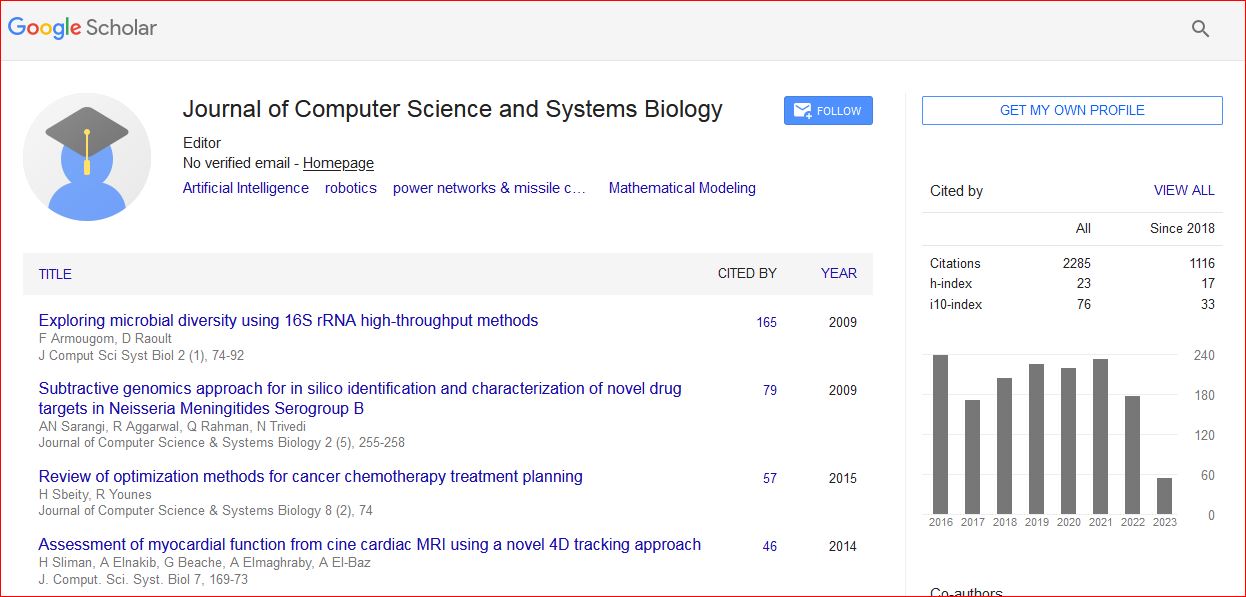
Journal of Computer Science & Systems Biology received 2279 citations as per Google Scholar report