Brief Report - (2025) Volume 15, Issue 3
Received: 01-May-2025, Manuscript No. jcde-25-175212;
Editor assigned: 05-May-2025, Pre QC No. P-175212;
Reviewed: 19-May-2025, QC No. Q-175212;
Revised: 22-May-2025, Manuscript No. R-175212;
Published:
29-May-2025
, DOI: 10.37421/2165-784X.2025.15.601
Citation: Carlos Mendoza. ”Building Resilient, Sustainable,
Smart Civil Infrastructure.” J Civil Environ Eng 15 (2025):601.
Copyright: © 2025 M. Carlos This is an open-access article distributed under the terms of the Creative Commons Attribution License, which permits unrestricted use,
distribution and reproduction in any medium, provided the original author and source are credited.
This paper presents a detailed review of recycled aggregate concrete in structural applications. It evaluates key aspects like its mechanical properties, durability, and overall structural performance. The insights here help engineers understand its potential for sustainable construction, outlining both its benefits and the considerations for effective design and deployment[1].
This review critically examines recent advancements in performance-based seismic design specifically for tall buildings. It consolidates current methodologies, discusses their applications, and identifies challenges, offering a clear perspective on enhancing the seismic resilience of complex high-rise structures[2].
Here's a look at how Artificial Intelligence (AI) is transforming structural health monitoring. This review offers a thorough examination of various AI applications, from data analysis to predictive maintenance, showcasing how these technologies improve the assessment and longevity of civil infrastructure[3].
This paper provides an overview of additive manufacturing technologies and their burgeoning role in civil and structural engineering. It delves into different 3D printing methods, materials, and potential applications, highlighting how these innovations could reshape construction practices and structural design[4].
This article explores the latest advancements in the design and construction of mass timber structures. It covers innovative connection systems, structural behaviors, and fire safety considerations, showcasing how timber is becoming a viable and sustainable alternative for modern, large-scale buildings[5].
This review surveys the emerging field of smart materials in civil engineering, discussing recent applications and future directions. It delves into materials like self-healing concrete and shape-memory alloys, illustrating their potential to enhance structural resilience, durability, and functionality through autonomous responses to environmental stimuli[6].
This comprehensive review explores digital twin technology as applied to structural health monitoring. It synthesizes current research, highlights its benefits for real-time performance assessment and predictive maintenance, and offers insights into the future potential for enhancing infrastructure management[7].
This article delves into the latest developments in ultra-high performance concrete (UHPC) for structural applications. It examines its superior mechanical properties, durability, and innovative uses in various structural elements, providing valuable information for engineers pushing the boundaries of concrete technology[8].
This review focuses on the current state of wind engineering for supertall buildings. It discusses advanced analytical techniques, aerodynamic shape optimization, and strategies for mitigating wind-induced vibrations, which are crucial for ensuring the safety and serviceability of increasingly slender high-rise structures[9].
This paper provides a comprehensive review of machine learning applications in structural design and optimization. It outlines how AI algorithms are being used to enhance various stages, from conceptual design to material selection and performance prediction, offering a glimpse into future automated and efficient structural engineering workflows[10].
Recent research highlights significant progress across civil and structural engineering, addressing challenges from sustainable materials to complex structural performance. The push for sustainability is evident in detailed reviews of recycled aggregate concrete in structural applications, which evaluate its mechanical properties, durability, and overall structural performance. These insights are crucial for engineers aiming to understand its potential for sustainable construction, outlining both its benefits and the considerations for effective design and deployment [1]. Concurrently, there is growing interest in mass timber structures, with recent advances focusing on innovative connection systems, structural behaviors, and fire safety. These developments showcase how timber is becoming a viable and sustainable alternative for modern, large-scale buildings, contributing to greener construction practices [5].
Further innovations are transforming the materials landscape. Ultra-high performance concrete (UHPC) continues to advance rapidly for structural applications, with new developments examining its superior mechanical properties, durability, and innovative uses in various structural elements. This provides valuable information for engineers pushing the boundaries of concrete technology [8]. Beyond conventional materials, the emerging field of smart materials in civil engineering is gaining traction. This includes materials like self-healing concrete and shape-memory alloys, which are being explored for their potential to enhance structural resilience, durability, and functionality through autonomous responses to environmental stimuli [6]. Additive manufacturing technologies, or 3D printing, are also playing a burgeoning role, as evidenced by overviews that delve into different printing methods, materials, and potential applications, highlighting how these innovations could reshape construction practices and structural design [4].
The integration of advanced technologies for monitoring and design is crucial for ensuring the longevity and safety of modern infrastructure. Artificial Intelligence (AI) is proving to be a transformative force in structural health monitoring, with comprehensive reviews detailing various AI applications. These range from sophisticated data analysis to predictive maintenance strategies, significantly improving the assessment and prolonging the longevity of civil infrastructure [3]. Parallel to this, digital twin technology is being extensively explored for its application in structural health monitoring. This technology synthesizes current research, highlights its benefits for real-time performance assessment and predictive maintenance, and offers profound insights into the future potential for enhancing overall infrastructure management [7]. These technological shifts empower more informed decisions and facilitate proactive maintenance, moving beyond reactive approaches.
Designing for complex and high-rise structures demands specialized engineering expertise and methodologies. Performance-based seismic design for tall buildings has seen critical advancements, with reviews consolidating current methodologies, discussing their applications, and identifying persistent challenges. The goal is to offer a clear perspective on enhancing the seismic resilience of complex high-rise structures [2]. Similarly, wind engineering for supertall buildings is a vital area of study, with reviews focusing on advanced analytical techniques, aerodynamic shape optimization, and effective strategies for mitigating wind-induced vibrations. These measures are crucial for ensuring the safety and serviceability of increasingly slender high-rise structures in urban environments [9]. These specialized fields collectively ensure that the tallest and most intricate buildings can safely withstand extreme environmental forces.
Looking ahead, machine learning is revolutionizing structural design and optimization workflows. Comprehensive reviews outline how AI algorithms are being used to enhance various stages, from conceptual design to material selection and performance prediction. This offers a glimpse into future automated and highly efficient structural engineering workflows, promising greater precision and speed [10]. These collective advancements across materials, sustainable construction techniques, intelligent monitoring systems, and advanced design methodologies underscore a dynamic and continuously evolving landscape in civil and structural engineering. The overarching aim remains to develop more resilient, sustainable, and intelligent infrastructure globally, capable of meeting future demands and environmental challenges.
Recent advancements in civil and structural engineering are diverse, spanning sustainable materials, advanced construction methods, and intelligent monitoring systems. Research highlights the potential of recycled aggregate concrete for sustainable construction, evaluating its mechanical properties and durability. Concurrently, mass timber structures are gaining prominence as a sustainable alternative, with innovations in design, connection systems, and fire safety being explored. Material science is also progressing with ultra-high performance concrete (UHPC) offering superior properties, and smart materials like self-healing concrete enhancing structural resilience. Additive manufacturing technologies are set to reshape construction practices by introducing new 3D printing methods and materials. Technological integration is key for modern infrastructure. Artificial Intelligence (AI) and digital twin technology are transforming structural health monitoring, providing tools for data analysis, predictive maintenance, and real-time performance assessment to improve infrastructure longevity. For complex structures, performance-based seismic design for tall buildings is evolving to enhance resilience, while wind engineering for supertall buildings focuses on mitigating vibrations through advanced techniques. Machine learning is also optimizing structural design, from conceptual stages to material selection, promising more efficient workflows. These collective efforts point towards a future of more resilient, sustainable, and intelligent civil infrastructure.
1. K. VLS, S. P, G. SK. "Performance of recycled aggregate concrete in structural applications: A review".Constr. Build. Mater. 395 (2023):132924.
Indexed at, Google Scholar, Crossref
2. H. W, J. PC, T. KT. "Performance-based seismic design for tall buildings: A critical review of recent advances".J. Build. Eng. 51 (2022):104279.
Indexed at, Google Scholar, Crossref
3. M. M, H. RG, M. S. "A comprehensive review of artificial intelligence applications in structural health monitoring".Eng. Struct. 260 (2022):114170.
Indexed at, Google Scholar, Crossref
4. F. W, S. LX, T. SL. "Review of additive manufacturing technologies for civil and structural engineering applications".Addit. Manuf. 43 (2021):102073.
Indexed at, Google Scholar, Crossref
5. R. JJ, M. HW, L. ZW. "Recent advances in design and construction of mass timber structures".J. Build. Eng. 74 (2023):106883.
Indexed at, Google Scholar, Crossref
6. S. KS, A. K, P. KG. "Smart materials in civil engineering: A review of recent applications and future trends".Constr. Build. Mater. 371 (2023):130635.
Indexed at, Google Scholar, Crossref
7. X. W, Y. LZ, L. JL. "Digital twin technology for structural health monitoring: A comprehensive review and future outlook".Autom. Constr. 139 (2022):104278.
Indexed at, Google Scholar, Crossref
8. A. MN, P. KM, H. FC. "Recent advances in ultra-high performance concrete for structural applications".Cem. Concr. Res. 147 (2021):106502.
Indexed at, Google Scholar, Crossref
9. S. HK, J. HP, Y. SC. "Advances in wind engineering for supertall buildings: A review".Eng. Struct. 257 (2022):114092.
Indexed at, Google Scholar, Crossref
10. L. L, M. ML, K. CW. "Machine learning applications in structural design and optimization: A review".Structures 47 (2023):101894.
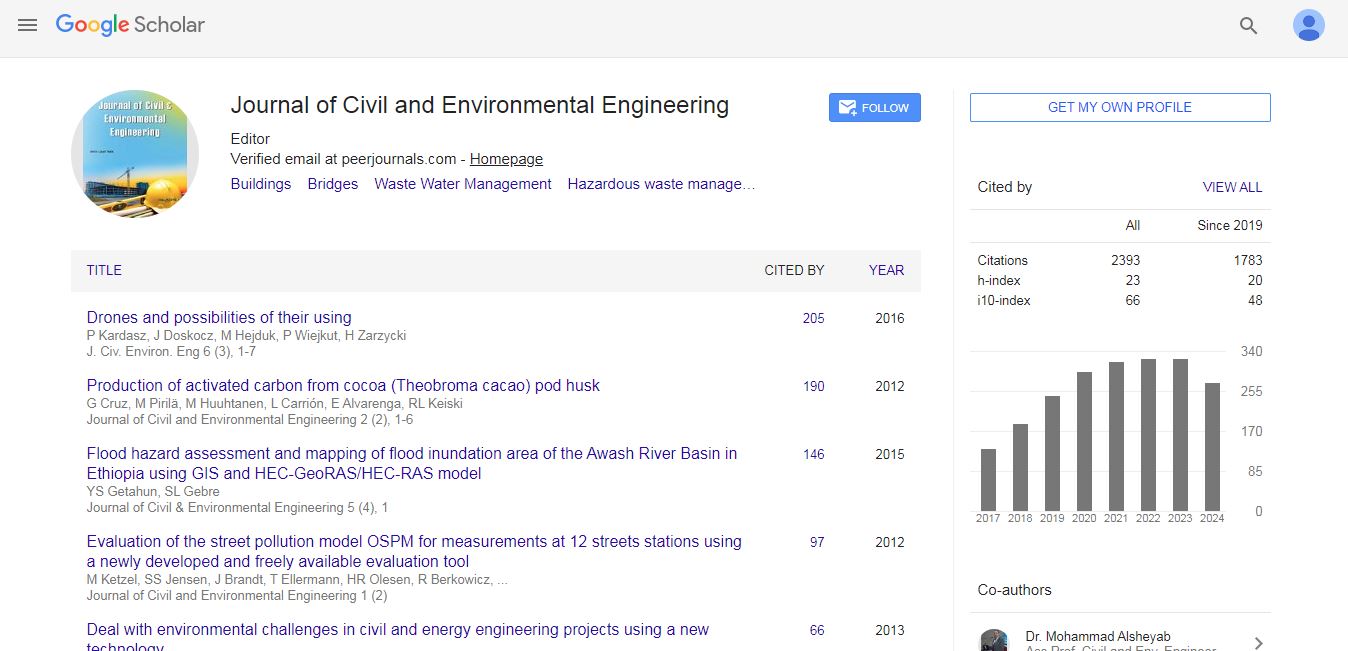
Journal of Civil and Environmental Engineering received 1798 citations as per Google Scholar report