Commentary - (2025) Volume 15, Issue 4
Received: 03-Aug-2025, Manuscript No. jprm-25-174454;
Editor assigned: 06-Aug-2025, Pre QC No. P-174454;
Reviewed: 19-Aug-2025, QC No. Q-174454;
Revised: 25-Aug-2025, Manuscript No. R-174454;
Published:
30-Aug-2025
, DOI: 10.37421/2161-105X.2025.15.748
Citation: Nasser, Ahmed. ”Bronchiectasis: Pathogenesis, Diagnosis, Modern Management.” J Pulm Respir Med 15 (2025):748.
Copyright: © 2025 Nasser A. This is an open-access article distributed under the terms of the Creative Commons Attribution License, which permits unrestricted use, distribution and reproduction in any medium, provided the original author and source are credited.
This article provides a current overview of bronchiectasis, touching on diagnostic criteria and contemporary management strategies. It highlights the importance of identifying the underlying cause and emphasizes a multidisciplinary approach to patient care, focusing on symptom control, reducing exacerbations, and improving quality of life[1].
This review offers a comprehensive look at the pathophysiology, diagnosis, and current management of bronchiectasis. It underscores the concept of the 'vicious cycle' of infection and inflammation and discusses the various diagnostic tools available, including high-resolution CT, alongside a range of treatment options from airway clearance to antibiotics and anti-inflammatory agents[2].
This clinical review provides essential insights into bronchiectasis, emphasizing its rising prevalence and varied etiologies beyond cystic fibrosis. It outlines key diagnostic approaches and offers a practical guide to managing the disease, focusing on preventing exacerbations and preserving lung function through personalized treatment plans[3].
This systematic review explores pharmacological treatments for bronchiectasis, assessing the efficacy of various drug classes. It critically evaluates the evidence for inhaled antibiotics, mucolytics, and anti-inflammatory agents, providing a foundation for clinical decision-making and highlighting areas where further research is needed to optimize patient outcomes[4].
This systematic review and meta-analysis consolidates global data on the prevalence of bronchiectasis, revealing significant variations across different regions and populations. The findings provide crucial epidemiological insights, informing public health strategies and resource allocation for managing this increasingly recognized chronic respiratory condition worldwide[5].
This comprehensive review delves into non-cystic fibrosis bronchiectasis, exploring current understanding of its etiology, pathogenesis, diagnosis, and treatment. It highlights diverse underlying causes and emphasizes personalized management strategies, focusing on reducing exacerbations and improving patient quality of life through a tailored therapeutic approach[6].
This systematic review and meta-analysis critically assesses anti-inflammatory treatments for non-cystic fibrosis bronchiectasis. It evaluates the efficacy and safety of various anti-inflammatory agents, providing valuable evidence for clinicians and guiding future research into therapeutic strategies aimed at breaking the chronic inflammation cycle in these patients[7].
This review provides an updated perspective on the complex pathogenesis of bronchiectasis. It discusses the interplay of various factors, including genetic predispositions, infectious insults, and immune dysfunction, which contribute to the 'vicious cycle' of inflammation and structural lung damage, laying groundwork for targeted therapeutic interventions[8].
This comprehensive review offers valuable insights into the role of the microbiome in bronchiectasis. It explores how dysbiosis in the respiratory tract contributes to disease progression, exacerbations, and treatment response, suggesting that modulating the microbiome could represent a promising new therapeutic avenue[9].
This article highlights the critical roles of chronic infection and persistent inflammation in driving the pathogenesis of non-cystic fibrosis bronchiectasis. It explains how these factors perpetuate a destructive cycle within the airways, leading to progressive lung damage and emphasizing the need for therapies that target both microbial load and inflammatory responses[10].
Bronchiectasis, a chronic respiratory condition, demands a thorough understanding of its diagnostic criteria and contemporary management strategies [1]. This complex disease necessitates identifying the underlying cause, which varies widely and extends beyond Cystic Fibrosis. A multidisciplinary approach to patient care is emphasized, focusing on controlling symptoms, reducing exacerbations, and ultimately enhancing the patient's quality of life [1, 3, 6]. Clinical reviews provide essential insights into its rising prevalence and diverse etiologies, outlining key diagnostic approaches and offering practical guides for management. The goal is to prevent exacerbations and preserve lung function through personalized treatment plans tailored to individual patient needs [3, 6].
The pathophysiology of bronchiectasis is intricate, often characterized by a 'vicious cycle' of infection and inflammation [2, 8]. This cycle involves a delicate interplay of factors including genetic predispositions, recurrent infectious insults, and immune dysfunction, all of which contribute significantly to structural lung damage [8]. An in-depth understanding underscores the critical roles of chronic infection and persistent inflammation in driving the disease's progression, particularly in non-Cystic Fibrosis bronchiectasis. These factors perpetuate a destructive cycle within the airways, leading to progressive lung deterioration. Laying the groundwork for targeted therapeutic interventions depends heavily on unraveling these complex mechanisms [2, 8, 10].
Accurate diagnosis utilizes various tools, notably high-resolution CT, which helps in assessing the extent of bronchial dilation and wall thickening [2, 3]. Once diagnosed, pharmacological treatments form a cornerstone of management. Systematic reviews critically evaluate the efficacy of different drug classes, providing a robust foundation for clinical decision-making. These include inhaled antibiotics to manage microbial load, mucolytics to aid in airway clearance, and anti-inflammatory agents to temper the inflammatory response [4]. These evaluations also highlight areas requiring further research to continually refine and optimize patient outcomes through evidence-based practices [4].
A specific focus exists on anti-inflammatory treatments, particularly for non-Cystic Fibrosis bronchiectasis. Extensive systematic reviews and meta-analyses rigorously assess the efficacy and safety profiles of various anti-inflammatory agents [7]. This evidence is invaluable for clinicians and serves to guide ongoing research into novel therapeutic strategies aimed at effectively breaking the chronic inflammation cycle that defines this condition. For non-Cystic Fibrosis bronchiectasis, personalized management strategies are paramount, focusing intently on minimizing exacerbations and substantially improving the patient's overall quality of life by adopting a tailored therapeutic approach [6, 7].
Epidemiological studies, including systematic reviews and meta-analyses, provide crucial insights into the worldwide prevalence of bronchiectasis. These studies reveal significant geographical and population-based variations, which are essential for informing public health initiatives and allocating healthcare resources effectively for this increasingly recognized chronic respiratory condition [5]. Furthermore, an exciting and evolving area of research explores the critical role of the microbiome in bronchiectasis. Dysbiosis, or an imbalance, in the respiratory tract's microbial communities, is understood to significantly contribute to disease progression, frequency of exacerbations, and even response to treatment. This understanding suggests that strategically modulating the microbiome could represent a promising new therapeutic avenue, opening doors for novel interventions [9].
Bronchiectasis, a chronic respiratory condition, requires a comprehensive understanding of its diagnosis, management, and underlying mechanisms. Recent research provides updates on diagnostic criteria and contemporary management strategies, stressing the importance of identifying the root cause and adopting a multidisciplinary patient care approach, focusing on symptom control, reducing exacerbations, and improving quality of life. The pathophysiology often involves a 'vicious cycle' of infection and inflammation, necessitating advanced diagnostic tools like High-Resolution CT and a range of treatments including airway clearance, antibiotics, and anti-inflammatory agents. There's a rising prevalence of bronchiectasis with varied etiologies beyond Cystic Fibrosis, underscoring the need for personalized treatment plans to preserve lung function. Pharmacological treatments, such as inhaled antibiotics, mucolytics, and anti-inflammatory agents, are continually evaluated for efficacy. Global epidemiological data reveals significant variations in its prevalence, influencing public health strategies. Furthermore, understanding non-Cystic Fibrosis bronchiectasis involves exploring its etiology, pathogenesis, and treatment, with personalized strategies being key. Specific anti-inflammatory treatments are assessed for their efficacy and safety to break the chronic inflammation cycle. Insights into the complex pathogenesis highlight genetic predispositions, infectious insults, and immune dysfunction. The respiratory microbiome's dysbiosis is also recognized as a contributor to disease progression and a potential therapeutic target, reinforcing the need for therapies that address both microbial load and inflammatory responses.
None
None
1. Peter JC, Michael RL, James DC. "Bronchiectasis: an update on diagnosis and management".Lancet Respir Med 9 (2021):923-936.
Indexed at, Google Scholar, Crossref
2. Wei Z, Xiao-Yan C, Yong-Jian L. "Bronchiectasis: an overview of pathophysiology, diagnosis and management".Ann Transl Med 11 (2023):1.
Indexed at, Google Scholar, Crossref
3. Stefano A, Francesco B, James DC. "Bronchiectasis: A Clinical Review".JAMA 327 (2022):2125-2131.
Indexed at, Google Scholar, Crossref
4. Eleanor RG, Claire LH, Jonathan DFPC. "Pharmacological treatments for bronchiectasis: a systematic review".Eur Respir Rev 30 (2021):210080.
Indexed at, Google Scholar, Crossref
5. Mohammed AA, Yasser KA, Saleh A. "The worldwide prevalence of bronchiectasis: a systematic review and meta-analysis".Eur Respir J 58 (2021):2004505.
Indexed at, Google Scholar, Crossref
6. E. B, R. MDLG, A. CG. "Non-cystic fibrosis bronchiectasis: a review of the current evidence on etiology, pathogenesis, diagnosis, and treatment".Clin Respir J 16 (2022):512-524.
Indexed at, Google Scholar, Crossref
7. Christopher JAD, Christopher TWMWTRS, James DC. "Anti-inflammatory treatments for non-cystic fibrosis bronchiectasis: a systematic review and meta-analysis".Lancet Respir Med 10 (2022):1056-1067.
Indexed at, Google Scholar, Crossref
8. Gang W, Chao W, Ming L. "Pathogenesis of bronchiectasis: An update".J Cell Mol Med 27 (2023):2289-2297.
Indexed at, Google Scholar, Crossref
9. Mohammed AA, Yasser KA, Saleh A. "The Microbiome in Bronchiectasis: A Comprehensive Review".J Clin Med 11 (2022):5313.
Indexed at, Google Scholar, Crossref
10. Wei Z, Xiao-Yan C, Yong-Jian L. "Role of chronic infection and inflammation in the pathogenesis of non-cystic fibrosis bronchiectasis".Curr Opin Pulm Med 29 (2023):226-231.
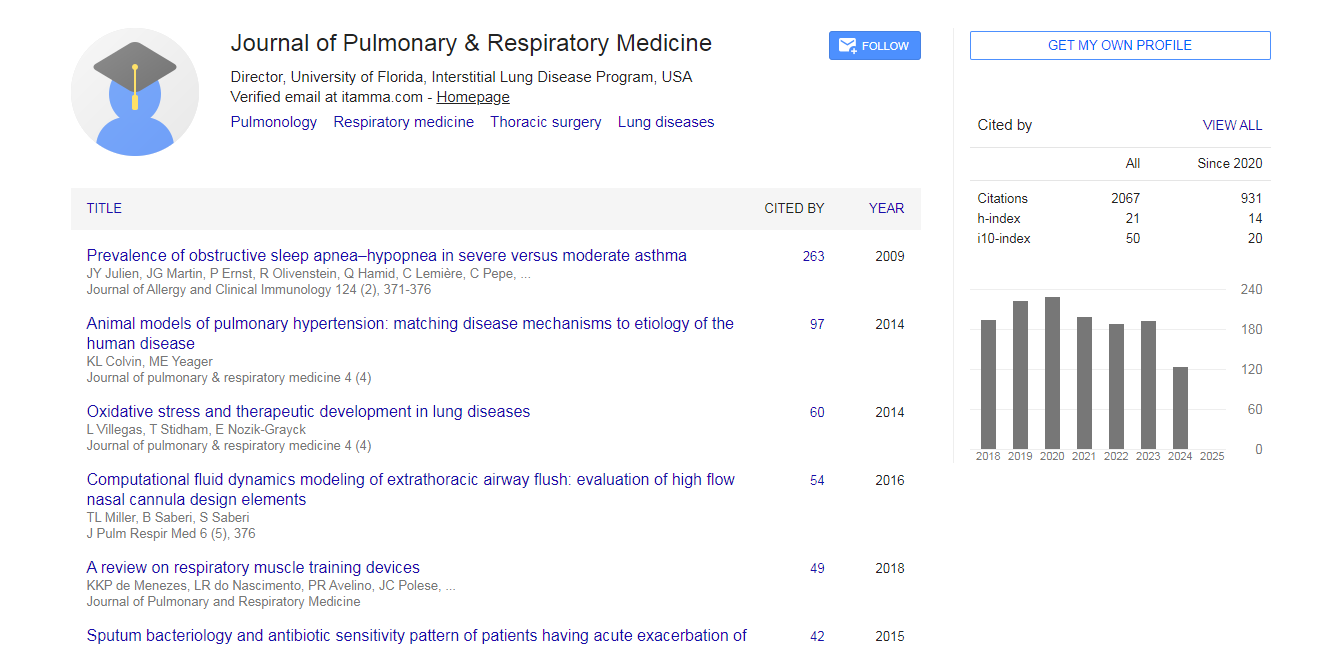
Pulmonary & Respiratory Medicine received 1690 citations as per Google Scholar report