Perspective - (2025) Volume 16, Issue 6
Received: 01-Nov-2025, Manuscript No. jch-26-178803;
Editor assigned: 03-Nov-2025, Pre QC No. P-178803;
Reviewed: 17-Nov-2025, QC No. Q-178803;
Revised: 22-Nov-2025, Manuscript No. R-178803;
Published:
29-Nov-2025
, DOI: 10.37421/2157-7099.2025.16.829
Citation: Silva, Miguel J.. ”Bridging Cytological and Histological Discrepancies: Improving Patient Care.” J Cytol Histol 16 (2025):829.
Copyright: © 2025 Silva J. Miguel This is an open-access article distributed under the terms of the Creative Commons Attribution License, which permits unrestricted use, distribution and reproduction in any medium, provided the original author and source are credited.
Cytological and histological discrepancies, while seemingly contradictory, represent a critical area of investigation in diagnostic pathology. These discrepancies, arising from various factors, can significantly influence patient management and therapeutic strategies, underscoring the importance of understanding their origins and implications. The first reference delves into the fundamental causes of these differences, highlighting sampling errors, interpretive variations among pathologists, and the inherent biological variability of tissues as primary contributors [1].
Further exploration into the specifics of these disagreements reveals that issues such as insufficient cellularity in cytological samples or architectural distortions in histological specimens are key reasons for discordance. This underscores the need for advanced methodologies to bridge the gap between these diagnostic modalities [2].
A significant clinical consequence of such discrepancies is the potential for false-negative cytology results, which can lead to delayed diagnoses, particularly in oncological cases. This emphasizes the critical need for meticulous sample preparation and expert interpretation in cytology, coupled with robust correlation with histology [3].
Beyond inherent biological factors, human interpretation also plays a role, with interobserver variability in cytological assessment contributing to discrepancies. The implementation of standardized reporting guidelines and continuous quality improvement programs is therefore crucial for enhancing diagnostic consistency and minimizing subjective influences [4].
In response to these challenges, emerging technologies like digital pathology and artificial intelligence are being developed to assist in lesion detection and classification. These advancements aim to reduce discordances by providing objective analysis and identifying subtle features that might be overlooked during manual review [5].
Sampling error, especially in procedures like fine-needle aspiration cytology, remains a persistent cause of discordant results. Therefore, optimizing sampling techniques and ensuring the adequacy of collected material are paramount for achieving accurate diagnoses and reliable correlations [6].
To enhance diagnostic precision and resolve ambiguities, the integration of ancillary techniques such as immunohistochemistry into cytological specimens is proving invaluable. This approach significantly aids in differentiating benign from malignant entities and determining the origin of tumors [7].
Specific clinical areas, such as gynecological cytology, present unique challenges where discrepancies can lead to either under- or overtreatment. In these contexts, careful review, correlation with subsequent histology, and stringent quality control are vital for optimal patient care [8].
The accurate diagnosis of lung nodules, for instance, is heavily reliant on the concordance between cytology and histology. Molecular markers are increasingly employed to predict malignancy in cytology samples, thereby guiding decisions for further investigations and treatment [9].
Ultimately, addressing these diagnostic challenges necessitates establishing clear communication channels between cytology and histology departments. Regular multidisciplinary team meetings and effective feedback mechanisms are essential for identifying and learning from potential diagnostic errors, thereby improving patient outcomes [10].
Cytology and histology, while distinct disciplines, are intricately linked in the diagnostic process, and their interplay is marked by potential discrepancies. These differences can arise from a multitude of factors, each carrying significant clinical weight. The first cited work meticulously details these causes, pointing to sampling errors that may yield an unrepresentative tissue fragment, subjective interpretation differences between pathologists, and the inherent biological variability that makes definitive classification challenging [1].
Understanding the precise nature of these discrepancies is crucial for effective clinical management. For example, insufficient cellularity in a cytology sample or architectural distortion in a histology specimen can both contribute to discordant diagnoses. Advanced molecular techniques are emerging as powerful tools to resolve these ambiguities when morphological assessment alone proves insufficient [2].
The clinical ramifications of false-negative cytology results are particularly concerning, as they can lead to a delay in cancer diagnosis and subsequent treatment. This underscores the imperative for highly meticulous cytological preparation and expert interpretation, alongside seamless communication with histopathology for confirmatory diagnoses [3].
Observer variability, a known factor in subjective disciplines, also impacts cytological interpretation, contributing to discrepancies. To mitigate this, the adoption of standardized reporting guidelines and the implementation of robust quality improvement programs are essential to minimize subjective interpretation and enhance diagnostic consistency across different practitioners [4].
In the pursuit of greater accuracy, digital pathology and artificial intelligence are becoming increasingly vital tools. These technologies are being explored to aid in the detection and classification of lesions, potentially reducing discrepancies by leveraging AI algorithms to identify subtle pathological features that might escape manual review [5].
Sampling error continues to be a primary culprit in discordant results, particularly in procedures like fine-needle aspiration. Ensuring that sampling techniques are optimized and that adequate cellular material is obtained are fundamental steps in achieving accurate diagnoses and reliable cytology-histology correlations [6].
To further bolster diagnostic accuracy and effectively resolve discordant findings, the integration of immunohistochemistry into cytological specimens is a valuable strategy. This technique is particularly useful in differentiating benign from malignant lesions and in determining the primary site of metastatic tumors [7].
In specific clinical domains, such as gynecological pathology, cytology-histology discordances demand careful attention due to their direct impact on treatment decisions, potentially leading to undertreatment or overtreatment. Robust quality control and thorough correlation with subsequent histology are therefore paramount in these cases [8].
The diagnostic pathway for lung nodules, for example, heavily relies on the concordance between cytological and histological assessments. The growing use of molecular markers in cytological samples to predict malignancy is significantly aiding in the decision-making process for further diagnostic workup or therapeutic intervention [9].
Fundamentally, addressing and mitigating these discrepancies hinges on establishing clear and efficient communication pathways between cytology and histology departments. Regular multidisciplinary team meetings and well-defined feedback loops are critical for identifying diagnostic errors, facilitating learning, and ultimately enhancing the quality of patient care [10].
Cytological and histological discrepancies are a significant challenge in pathology, stemming from sampling errors, interpretation variability, and biological differences. These discrepancies can impact patient management and treatment decisions. Key strategies to address these issues include meticulous sample preparation, expert interpretation, advanced molecular techniques, immunohistochemistry, digital pathology, and artificial intelligence. Robust interdisciplinary communication, standardized reporting, and quality improvement programs are crucial for minimizing errors, enhancing diagnostic accuracy, and improving patient outcomes. Addressing discrepancies in specific areas like gynecological cytology and lung nodule diagnosis is vital for appropriate patient care.
None
None
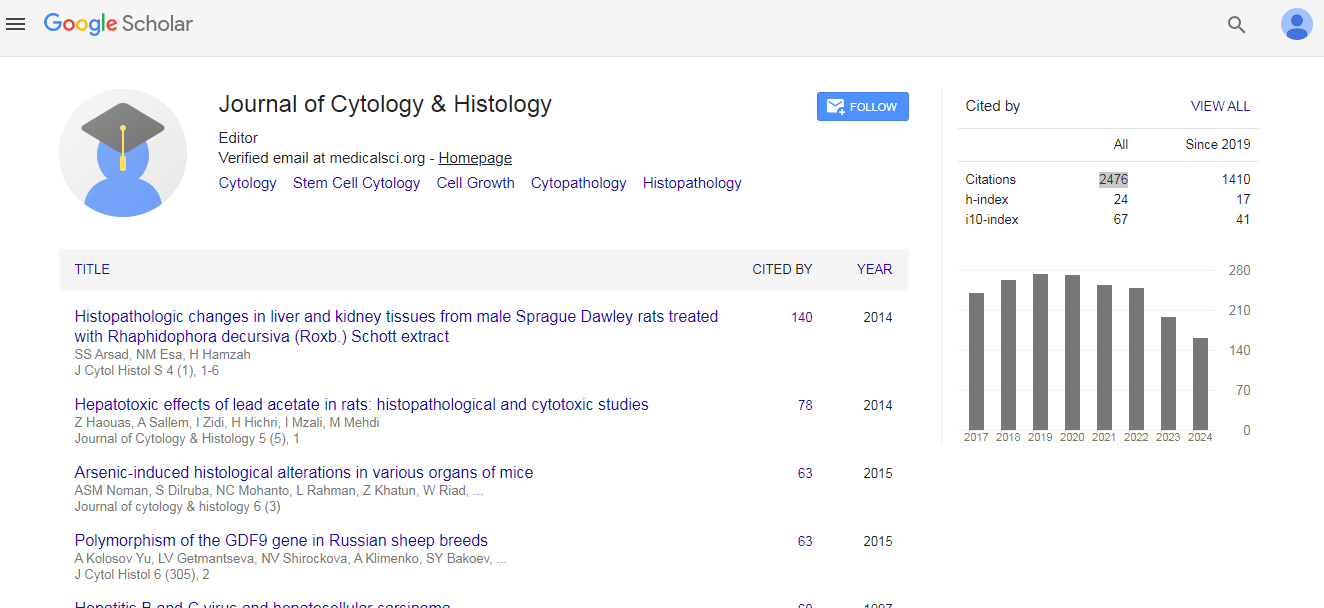
Journal of Cytology & Histology received 2476 citations as per Google Scholar report