Perspective - (2025) Volume 15, Issue 3
Received: 02-Jun-2025, Manuscript No. jprm-25-174451;
Editor assigned: 04-Jun-2025, Pre QC No. P-174451;
Reviewed: 18-Jun-2025, QC No. Q-174451;
Revised: 23-Jun-2025, Manuscript No. R-174451;
Published:
30-Jun-2025
, DOI: 10.37421/2161-105X.2025.15.744
Citation: Al-Saleh, Omar. ”Breathing: Therapy, Threats and Human Adaptation.” J Pulm Respir Med 15 (2025):744.
Copyright: © 2025 Al-Saleh O. This is an open-access article distributed under the terms of the Creative Commons Attribution License, which permits unrestricted use, distribution and reproduction in any medium, provided the original author and source are credited.
Diaphragmatic breathing is a potent technique recognized for its ability to swiftly calm the nervous system. A specific study revealed that this practice significantly improves heart rate variability in healthy adults, which strongly suggests an immediate boost in parasympathetic activity. This finding positions diaphragmatic breathing as a remarkably simple yet effective method for managing stress and promoting deep relaxation [1].
For individuals suffering from Chronic Obstructive Pulmonary Disease (COPD), a focused and high-intensity training regimen for their respiratory muscles yields substantial benefits. This targeted conditioning demonstrably strengthens their breathing capabilities, leading to measurable improvements in exercise tolerance and, crucially, an elevated quality of life. The evidence clearly underscores the profound impact of specialized muscle conditioning on enhancing lung health in this population [2].
The integration of mindfulness practices, particularly breathing and walking meditation, presents a viable and compassionate approach within palliative care settings. These gentle yet profound methods assist patients effectively in managing their symptoms and significantly improving their overall well-being. This suggests a readily accessible and comforting strategy to enhance patient comfort and mental state during critical periods [3].
Sleep apnea, a condition characterized by recurrent interruptions in breathing and subsequent intermittent oxygen deprivation, is firmly established as a major risk factor for various forms of heart disease. A deep understanding of precisely how this lack of oxygen affects the intricate cardiovascular system is absolutely crucial. This knowledge is fundamental for developing effective treatment protocols and robust prevention strategies to mitigate its serious health consequences [4].
Freedivers showcase extraordinary physiological adaptations that allow them to endure prolonged periods of breath-holding. These remarkable changes encompass alterations in cardiovascular function and highly efficient oxygen conservation mechanisms throughout their bodies. This phenomenon compellingly reveals the human body's incredible, inherent capacity to adapt and perform under extremely challenging and demanding conditions [5].
Air pollution exerts a profound and detrimental influence on the respiratory systems of children. Recent scientific studies provide compelling evidence, confirming its direct link to increased rates of asthma, developmental issues within the lungs, and various other serious breathing problems. This situation highlights an urgent and critical public health concern, particularly for these vulnerable younger populations who are disproportionately affected [6].
Diaphragmatic breathing has been consistently identified as a highly effective, non-pharmacological intervention for significantly reducing anxiety. A comprehensive systematic review and meta-analysis confirmed its consistent and substantial benefits, suggesting that this technique can serve as a primary, accessible strategy for individuals actively seeking to manage stress and substantially improve their mental well-being over time [7].
While widely recognized primarily for its metabolic benefits, intermittent fasting also importantly influences systems closely related to breathing. It specifically impacts processes involving inflammation and cellular repair throughout the body. This indicates that intermittent fasting offers a much broader spectrum of health improvements, extending far beyond simple weight management and significantly touching upon overall systemic health and resilience [8].
Targeted breathing exercises represent a non-invasive yet highly valuable method for effectively managing various types of pain. By consciously modulating the nervous system, these specialized techniques have the capacity to reduce the perception of pain and significantly improve an individual's coping mechanisms. This makes breathing exercises a valuable and accessible addition to a holistic pain therapy regimen [9].
With the natural process of aging, the human respiratory system undergoes significant and often unavoidable changes, directly affecting both lung capacity and overall efficiency. A thorough understanding of these specific age-related mechanisms is absolutely crucial. This knowledge is essential for effectively addressing the unique respiratory vulnerabilities that emerge in older adults and for successfully maintaining their breathing health as they advance in years [10].
Conscious breathing techniques are increasingly recognized for their profound impact on human physiology, influencing both mental and physical health. Diaphragmatic breathing, a cornerstone technique, has been scientifically validated for its ability to immediately calm the nervous system. Research indicates that this practice improves heart rate variability in healthy adults, suggesting an instant boost in parasympathetic activity, which offers a simple yet potent method for stress management and relaxation [1]. This non-pharmacological approach is also a highly effective tool for significantly reducing anxiety. A comprehensive systematic review confirmed its consistent benefits, establishing it as a primary strategy for individuals seeking to enhance their mental well-being and coping mechanisms [7]. Moreover, targeted breathing exercises provide a non-invasive pathway for managing various types of pain. These techniques function by modulating the nervous system, leading to a reduction in pain perception and an improvement in overall coping abilities, thus serving as a valuable addition to holistic pain therapy regimens [9].
In clinical settings, specific breathing-related interventions offer significant benefits for patients with chronic conditions and those requiring supportive care. For individuals diagnosed with Chronic Obstructive Pulmonary Disease (COPD), focused and high-intensity training of respiratory muscles demonstrably improves their breathing strength. This leads to better exercise tolerance and a higher quality of life, powerfully illustrating the efficacy of targeted muscle conditioning for enhancing lung health [2]. Additionally, the integration of mindfulness into palliative care, particularly through breathing and walking meditation, represents a viable and compassionate approach. This method aids patients in managing symptoms effectively and significantly improves their overall well-being, suggesting a gentle and accessible strategy for promoting comfort and quality of life in challenging health stages [3].
Respiratory health is continuously threatened by environmental factors and systemic conditions. Air pollution, for example, profoundly affects the delicate respiratory systems of children. Recent studies provide compelling evidence, confirming its direct link to increased asthma rates, impaired lung development, and various other breathing problems. This situation highlights a critical public health concern, especially for these vulnerable younger populations [6]. Another significant threat to health involves sleep apnea, a condition characterized by interrupted breathing and intermittent oxygen deprivation during sleep. This disorder is firmly established as a major risk factor for heart disease. A deep understanding of precisely how this lack of oxygen impacts the cardiovascular system is crucial for developing effective treatment protocols and robust prevention strategies to mitigate its serious health consequences [4].
As individuals age, the respiratory system naturally undergoes significant changes that affect lung capacity and efficiency. Understanding these age-related mechanisms is absolutely crucial for addressing unique respiratory vulnerabilities in older adults and for successfully maintaining their optimal breathing health throughout their later years [10]. Beyond the challenges, the human body also exhibits remarkable physiological adaptations. Freedivers, for example, showcase extraordinary adaptations to prolonged breath-holding. These include notable changes in cardiovascular function and highly efficient oxygen conservation mechanisms, revealing the body's incredible capacity to adapt under extreme conditions [5].
Furthermore, various systemic health practices, not directly related to breathing, can still influence respiratory functions indirectly. Intermittent fasting, while primarily recognized for its metabolic benefits, has been observed to impact systems related to breathing, specifically influencing processes like inflammation and cellular repair. This indicates that intermittent fasting offers a broad spectrum of health improvements that extend far beyond simple weight management, touching upon overall systemic health and resilience [8].
Research thoroughly explores the significant role of breathing in human health, encompassing both therapeutic interventions and various health challenges. Diaphragmatic breathing is consistently shown to be a highly effective, non-pharmacological method for calming the nervous system, boosting parasympathetic activity, and immediately improving heart rate variability in healthy adults. This technique is also a powerful tool for reducing anxiety, making it a primary strategy for enhancing mental well-being and managing stress. Furthermore, targeted breathing exercises provide a non-invasive approach to pain management, where they modulate the nervous system to decrease pain perception and improve coping mechanisms, adding value to pain therapy. In clinical contexts, focused training of respiratory muscles in patients with Chronic Obstructive Pulmonary Disease significantly strengthens their breathing, leading to better exercise tolerance and an improved quality of life. Additionally, integrating mindfulness through breathing and walking meditation is a viable and gentle strategy in palliative care, assisting patients in managing symptoms and boosting their overall well-being. However, respiratory health faces several threats. Air pollution profoundly impacts children, contributing to increased asthma rates, impaired lung development, and other breathing problems, highlighting a serious public health concern. Sleep apnea, characterized by interrupted breathing and intermittent oxygen deprivation, is identified as a major risk factor for heart disease, emphasizing the critical link between oxygen supply and cardiovascular health. Conversely, the human body demonstrates remarkable adaptive capabilities. Freedivers, for example, exhibit extraordinary physiological adaptations, including cardiovascular changes and efficient oxygen conservation during prolonged breath-holding. Intermittent fasting, primarily recognized for metabolic benefits, also influences breathing-related systems by affecting inflammation and cellular repair, suggesting broader systemic health improvements. Understanding age-related changes in the respiratory system, which affect lung capacity and efficiency, is crucial for addressing vulnerabilities and maintaining breathing health in older adults.
None
None
1. Kazuya N, Tsuyoshi U, Kaori S. "The Immediate Effects of Diaphragmatic Breathing on Heart Rate Variability in Healthy Adults: A Randomized Crossover Trial".J Phys Ther Sci 32 (2020):247-251.
Indexed at, Google Scholar, Crossref
2. Huijuan Z, Mingming H, Min Z. "The effects of high-intensity inspiratory muscle training on respiratory muscle strength, exercise capacity and quality of life in patients with COPD: a systematic review and meta-analysis".BMC Pulm Med 20 (2020):167.
Indexed at, Google Scholar, Crossref
3. Jennifer LM, Rachel LH, Allison JP. "Mindfulness-Based Breathing and Walking Meditation in Palliative Care: A Feasibility Study".J Palliat Med 22 (2019):1391-1397.
Indexed at, Google Scholar, Crossref
4. Fan S, Chunli C, Yi L. "Sleep Apnea and Cardiovascular Disease: The Role of Intermittent Hypoxia".Int J Environ Res Public Health 17 (2020):8533.
Indexed at, Google Scholar, Crossref
5. Alessandro PM, Ilaria T, Marco B. "Physiological Effects of Breath Holding in Trained Freedivers: A Review".Front Physiol 12 (2021):641883.
Indexed at, Google Scholar, Crossref
6. Min-Woo L, Mi-Na K, Byung-Jae L. "Impact of air pollution on respiratory health in children: A review of recent evidence".J Environ Health Sci 46 (2020):1-13.
Indexed at, Google Scholar, Crossref
7. Katerina AJ, Thomas WW, Sarah EJ. "The Efficacy of Diaphragmatic Breathing on Anxiety: A Systematic Review and Meta-Analysis".J Clin Psychol 78 (2022):1475-1491.
Indexed at, Google Scholar, Crossref
8. Benjamin DH, Joseph BM, Jeffrey LA. "Intermittent Fasting and Metabolic Health: A Review".Med Clin North Am 107 (2023):11-25.
Indexed at, Google Scholar, Crossref
9. Rachel AC, Katherine AD, Sarah MJ. "Breathing Exercises for Pain Management: A Systematic Review".J Pain Res 14 (2021):1655-1670.
Indexed at, Google Scholar, Crossref
10. David AB, Christine MA, Robert JD. "Aging and the Respiratory System: Mechanisms and Clinical Implications".Ageing Res Rev 74 (2022):101524.
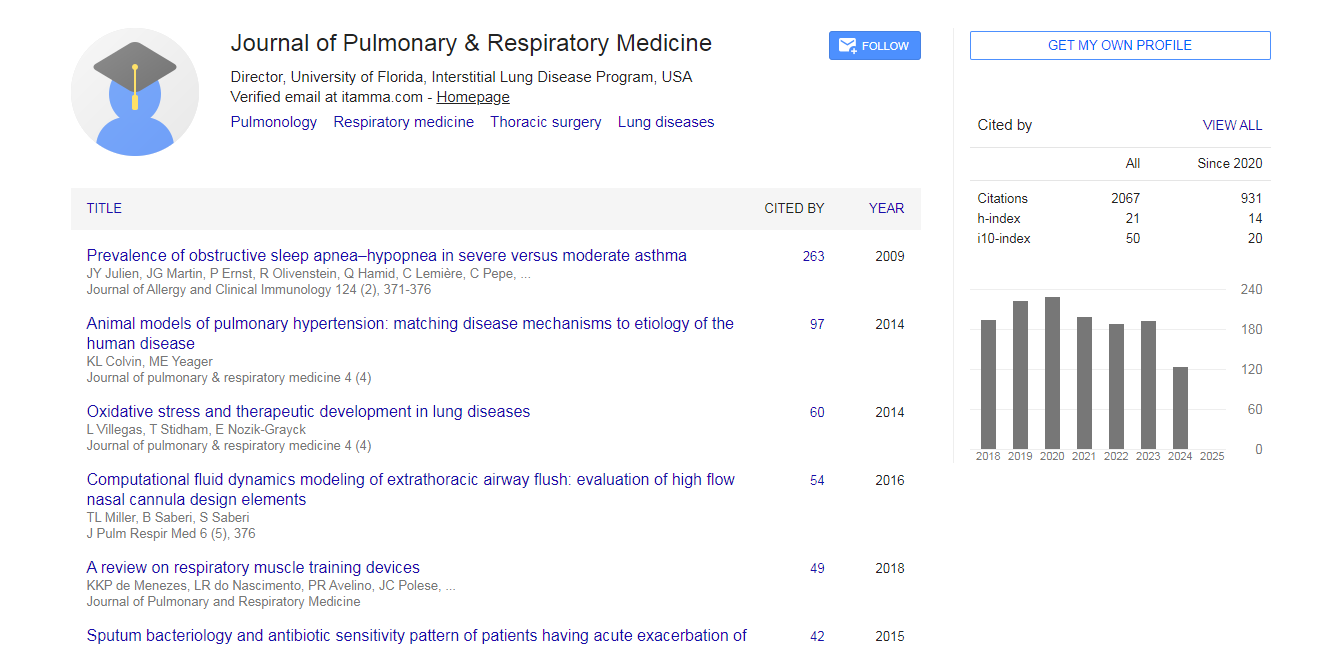
Pulmonary & Respiratory Medicine received 1690 citations as per Google Scholar report