Brief Report - (2025) Volume 11, Issue 4
Received: 01-Aug-2025, Manuscript No. jssc-26-188284;
Editor assigned: 04-Aug-2025, Pre QC No. P-188284;
Reviewed: 18-Aug-2025, QC No. Q-188284;
Revised: 22-Aug-2025, Manuscript No. R-188284;
Published:
29-Aug-2025
, DOI: 10.37421/2472-0437.2025.11.306
Citation: Adams, John. ”Bolted Steel Connections: Performance
Under Diverse Loads.” J Steel Struct Constr 11 (2025):306.
Copyright: © 2025 Adams J. This is an open-access article distributed under the terms of the Creative Commons Attribution License, which permits unrestricted use, distribution
and reproduction in any medium, provided the original author and source are credited.
The behavior of bolted connections in steel structures is a critical area of research for ensuring structural integrity and safety. Experimental investigations provide invaluable data on how these connections perform under various conditions. One study offers a detailed experimental investigation into the behavior of bolted connections in steel structures, focusing on load-carrying capacity, failure mechanisms, and deformation characteristics of various bolted joint configurations under different loading conditions. Key insights include the influence of bolt type, material properties, and connection geometry on overall structural performance, offering valuable data for design optimization and improved seismic resistance [1].
Another research examines the fatigue behavior of bolted connections subjected to cyclic loading. It identifies critical factors influencing fatigue life, such as stress concentrations at bolt holes and the presence of initial defects. The findings highlight the importance of surface treatment and proper bolt tensioning in extending the fatigue performance of steel structures, contributing to more reliable long-term design [2].
Furthermore, a paper investigates the seismic performance of steel moment-resisting frames with bolted connections. Through experimental testing, the study evaluates the ductility, energy dissipation, and overall seismic resilience of these connections. The results underscore the effectiveness of specific connection details in achieving ductile behavior under earthquake-induced forces, providing guidance for seismic design practices [3].
Another study explores the behavior of eccentric bolted connections in steel structures, which are common in various structural applications. Experiments were conducted to determine the moment-rotation characteristics and ultimate strength of these connections. The findings offer improved analytical models and design recommendations for handling eccentric loading, crucial for accurate structural analysis [4].
Additionally, research investigates the performance of novel bolted connection designs incorporating advanced materials. The experiments assess the enhanced strength, stiffness, and durability of these innovative connections compared to traditional ones. The results demonstrate the potential of new material applications to significantly improve the efficiency and robustness of steel structures [5].
A significant area of focus is the behavior of bolted connections under progressive collapse scenarios in steel buildings. Experimental tests simulate scenarios of loss of support and subsequent load redistribution. The findings provide critical data on the robustness and failure modes of bolted joints in extreme events, aiding in the development of design strategies to prevent catastrophic collapse [6].
Moreover, experimental work examines the behavior of preloaded bolted connections in steel structures, specifically their performance under dynamic loads. The research investigates the influence of preload on slip resistance and connection stiffness. Results offer insights into maintaining connection integrity and preventing premature failure in vibration-prone environments [7].
The influence of corrosion on the performance of bolted connections in steel structures is also a crucial consideration. Experimental tests were conducted on corroded specimens to assess the reduction in load-carrying capacity and changes in failure modes. This research highlights the critical need for corrosion protection measures to ensure the long-term durability and safety of steel structures [8].
In situations where access to both sides of the connection is limited, blind bolted connections are commonly used. Experimental investigations were performed to evaluate their strength, stiffness, and failure characteristics. The findings provide valuable data for the design and application of these specialized connections in construction [9].
Finally, the effect of bolt loosening on the structural performance of bolted connections is explored. Experimental tests were conducted on connections with varying degrees of bolt loosening under different load types. The results quantify the reduction in stiffness and strength and identify the critical loosening levels that can lead to failure, providing insights for monitoring and maintenance strategies [10].
The load-carrying capacity and failure mechanisms of bolted connections are extensively studied through experimental methods. Research has meticulously examined various bolted joint configurations under diverse loading conditions, revealing how bolt type, material properties, and connection geometry critically influence overall structural performance. This detailed data is instrumental in optimizing designs and enhancing seismic resistance [1].
Fatigue behavior under cyclic loading is another significant aspect investigated. Studies have pinpointed key factors affecting fatigue life, such as stress concentrations near bolt holes and pre-existing defects, emphasizing the role of surface treatments and appropriate bolt tensioning in extending structural longevity and ensuring reliable long-term performance [2].
The seismic performance of steel moment-resisting frames, particularly those employing bolted connections, has been experimentally evaluated for ductility, energy dissipation, and seismic resilience. These evaluations highlight how specific connection designs contribute to ductile behavior during seismic events, offering crucial guidance for seismic design practices [3].
Eccentric bolted connections, frequently encountered in steel structures, are analyzed to understand their moment-rotation characteristics and ultimate strength. The experimental outcomes have led to improved analytical models and design recommendations essential for accurate structural analysis under eccentric loads [4].
Innovative bolted connection designs utilizing advanced materials have also been subjected to experimental scrutiny. These studies assess the superior strength, stiffness, and durability of novel connections compared to conventional ones, demonstrating the potential of advanced materials to enhance structural efficiency and robustness [5].
The response of bolted connections during progressive collapse scenarios in steel buildings is a critical area for safety research. Experimental simulations of support loss and load redistribution provide essential data on the robustness and failure modes of bolted joints in extreme events, informing strategies to prevent catastrophic structural failure [6].
The performance of preloaded bolted connections under dynamic loads is investigated to understand the impact of preload on slip resistance and connection stiffness. These findings are vital for maintaining connection integrity and preventing premature failure in environments prone to vibration [7].
The detrimental effects of corrosion on bolted connections are experimentally assessed. Tests on corroded specimens quantify the reduction in load-carrying capacity and alterations in failure modes, underscoring the necessity of corrosion protection for long-term durability and safety [8].
Blind bolted connections, employed where access is restricted, have undergone experimental investigation to determine their strength, stiffness, and failure characteristics. The results offer essential data for the effective design and application of these specialized connections in construction [9].
The consequences of bolt loosening on structural performance are quantified through experimental tests. By examining connections with varying degrees of loosening under different load types, researchers have identified critical loosening levels that can lead to failure, informing crucial monitoring and maintenance strategies [10].
This collection of research focuses on the experimental investigation of bolted connections in steel structures. Studies cover a wide range of performance aspects including static load capacity, fatigue under cyclic loading, seismic behavior, and response to eccentric loads. The impact of advanced materials, progressive collapse scenarios, preload, corrosion, and bolt loosening on connection performance are also examined. Key findings highlight the influence of design parameters, material properties, and external factors on structural integrity, providing valuable insights for design optimization, reliability, and safety in steel construction.
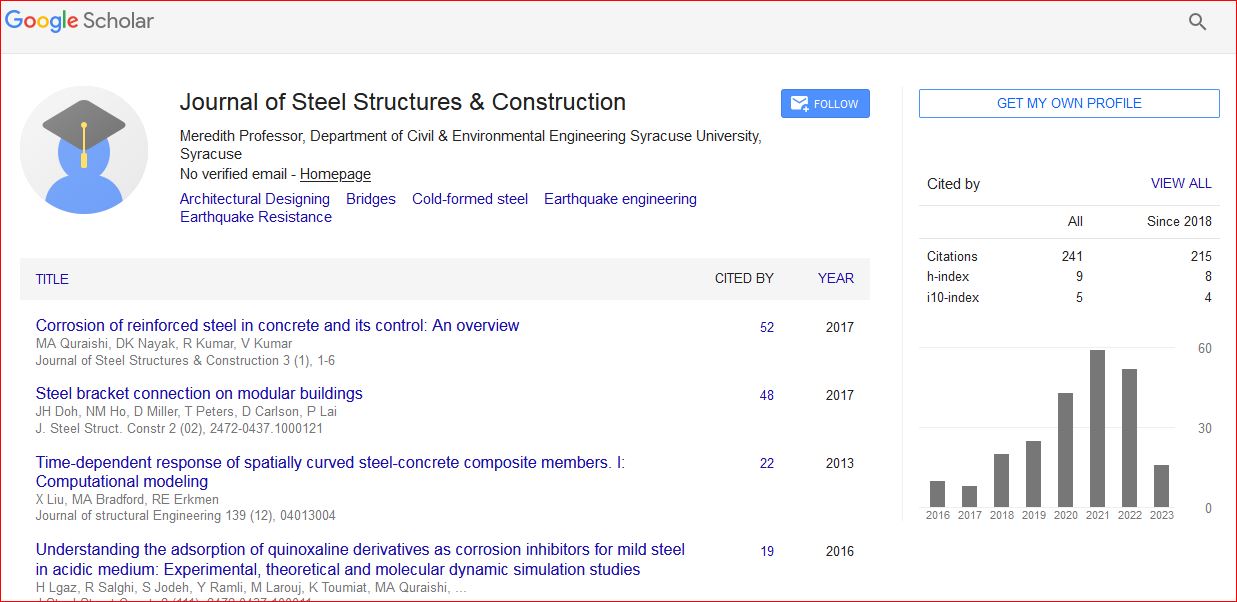
Journal of Steel Structures & Construction received 583 citations as per Google Scholar report