Opinion - (2025) Volume 14, Issue 4
Received: 01-Aug-2025, Manuscript No. jbfa-25-176810;
Editor assigned: 04-Aug-2025, Pre QC No. P-176810;
Reviewed: 18-Aug-2025, QC No. Q-176810;
Revised: 22-Aug-2025, Manuscript No. R-176810;
Published:
29-Aug-2025
, DOI: 10.37421/2167-0234.2025.14.543
Citation: Tanaka, Akira. ”Blockchain Transforms Finance: Innovation, Risks, Regulation.” J Bus Fin Aff 14 (2025):543.
Copyright: © 2025 Tanaka A. This is an open-access article distributed under the terms of the Creative Commons Attribution License, which permits unrestricted use, distribution and reproduction in any medium, provided the original author and source are credited.
Blockchain technology is actively reshaping financial innovation, prompting examination of its myriad applications, inherent challenges, and the continually evolving regulatory landscape. It promises greater efficiency and transparency within finance, yet significant hurdles persist, including scalability, interoperability, and the imperative for new legal frameworks to effectively manage distributed ledger technologies [1].
A systematic review of existing research further highlights blockchain's pivotal role in supply chain finance. Here, key benefits such as enhanced transparency, traceability, and efficiency in financing complex supply chains are evident. Current challenges are being outlined, paving the way for future research to explore its potential impact on both operational and financial performance [2].
The burgeoning field of Decentralized Finance (DeFi) presents a compelling area for investigation, analyzing both its inherent risks and transformative opportunities. DeFi leverages blockchain to establish a new, permissionless financial ecosystem, holding the potential to democratize access to financial services. However, it concurrently raises significant concerns regarding systemic risk, regulatory arbitrage, and technological vulnerabilities [3].
A comprehensive systematic literature review provides a broad overview of blockchain technology's integration into financial markets. This work synthesizes findings on diverse applications, including crucial functions like trading, clearing, and settlement. It also identifies the principal drivers and barriers to widespread adoption, offering valuable insights into future research directions and practical implications [4].
The implications of Central Bank Digital Currencies (CBDCs) for monetary policy, viewed through a blockchain lens, are also under scrutiny. Research delves into how CBDCs, grounded in blockchain principles, could fundamentally alter mechanisms of money creation, transmission, and the overall effectiveness of monetary policy tools, presenting opportunities for enhanced control alongside new challenges for central banks [5].
Exploring the intersection of blockchain technology and corporate finance, a review synthesizes academic literature to identify its impact on fundraising, corporate governance, and financial reporting. It outlines the clear potential for increased efficiency and transparency in corporate financial operations, while acknowledging the nascent stage of practical adoption [6].
In the realm of sustainable finance, a systematic review highlights blockchain's capacity to enhance transparency and traceability. This applies to green investments, carbon markets, and impact investing, ultimately contributing to greater accountability and efficiency in achieving critical Environmental, Social, and Governance (ESG) objectives [7].
The tokenization of securities on blockchain platforms is another area of active exploration. This process offers opportunities for democratizing asset ownership and increasing market liquidity, though it faces significant challenges related to regulatory compliance, legal frameworks, and the technical complexities of integrating traditional financial instruments with distributed ledger technology [8].
The banking sector, in particular, stands to experience a transformative impact from blockchain technology. Comprehensive reviews identify key areas for innovation, cost reduction, and enhanced security, spanning payments, remittances, identity management, and trade finance. This necessitates strategic shifts for traditional banks to effectively adapt to such a disruptive technology [9].
Finally, regulatory challenges specifically concerning Decentralized Finance (DeFi) are a major focus of systematic literature reviews. Existing financial regulations struggle to encompass DeFi's permissionless and global nature, bringing to light key concerns such as investor protection, market integrity, and Anti-Money Laundering (AML) compliance. This understanding proposes clear avenues for developing effective regulatory responses [10].
Blockchain technology is fundamentally reconfiguring the landscape of financial innovation, promising significant advancements in efficiency and transparency across various financial operations [1]. Its integration into financial markets offers a comprehensive overview of how trading, clearing, and settlement processes can be transformed, alongside identifying the key drivers and barriers influencing its widespread adoption [4]. This technology's distributed ledger capabilities are set to introduce new paradigms, but navigating challenges like scalability and interoperability remains crucial for its broader acceptance and successful implementation within existing financial structures [1].
In the corporate finance domain, blockchain's intersection is growing, with academic literature synthesizing its impact on areas such as fundraising, corporate governance, and financial reporting. It outlines a clear potential for increased operational efficiency and transparency, even as its practical adoption is still in an early stage [6]. Similarly, within supply chain finance, a systematic review synthesizes existing research, identifying key benefits like enhanced transparency, traceability, and overall efficiency in managing complex supply chains. This also includes outlining current challenges and proposing future research agendas to fully understand its impact on both operational and financial performance [2].
The rise of Decentralized Finance (DeFi) exemplifies blockchain's capacity to create a new, permissionless financial ecosystem. This system holds significant promise for democratizing access to financial services, yet it introduces substantial concerns regarding systemic risk, regulatory arbitrage, and inherent technological vulnerabilities [3]. Concurrently, Central Bank Digital Currencies (CBDCs), built on blockchain principles, are being investigated for their profound implications on monetary policy. Such currencies could reshape money creation and transmission mechanisms, impacting the effectiveness of policy tools, and presenting both opportunities for enhanced control and new challenges for central banks worldwide [5].
Another transformative aspect is the tokenization of securities on blockchain platforms. This development offers clear opportunities for democratizing asset ownership and significantly increasing market liquidity. However, it confronts considerable challenges tied to regulatory compliance, the establishment of appropriate legal frameworks, and the technical complexities of integrating traditional financial instruments with distributed ledger technology [8]. Furthermore, blockchain technology is playing an increasingly vital role in advancing sustainable finance. It can notably enhance transparency and traceability in green investments, carbon markets, and impact investing, thereby contributing to greater accountability and efficiency in achieving crucial Environmental, Social, and Governance (ESG) objectives [7].
The banking sector is poised for a comprehensive transformation due to blockchain technology. Reviews identify critical areas where innovation can reduce costs and boost security, ranging from payments and remittances to identity management and trade finance. This disruptive shift mandates strategic adaptations from traditional banks to remain competitive and relevant [9]. Despite these opportunities, regulatory challenges are particularly acute for Decentralized Finance (DeFi). Existing financial regulations often struggle to encompass DeFiâ??s permissionless and global nature, bringing to the forefront concerns around investor protection, market integrity, and Anti-Money Laundering (AML) compliance. Developing effective regulatory responses in this rapidly evolving space is a significant ongoing challenge [10].
Blockchain technology is fundamentally transforming various facets of the financial sector. Initial explorations highlight its role in reshaping financial innovation, promising enhanced efficiency and transparency, despite hurdles like scalability and regulatory clarity. The application extends to optimizing supply chain finance through improved transparency and traceability, and integrating into broader financial markets for trading, clearing, and settlement. The emergence of Decentralized Finance (DeFi) offers a new permissionless financial ecosystem with potential for democratized access but also significant systemic risks and regulatory challenges. Central Bank Digital Currencies (CBDCs), built on blockchain principles, are being examined for their implications on monetary policy, offering both greater control and new complexities for central banks. Beyond these, blockchain is impacting corporate finance by enhancing fundraising, governance, and reporting, though its practical adoption is still evolving. Its potential for sustainable finance is evident in boosting transparency for green investments and ESG objectives. The tokenization of securities represents an opportunity for democratizing asset ownership and increasing liquidity, contending with regulatory and technical hurdles. Furthermore, the technology promises to revolutionize the banking sector, driving innovation, cost reduction, and security across payments, remittances, and identity management, necessitating strategic adaptations from traditional institutions. Regulatory frameworks are struggling to keep pace, particularly with DeFi's global and permissionless nature, emphasizing the need for robust responses to protect investors and ensure market integrity.
None
None
Indexed at, Google Scholar, Crossref
Indexed at, Google Scholar, Crossref
Indexed at, Google Scholar, Crossref
Indexed at, Google Scholar, Crossref
Indexed at, Google Scholar, Crossref
Indexed at, Google Scholar, Crossref
Indexed at, Google Scholar, Crossref
Indexed at, Google Scholar, Crossref
Indexed at, Google Scholar, Crossref
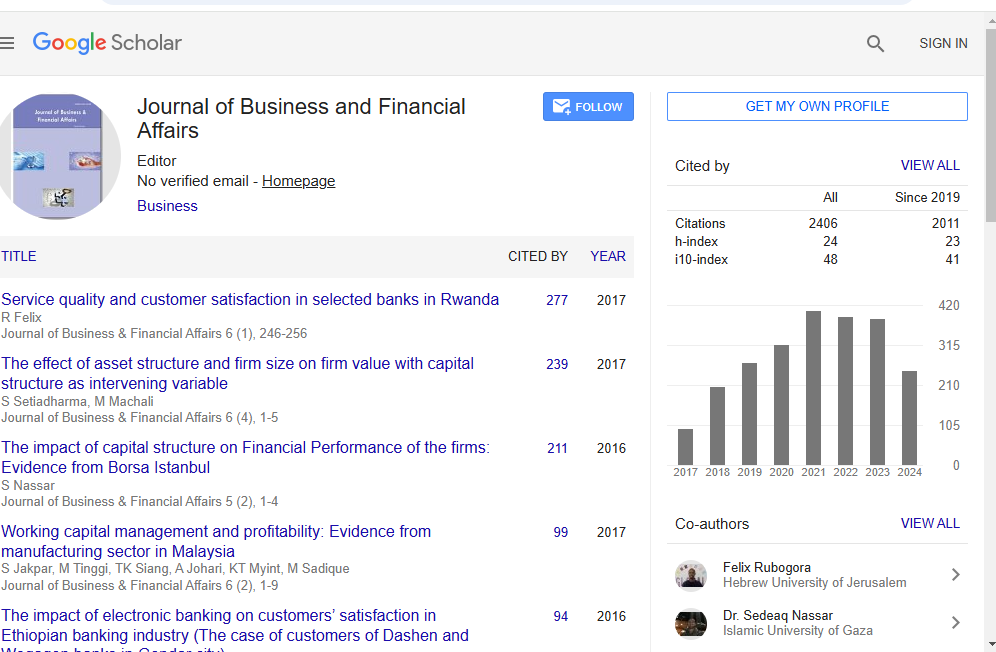
Journal of Business & Financial Affairs received 1726 citations as per Google Scholar report