Brief Report - (2025) Volume 16, Issue 2
Received: 01-Mar-2025, Manuscript No. jhmi-26-178820;
Editor assigned: 03-Mar-2025, Pre QC No. P-178820;
Reviewed: 17-Mar-2025, QC No. Q-178820;
Revised: 24-Mar-2025, Manuscript No. R-178820;
Published:
31-Mar-2025
, DOI: 10.37421/2157-7420.2025.16.582
Citation: Müller, Thomas J.. ”Blockchain: Empowering Patient-centric Healthcare Data.” J Health Med Informat 16 (2025):582.
Copyright: © 2025 Müller J. Thomas This is an open-access article distributed under the terms of the Creative Commons Attribution License, which permits unrestricted use, distribution and reproduction in any medium, provided the original author and source are credited.
The landscape of healthcare is undergoing a profound transformation, driven by the increasing digitization of medical information and the growing demand for secure and efficient data sharing mechanisms. Traditional centralized systems for storing and managing electronic health records (EHRs) have historically faced significant challenges related to data security, patient privacy, and interoperability across different healthcare providers and research institutions. The advent of blockchain technology has emerged as a promising solution to address these persistent issues, offering a decentralized and immutable ledger that can revolutionize how medical data is handled. One of the primary advantages of blockchain in healthcare is its inherent security features, stemming from its decentralized architecture and cryptographic principles. This technology can create robust frameworks for sharing medical data, ensuring that information is not stored in a single point of failure, thus mitigating risks of data breaches and unauthorized access. The ability to create secure and interoperable frameworks for sharing medical data is a critical step towards a more connected and efficient healthcare ecosystem. Furthermore, blockchain's immutable nature plays a crucial role in enhancing data integrity. Once a record is added to the blockchain, it cannot be altered or deleted without the consensus of the network, providing a tamper-proof audit trail of all data transactions. This feature is particularly important in healthcare, where the accuracy and reliability of patient information are paramount for diagnosis, treatment, and research. The decentralized and immutable nature of blockchain technology can significantly enhance patient privacy and empower individuals with greater control over their personal health information. By providing a patient-centric approach to data management, blockchain systems allow patients to grant or revoke access to their medical records, fostering trust and transparency in data sharing processes. Addressing the key challenges in current healthcare systems, such as data fragmentation and the lack of interoperability, is a central theme in the application of blockchain. The proposed frameworks aim to create a unified yet secure platform where diverse healthcare stakeholders, including patients, providers, and researchers, can interact with medical data in a controlled and transparent manner. The use of smart contracts, self-executing contracts with the terms of the agreement directly written into code, offers a powerful mechanism for managing data access permissions. These contracts can automate the process of granting or denying access based on predefined rules, ensuring that only authorized parties can view or utilize specific medical data. Distributed ledger technology (DLT), the underlying infrastructure of blockchain, is instrumental in preventing unauthorized modifications to electronic health records (EHRs). This prevents malicious actors from altering patient histories, thereby maintaining the integrity of critical medical information and ensuring compliance with regulatory requirements. The ability of blockchain to empower patients with granular control over who can access their medical history and for what purpose is a significant development. This patient-empowerment fosters trust and compliance within the complex ecosystem of healthcare data exchange, shifting the paradigm towards a more patient-centric model. Improving the security and privacy of distributed medical data systems is a fundamental goal. Blockchain's decentralized approach, combined with cryptographic techniques and consensus mechanisms, ensures data integrity and effectively prevents breaches, creating a more secure environment for sensitive health information. Finally, blockchain facilitates secure data sharing among multiple stakeholders, including patients, providers, and researchers, without the need for a central authority. This disintermediation not only enhances security but also streamlines data exchange processes, paving the way for more collaborative and efficient healthcare research and practice.
The application of blockchain technology in healthcare is fundamentally reshaping how medical data is managed, secured, and shared. This revolutionary approach offers a decentralized and immutable ledger, providing a robust alternative to traditional centralized databases that are often vulnerable to security threats and privacy concerns. Blockchain's decentralized architecture distributes data across a network of computers, eliminating single points of failure and significantly reducing the risk of data breaches. This distributed nature ensures that even if one node in the network is compromised, the integrity of the entire dataset remains intact, a critical consideration for sensitive medical information. The immutable characteristic of blockchain means that once data is recorded, it cannot be altered or deleted without the consensus of the network. This feature provides a tamper-proof audit trail, offering verifiable proof of data provenance and history, which is essential for maintaining the trust and accuracy of electronic health records (EHRs). Enhancing patient privacy is a cornerstone of blockchain-based healthcare systems. By implementing patient-centric frameworks, individuals gain greater control over their personal health information, deciding who can access their data and for what purpose. This empowerment fosters a more trusting relationship between patients and healthcare providers. Interoperability, a long-standing challenge in healthcare, is addressed by blockchain through its ability to create standardized and secure data exchange protocols. This allows different healthcare systems and applications to communicate and share data seamlessly, improving care coordination and research capabilities. Smart contracts, an integral component of blockchain technology, automate access control and data sharing agreements. These self-executing contracts ensure that data is accessed only by authorized parties according to predefined rules, thereby maintaining the confidentiality and security of sensitive medical information. Distributed ledger technology (DLT) underpins the security of EHRs, preventing unauthorized modifications and ensuring the integrity of patient histories. This technological foundation builds confidence in the accuracy and reliability of the medical data being managed. The empowerment of patients with granular control over their medical history is a paradigm shift. This level of autonomy not only strengthens patient rights but also encourages greater engagement in their own healthcare, leading to improved health outcomes and a more collaborative healthcare environment. Blockchain's decentralized approach significantly enhances the security and privacy of distributed medical data systems. By leveraging cryptographic techniques and consensus mechanisms, it ensures that data remains protected from unauthorized access and tampering, a vital aspect for maintaining patient confidentiality. Ultimately, blockchain facilitates secure data sharing among various stakeholders, including patients, healthcare providers, and researchers, without relying on a central authority. This disintermediation not only streamlines data exchange but also fosters a more transparent and accountable healthcare ecosystem.
Blockchain technology offers a secure and patient-centric approach to managing and sharing medical data. Its decentralized and immutable nature enhances data integrity, privacy, and interoperability within healthcare systems. Frameworks leveraging blockchain and smart contracts empower patients with granular control over their health information, enabling controlled access for authorized parties while maintaining a transparent and auditable record of all transactions. This paradigm shift addresses critical challenges in current healthcare data management, fostering trust and collaboration among stakeholders and paving the way for more efficient and secure healthcare practices.
None
None
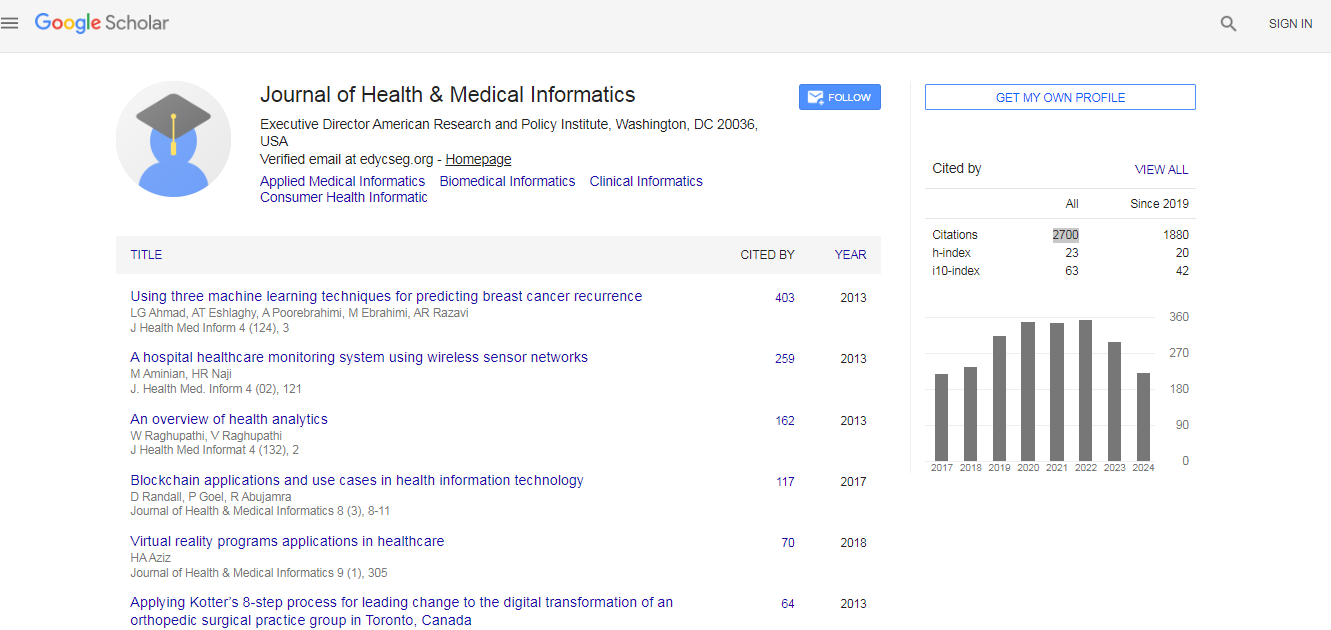
Journal of Health & Medical Informatics received 2700 citations as per Google Scholar report